2025 Louvre Heist
The password to the Louvre's surveillance system was reportedly "Louvre." That detail, cited in post-heist reporting, captures something essential about what happened at the world's most famous museum: a brazen crime enabled not by criminal genius but by institutional complacency. In fewer than eight minutes, two men in balaclavas cut through a glass window, seized eight pieces of the French Crown Jewels from the Galerie d'Apollon, rode a furniture lift to the ground floor, met two accomplices on motor scooters, and vanished into the streets of Paris. It was the first art theft from the Louvre since 1998 and the most dramatic since Vincenzo Peruggia walked out with the Mona Lisa in 1911.
Thirty Minutes After Opening
The robbery began at approximately 9:30 a.m. Central European Summer Time, half an hour after the museum opened to visitors on a Sunday morning. Two members of the crew, their faces hidden by balaclavas, entered the building. From a balcony overlooking the 16th-century Galerie d'Apollon, they used a disc cutter to slice through a glass window, triggering security alarms that went unanswered quickly enough to matter. Inside the gallery, they smashed display cases and grabbed tiaras, necklaces, earrings, and brooches that had belonged to queens and empresses of France. The entire operation took just under eight minutes, with the thieves spending only four minutes inside the building itself. On their way out, they attempted to set fire to the lift they had used, perhaps hoping to destroy evidence. Two accomplices waited outside on scooters. The crew scattered into Paris traffic.
Empresses and Their Jewels
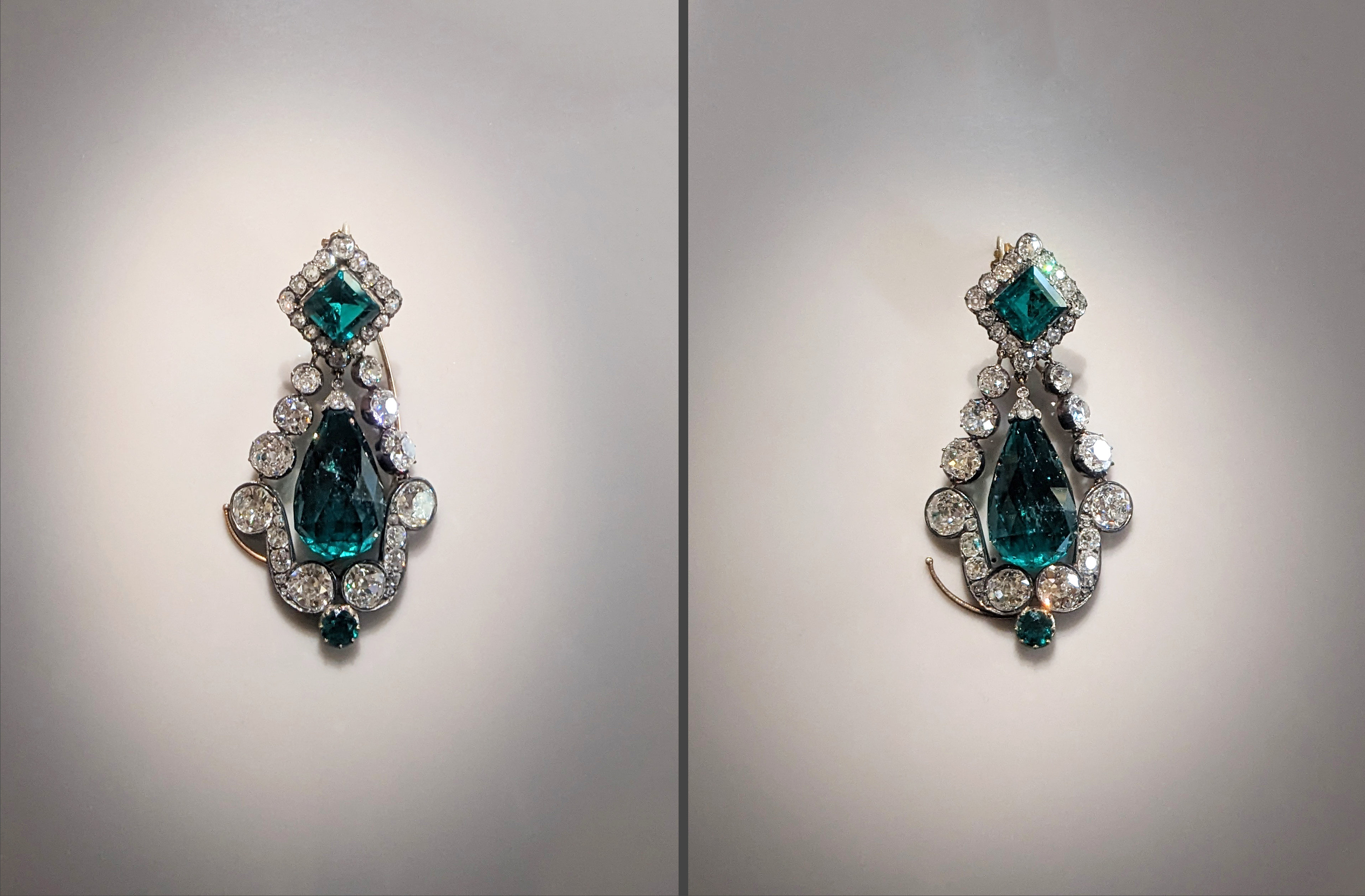
The stolen pieces spanned two centuries of French monarchy. From the sapphire set of Queen Marie-Amalie and Queen Hortense, the thieves took a tiara, a necklace, and an earring. From Empress Marie Louise's collection, they grabbed an emerald necklace and a pair of emerald earrings. From Empress Eugenie de Montijo, they seized a reliquary brooch, a large corsage bow brooch, and a tiara. In their haste to escape, the robbers dropped the Crown of Empress Eugenie, damaging it by forcing it through an opening in the display case too small for its frame. A second jeweled item was also dropped but has not been publicly identified. The Crown of Louis XV, the Sancy diamond, and the Hortensia diamond, also displayed in the Galerie d'Apollon, were left behind. Prosecutor Laure Beccuau noted that while the curator estimated damages in the tens of millions of euros, "the greater loss was to France's historical heritage."
Warnings Ignored
The heist did not happen in a vacuum. Museum director Laurence des Cars had requested a police security audit before the robbery, and while recommendations were made, they were only beginning to be implemented when the thieves struck. A 2014 audit by France's National Cybersecurity Agency had warned about serious security flaws, including outdated software and passwords so weak the word "trivial" was used to describe them. Other French museums had been robbed in the months prior: the Cognacq-Jay Museum and another institution in November 2024, the Adrien Dubouche Museum in September 2025, and the National Museum of Natural History in Paris, which lost gold worth hundreds of thousands of euros just weeks before the Louvre heist. A subsequent report by the Cour des Comptes found that the museum had "favoured operations that were visible and attractive" over essential maintenance and security upgrades. The pattern was clear to everyone except those who could have prevented the crime.
The Manhunt and the Missing Jewels
Within a week, police arrested two men in their 30s from Seine-Saint-Denis. After four days in custody, they partially admitted involvement and were charged with organized gang theft and criminal conspiracy. Over the following weeks, nine more suspects were detained. Five were ultimately charged; the rest were released. More than 100 investigators were assigned to the case, collecting over 150 pieces of evidence including fingerprints and DNA. Interpol added the jewels to its Stolen Works of Art database the day after the robbery. CCTV footage aired on French television in January 2026 showed the burglars in action: one in a black balaclava and yellow high-visibility jacket, the other in black with a motorcycle helmet. President Macron called the robbery "an attack on a heritage that we cherish because it is our history." Director des Cars offered her resignation the day of the burglary; it was declined. The Louvre reopened three days later, but the Galerie d'Apollon remained closed. As of early 2026, the location of the jewels remains unknown.
From the Air
Coordinates: 48.859N, 2.337E. The Louvre is located on the right bank of the Seine in central Paris, identifiable by its distinctive courtyard and glass pyramid. Recommended viewing at 2,000-4,000 ft AGL. Nearest airports: Paris Orly (LFPO) and Paris Le Bourget (LFPB). Note: central Paris is restricted airspace.