21st Century Museum of Contemporary Art, Kanazawa
From the air, it looks like a contact lens dropped onto the center of Kanazawa. A flat, perfectly circular disc of glass and white steel, 112.5 meters in diameter, sitting among the dark tile roofs and garden canopy of one of Japan's best-preserved castle towns. The 21st Century Museum of Contemporary Art is an exercise in architectural disappearance -- a building designed to be seen through, walked through from any direction, and never to impose itself on the city around it. Architects Kazuyo Sejima and Ryue Nishizawa of SANAA opened it in 2004, and within a single year, more than 1.5 million people had passed through its transparent walls. For a city of fewer than half a million, those numbers were staggering. Even in 2020, battered by the pandemic, the museum still ranked among the ten most-visited art museums on the planet.
Architecture as Invitation
Most museums announce themselves. They present a grand facade, a single entrance, a clear hierarchy between the institution and the visitor. SANAA rejected every one of those conventions. The circular floor plan has no front or back. Visitors can enter from multiple points around the perimeter, arriving from Kenroku-en garden to the east or the shopping streets to the west without ever feeling they've come in through a side door. The building sits low to the ground, its curved glass walls offering views straight through the interior to the landscape beyond. The effect is deliberate: the museum refuses to be perceived as a large, introverted mass. Inside, the galleries are scattered like rooms in a village rather than arranged along a corridor. They vary wildly in proportion and character -- some flooded with daylight through glass ceilings, others sealed in darkness, with heights ranging from four to twelve meters. Four glazed courtyards punctuate the interior, pulling light into the center and creating moments where you're simultaneously inside and outside.
Where the City Walks In
The genius of the building is its perimeter. While the museum galleries occupy the center, the outer ring belongs to the community. A library, a lecture hall, and a children's workshop wrap around the exhibition spaces, free to enter, no ticket required. This was SANAA's most radical gesture: blurring the boundary between the museum and the city so thoroughly that residents pass through the building as part of their daily routine. The circulation spaces between galleries double as exhibition areas, so even the act of walking from the library to the lecture hall becomes an encounter with art. The museum's logo is its own floor plan -- a circle filled with smaller geometric shapes -- printed on signage and T-shirts. Fashion designer Naoki Takizawa designed custom uniforms for the staff, extending the architectural philosophy right down to what people wear. The building is not just a container for art. It is a social space that happens to contain art.
Art That Belongs to This Place
The museum's collection policy is as unconventional as its architecture. It focuses exclusively on works produced since 1980 that, in the museum's own words, 'propose new values.' But the real distinction is the emphasis on site-specific installations -- works created for Kanazawa, shaped by the city's light, seasons, and culture, intended to become 'closely associated with the Kanazawa area.' This is not a museum that collects masterpieces from elsewhere and ships them in. It commissions artists to respond to the place itself. Founding artistic director Yuko Hasegawa, who returned to lead the institution in 2021, has guided this philosophy of deep local connection paired with global ambition. The result is a collection that could not exist anywhere else, housed in a building that treats contemporary art not as something precious to be guarded behind walls, but as something alive, breathing the same air as the city outside.
A Castle Town Reimagined
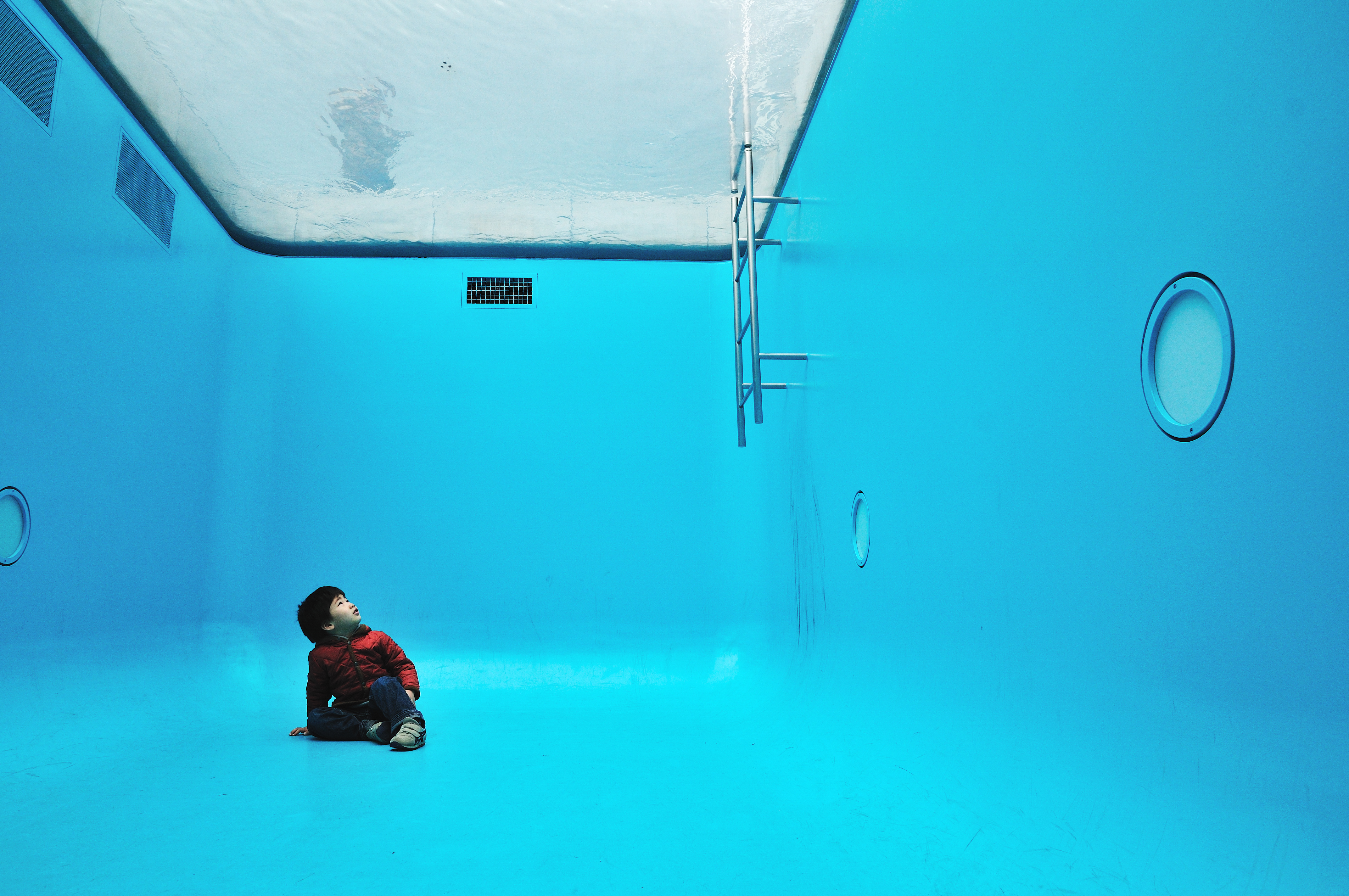
Kanazawa survived the Second World War without significant bombing, preserving its samurai and geisha districts, its centuries-old Kenroku-en garden, and the bones of a castle town that dates back to the Maeda clan's rule during the Edo period. The museum sits at the intersection of that history and a city betting on contemporary culture. Its location near Kenroku-en and the Ishikawa Prefectural Museum of Art creates a cultural corridor where visitors move between centuries in a few hundred meters -- from meticulously raked gravel gardens to Leandro Erlich's permanently installed swimming pool illusion. That tension between old and new is precisely what makes the museum work. SANAA's glass circle does not compete with the castle town. It defers to it, keeping its profile low, its materials transparent, its borders open. The building whispers where the castle walls once shouted, and somehow that quiet confidence has drawn millions of visitors to a city on the Sea of Japan coast that most international travelers once passed by entirely.
From the Air
Located at 36.56°N, 136.66°E in central Kanazawa, Ishikawa Prefecture. The circular museum building is visible as a distinctive white disc among the darker traditional rooftops, adjacent to the green expanse of Kenroku-en garden. Nearest airport is Komatsu Airport (RJNK), approximately 30 km southwest. Approach from the Sea of Japan coast for context of Kanazawa's position between mountains and sea. Cruising altitude of 3,000-5,000 feet offers the best perspective on the museum's circular form against the surrounding urban grid.