228 Peace Memorial Park
The architect who designed the monument at the center of this park submitted his entry from a prison cell. Cheng Tzu-tsai had been convicted of attempted murder in 1971, following a failed assassination attempt on Chiang Ching-kuo, the son of Chiang Kai-shek. After serving his sentence, he was imprisoned again in 1991 for illegally entering Taiwan. From behind bars, he designed a memorial to the February 28 Incident of 1947, a massacre whose very existence the government had suppressed for nearly half a century. That a former political prisoner created the official monument to victims of state violence is the kind of detail that makes this park's history read less like a city planning document and more like a novel.
From Temple Grounds to Colonial Park
The park occupies land at 3 Ketagalan Boulevard in Taipei's Zhongzheng District, and its history mirrors Taiwan's own turbulent transitions. It was established in 1900 during the Japanese colonial period as Taihoku New Park, built on the grounds of a former temple. It was the first European-style urban park in Taiwan, situated near the Governor-General's Office. In 1930, Japanese authorities added a radio station to the grounds, designed by architect Kuriyama Shunichi. The station housed the Taihoku Broadcasting Bureau, and by 1931, the Taiwan Broadcast Association was using it as the center of island-wide radio operations. In 1935, the park served as one of the venues for the Taiwan Exposition commemorating 40 years of Japanese colonial rule, a public relations exercise that celebrated the very occupation many Taiwanese endured rather than embraced.
February 28, 1947
After Japan's surrender in 1945, Taiwan was handed over to the Republic of China. The park was renamed Taipei New Park, and the radio station became the Taiwan Broadcasting Company. What followed was a period of escalating tension between the Kuomintang government and the local Taiwanese population, driven by corruption, economic mismanagement, and cultural arrogance. On February 28, 1947, a confrontation between government agents and a cigarette vendor sparked an island-wide uprising. The government's response was a brutal crackdown. Estimates of the dead range from 10,000 to 30,000. For decades afterward, the incident was a forbidden subject under martial law. The park itself, renamed again, would eventually become the site where this suppressed history was finally acknowledged.
The Rededication
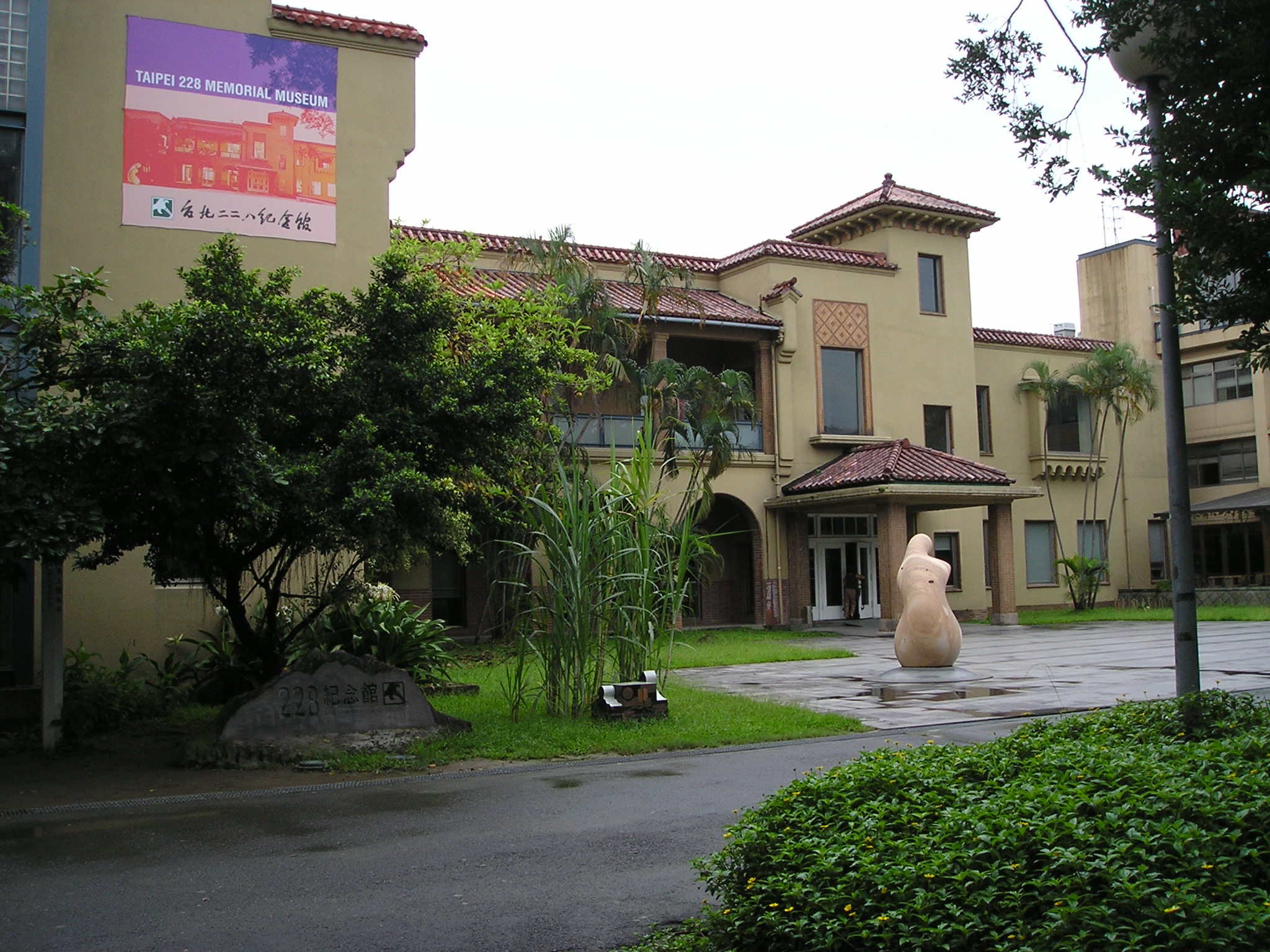
It took until the 1990s for the February 28 Incident to be openly discussed in Taiwan. In 1996, the Taipei City Government designated the former radio station as a historical site. Two years later, the building became home to the Taipei 228 Memorial Museum, and the park was formally rededicated as 228 Peace Memorial Park. The monument designed by Cheng Tzu-tsai stands at the center, inscribed with an exhortation for peace and unity. The National Taiwan Museum anchors the park's north entrance, lending the space a dual identity as both cultural institution and memorial ground. In November 2019, the Bureau of Cultural Heritage declared the museum a cultural asset, cementing its protected status. The park also contains a bandshell and exercise areas where local residents gather daily, their morning tai chi routines unfolding in the shadow of a monument to events most of them were raised never to discuss.
The Park in Literature and Life
Beyond its memorial function, the park carries other layers of cultural meaning. It provides the primary setting for Pai Hsien-yung's novel Crystal Boys, which references the park's longstanding reputation as a gathering place for Taipei's gay community. The novel's frank treatment of gay life in Taipei during the martial law era added another dimension to a space already charged with the weight of suppressed histories. Accessible via the National Taiwan University Hospital MRT station, the park today serves as a green refuge in the dense urban grid of central Taipei. Office workers eat lunch on its benches. Students study under its trees. Tourists photograph the monument. Few places in any city carry so many historical layers in such a compact footprint: colonial showpiece, propaganda center, site of state violence, memorial to the dead, literary landmark, and neighborhood park, all occupying the same few hectares of ground.
From the Air
Coordinates: 25.042N, 121.515E in the Zhongzheng District of central Taipei. The park is located on Ketagalan Boulevard near the Presidential Office Building. Taipei Songshan Airport (ICAO: RCSS) is approximately 5 km to the northeast. Taoyuan International Airport (RCTP) is about 40 km to the west. The park is visible as a green rectangle in the dense urban grid south of Taipei Main Station.