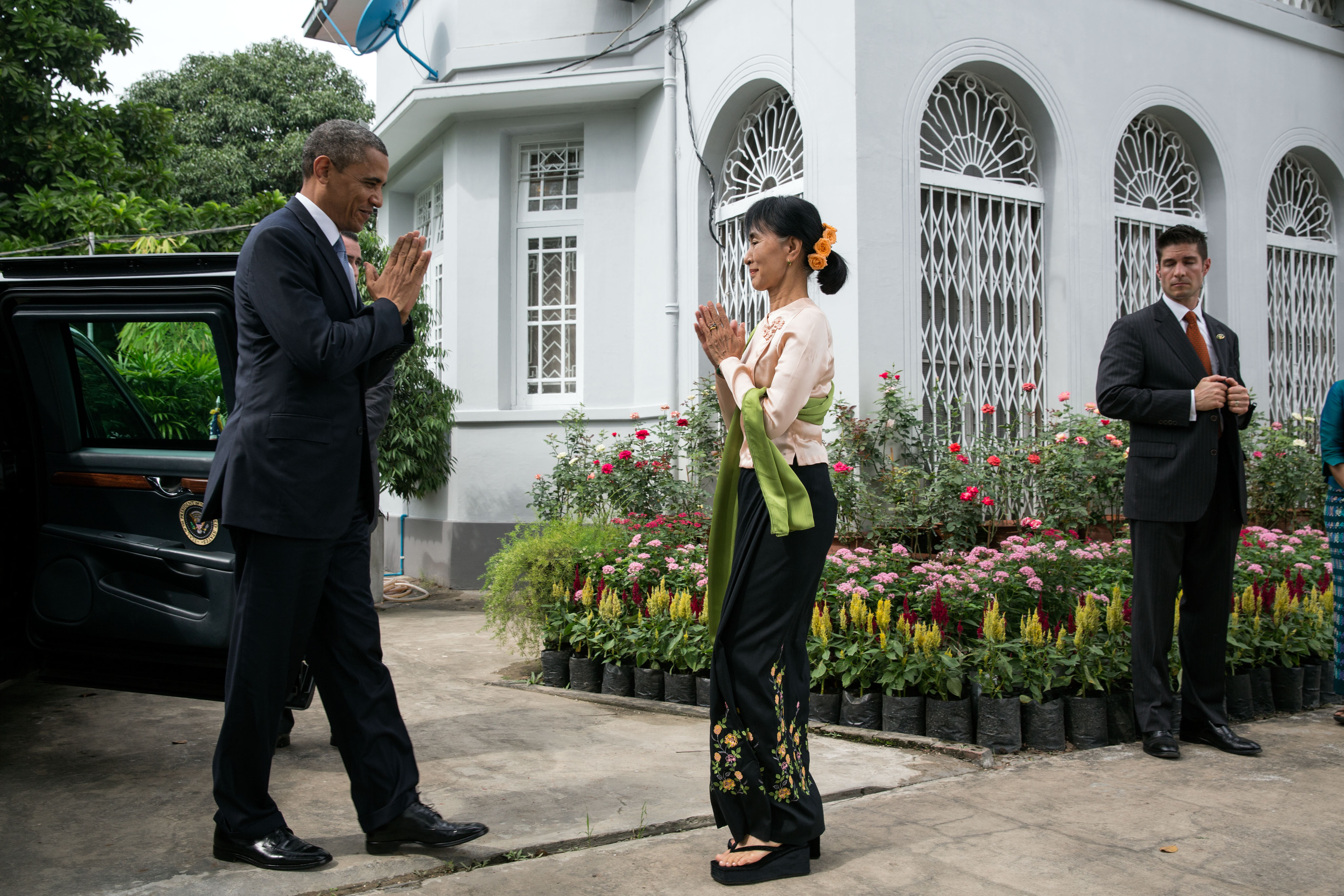
54 University Avenue
For most houses, an address is just a number on a street. This one became a symbol recognized around the world. Fifty-four University Avenue, a colonial-era villa on the shores of Inya Lake in Yangon, served as the gilded cage of Aung San Suu Kyi for almost fifteen of the twenty-one years between 1989 and 2010. Behind its iron gate, a Nobel Peace Prize laureate read by candlelight after Cyclone Nargis destroyed the roof and cut the electricity. Through its bars, she accepted the blessings of Buddhist monks during the Saffron Revolution. And on 13 November 2010, when security forces finally removed the barricades, she waved to the crowd that had rushed to the house to celebrate the end of her detention -- an image that flashed across the planet within minutes.
A Family's Inheritance
The house on University Avenue Road came to Aung San Suu Kyi through grief. In 1953, following the death of her elder brother, the young Suu Kyi, her mother Khin Kyi, and her eldest brother Aung San Oo moved from the family home on Tower Lane -- now preserved as the Bogyoke Aung San Museum -- to this lakeside villa facing Inya Lake. The property sits on a 0.6-hectare lot in Bahan Township, a leafy residential district in Yangon. It was a substantial compound even by the standards of the old colonial elite, built in a style that blended European architecture with tropical practicality: high ceilings, wide verandas, and grounds that sloped down toward the water. For decades, it was simply a family home. What transformed it into something larger was the political awakening of 1988.
Confined but Unbroken
Aung San Suu Kyi returned to Myanmar in 1988 to care for her ailing mother and found herself drawn into the pro-democracy movement during the 8888 Uprising. The military junta placed her under house arrest the following year. Over the next two decades, the house at 54 University Avenue became the physical embodiment of her confinement -- and her resistance. She was held there through three separate periods of house arrest: 1989 to 1995, 2000 to 2002, and 2003 to 2010. The house fell into disrepair. In May 2008, Cyclone Nargis tore off the roof, and the junta provided no generator. Suu Kyi lived in virtual darkness, relying on candles at night. The house was finally renovated in August 2009, but by then the world had come to associate its crumbling facade with the human cost of military rule.
The Intruder Who Extended Her Sentence
On 4 May 2009, an American citizen named John Yettaw swam across Inya Lake and entered the compound uninvited, just two weeks before Suu Kyi was scheduled for release. Under Myanmar law, it is illegal to have a guest stay overnight without notifying authorities. The junta seized on the violation. Suu Kyi was arrested on 13 May and sentenced to eighteen additional months of house arrest -- a maneuver that effectively prevented her from participating in the 2010 general elections. The timing struck many observers as too convenient to be coincidental. Whether Yettaw acted alone or was manipulated remains disputed, but the result was clear: the regime had found a pretext to keep its most prominent critic locked away through another election cycle.
A House Divided
The family drama surrounding 54 University Avenue has been as tangled as the politics. In 2000, Aung San Oo, Suu Kyi's elder brother and a United States citizen, filed a lawsuit demanding half ownership of the property. Time magazine reported that Burmese exiles and observers in Yangon believed the junta had encouraged the suit as an act of spite against Suu Kyi. In 2016, a Yangon district court ordered the property divided equally between the siblings. The ruling triggered attempts to auction the house -- in March 2024, August 2024, and February 2025 -- but no bidders appeared at any of them, even as the asking price dropped from 300 billion to 297 billion kyats, roughly 141 million U.S. dollars. The house that the world associated with democratic aspiration had become, in practical terms, unsellable.
Legacy in Stone and Memory
When Luc Besson filmed The Lady, his 2011 biographical film about Suu Kyi, his production crew built a precise one-to-one scale replica of the house, oriented to the correct cardinal directions so that the audience would see the sunrise from the same angle. They worked from satellite imagery and roughly 200 family photographs. That level of obsessive accuracy speaks to what 54 University Avenue had become by then: not merely a residence but a landmark of conscience, as recognizable in its way as Robben Island or the Mandela House in Soweto. The house stands today on University Avenue Road, its future uncertain, its past inseparable from the struggle for democracy in Myanmar -- a struggle that remains, as of this writing, unresolved.
From the Air
Located at 16.826N, 96.151E in Bahan Township, Yangon, Myanmar. The house sits on the eastern shore of Inya Lake, one of the two large lakes visible in central Yangon from altitude. Inya Lake appears as a dark oval surrounded by green parkland and the campus of Yangon University. Mingaladon International Airport (VYYY) lies approximately 15 kilometers to the north. The Shwedagon Pagoda, Myanmar's most prominent landmark, is visible roughly 3 kilometers to the south of the lake.