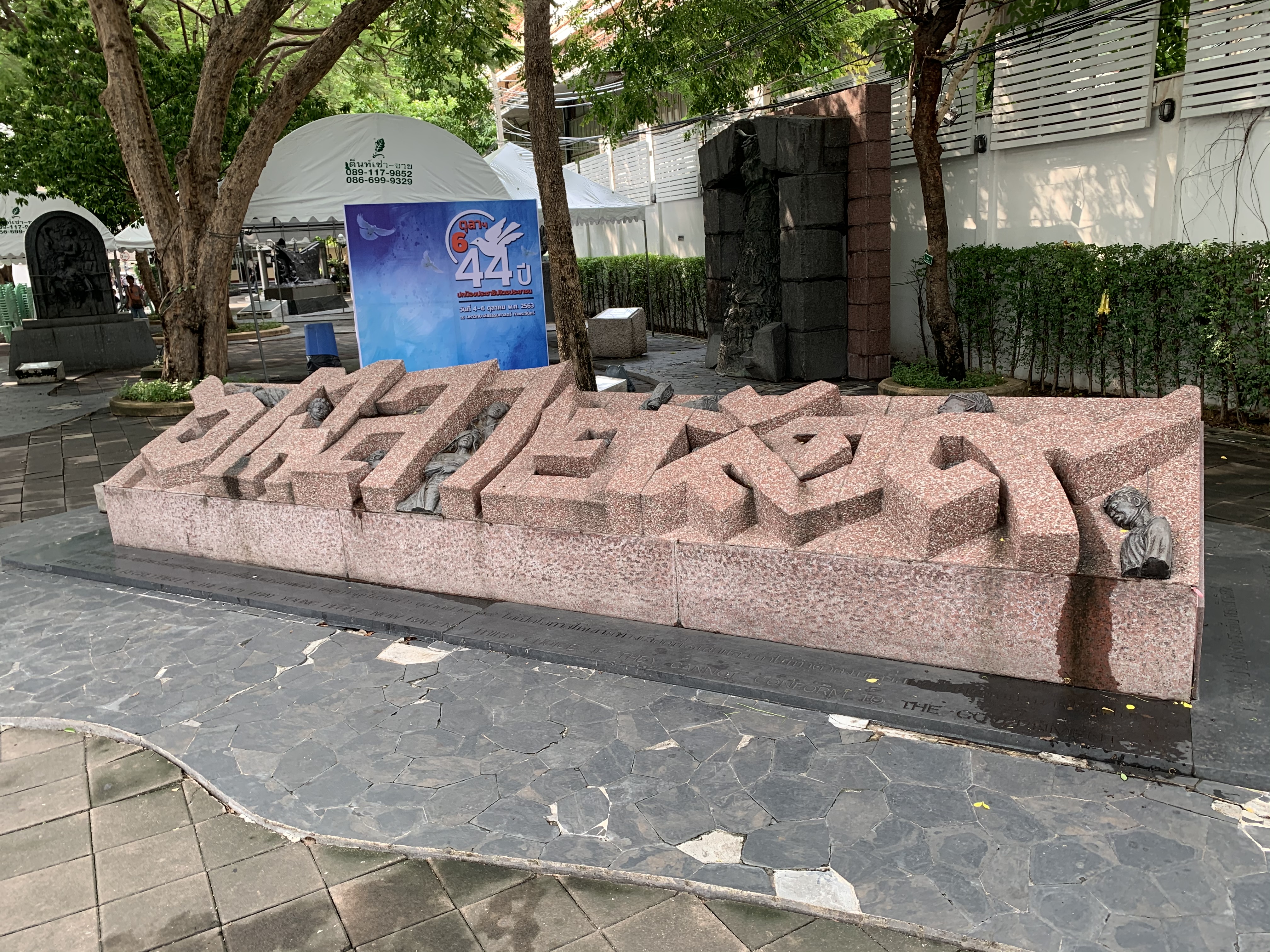
6 October 1976 Massacre
Neal Ulevich's photograph won the 1977 Pulitzer Prize for spot news. It shows a man swinging a folding chair at a body hanging from a tree on the grounds of Thammasat University. Other bodies lie on the pavement. Bystanders watch. The image captured what happened on the morning of October 6, 1976, when Thai police, right-wing paramilitaries, and ordinary citizens attacked student protesters who had occupied the university and the adjacent Sanam Luang royal field. The official death toll was forty-five. Unofficial counts exceeded one hundred. The event is still known in Thailand by the deliberately vague phrase "the 6 October event," a name that historian Thongchai Winichakul argues is designed to hover between memory and forgetfulness.
The Provocation
The students had been protesting since mid-September 1976 against the return of exiled former Prime Minister Thanom Kittikachorn, a military strongman who had been overthrown in a popular uprising in October 1973. Three years of fragile democracy had followed, but by 1976 the Cold War fear of communism was reshaping Thai politics. Vietnam, Cambodia, and Laos had fallen to communist governments in succession, and Thailand's military establishment saw left-leaning students as an existential threat. On September 24, in the city of Nakhon Pathom just west of Bangkok, two labor activists posting anti-Thanom posters were beaten to death by police, their bodies hung from a gate. When students at Thammasat staged a play reenacting the killings, right-wing media accused them of committing lese-majeste, claiming one actor resembled Crown Prince Vajiralongkorn.
The Morning Assault
At dawn on October 6, armed forces surrounded Thammasat University. Police carried scoped rifles. Naval vessels positioned themselves on the Chao Phraya River bordering the campus. After a free-fire order was issued by the Bangkok police chief between 7:30 and 8:00 a.m., officers stormed the grounds. Right-wing paramilitaries followed them in, groups like the Red Gaurs, composed of ex-mercenaries, discharged soldiers, and unemployed youth who had been radicalized by anti-communist propaganda. Students trying to escape by diving into the river were shot at from boats. Those fleeing through the front gates were seized by mobs. Witnesses reported that paramilitaries assaulted, robbed, and shot protesters who had already surrendered. Some were hanged from trees and beaten. Others were set on fire. The student leaders offered to surrender and negotiate with Prime Minister Seni Pramoj, but it remains unclear whether the prime minister held any real authority that morning.
The Coup That Followed
On the afternoon of October 6, with the campus still smoldering, the major military factions agreed to overthrow Prime Minister Seni. King Bhumibol was aware of the plot and did not oppose it. That evening, Admiral Sangad Chaloryu announced that the military, operating under the name "National Administrative Reform Council," had seized power to "prevent a Vietnamese-backed communist plot" and preserve "the Thai monarchy forever." The British ambassador reported that the monarchy had acquiesced and may have approved. The massacre had provided exactly the pretext the military needed. None of the perpetrators were held accountable. Instead, 3,094 students and civilians were detained. Many were brutally abused. Eighteen protest organizers were charged with rebellion and attempting to murder government officials. They were held for two years before receiving a royal amnesty whose broad language, scholars note, implicitly shielded the perpetrators from future prosecution.
The Architecture of Forgetting
For decades, the Thai state worked to erase the massacre from public memory. It appeared in few history textbooks. The amnesty laws, passed in December 1976, legalized both the coup and the violence that preceded it, creating what Thailand scholar Tyrell Haberkorn calls a consolidation of impunity. Thongchai Winichakul has argued that the deliberately ambiguous name "6 October event" is loaded with unsettled meanings, placing the massacre "on the edge between recognizability and anonymity, between history and the silenced past." The government's silence became self-reinforcing: without official acknowledgment, public discussion withered, and the massacre receded into a contested space where those who remembered it and those who preferred to forget could coexist without confrontation.
Breaking the Silence
Former student activists and academics have fought back against erasure. The Documentation of Oct 6 project, managed by Chulalongkorn University professor Puangthong Pawakapan, created an online archive at Doct6.com where photographs, newspaper clippings, oral testimonies, and death certificates are digitized for public access. The documentary Respectfully Yours, screened at the fortieth anniversary commemoration in 2016, deliberately focused on the faces and families of victims to, as Puangthong put it, not "treat them like numbers." Thammasat University hosts annual commemoration events with lectures, survivor interviews, and performances. In 2019, the student council created the Jarupong Thongsin for Democracy Award, named after a student leader who died in the massacre. In a country where remembering October 6 remains an act with political weight, the memorial sits quietly on the Thammasat campus, marking a place the nation has yet to fully reckon with.
From the Air
Thammasat University at 13.756N, 100.491E sits on the banks of the Chao Phraya River in Bangkok's historic Rattanakosin Island district, adjacent to Sanam Luang, the large ceremonial field next to the Grand Palace. The campus, river, and palace complex form a distinctive cluster visible from low altitude. Nearest airports: Don Mueang International (VTBD) 12nm north, Suvarnabhumi (VTBS) 18nm east. Best viewing altitude: 2,000-4,000 feet AGL.