69th Infantry Regiment (New York)
The color staffs of the 69th Infantry Regiment are authorized to be one foot longer than standard. The reason is practical: twenty-three campaign streamers will not fit on a regulation-length pole. Born from the failed Young Ireland rebellion of 1848, forged in the carnage of the Civil War, and still deploying soldiers to conflict zones in the twenty-first century, the Fighting Sixty-Ninth has been marching out of its Lexington Avenue armory in Manhattan for more than 170 years. It is the unit Robert E. Lee himself named, the regiment that Douglas MacArthur praised from across the Pacific, and the outfit that John F. Kennedy honored before the Irish Parliament.
Rebels in Exile
The regiment traces its origins to Irish nationalists who fled to New York after the collapse of the 1848 Young Ireland rebellion against British rule. Men like Michael Doheny, Richard O'Gorman, and James Huston organized independent military companies in the city, drilling at the Center Market with the twin hopes of building a fighting force and one day returning to liberate Ireland. By mid-1849, a skeleton "1st Irish Regiment" had formed. On December 21, 1849, the New York State government adopted their proposals and mustered the unit into the state militia. The 69th Regiment designation came in 1851 when a second Irish regiment was organized. Thomas Francis Meagher, another Young Ireland leader who had escaped to New York, would become its most famous early figure. Irish secret societies like the Fenians permeated the ranks. At the outbreak of the Civil War, the 69th's commander, Michael Corcoran, doubled as head of the Fenian Brotherhood -- and had recently gained notoriety for refusing to parade the regiment for the visiting Prince of Wales in protest against British rule.
The Bloodiest Ledger
Corcoran led the 69th to Washington in April 1861, and within months it was fighting at the First Battle of Bull Run, where it covered the Union Army's chaotic retreat. Corcoran was captured; the regiment lost 41 killed, 85 wounded, and 60 prisoners. Re-enrolled as volunteers under Meagher's new Irish Brigade, the 69th charged into some of the war's most savage engagements. At Malvern Hill, it drove back the Confederate Louisiana Tigers -- the action for which Lee reportedly dubbed them "The Fighting 69th." At Antietam, the brigade made five charges against the Sunken Road; eight color-bearers fell, Meagher was carried unconscious from the field, and casualties reached 60 percent. Fredericksburg was worse: storming Marye's Heights, the 69th lost 512 of 1,000 men and 14 of 15 officers. The Confederate defenders saluted the suicidal bravery with a rousing cheer. By Gettysburg, only 75 men remained in the regiment. Out of more than 2,000 Union regiments, the 69th lost more soldiers than all but six.
The Rainbow and Beyond
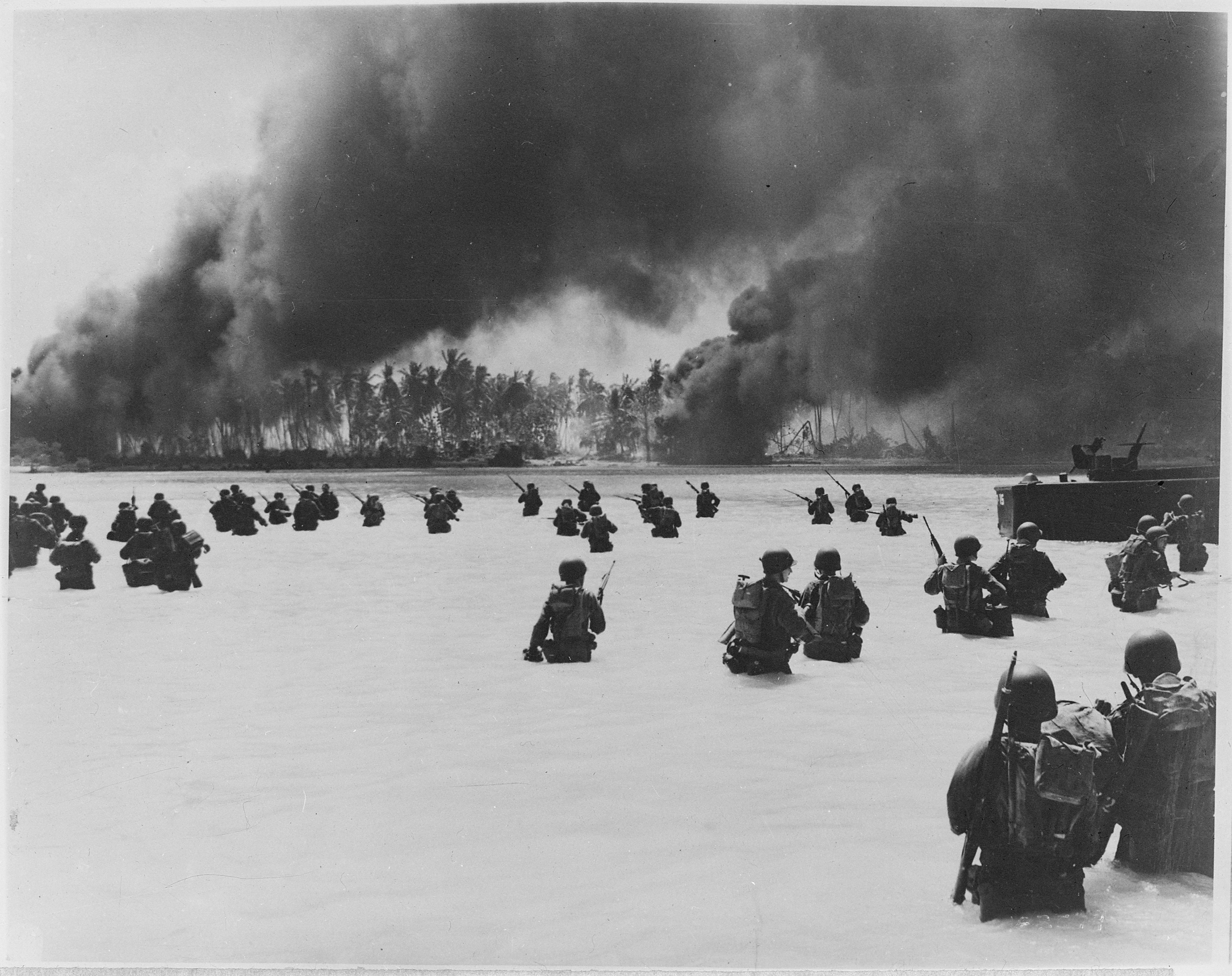
Redesignated the 165th Infantry for World War I, the regiment shipped to France in 1917 as part of the 42nd "Rainbow" Division. Its chaplain, Father Francis Duffy, became legendary for walking unarmed into the thick of battle to aid the wounded and bury the dead. Sergeant Joyce Kilmer wrote his poem "Rouge Bouquet" to memorialize 21 men killed when a dugout collapsed under bombardment near Baccarat. At Chateau-Thierry, the regiment suffered 264 killed (including Kilmer), 150 missing, and 1,200 wounded in four days. When other regiments reported being "too fatigued" to advance, the 69th replied it would "consider an order to advance as a compliment." Brigadier General Douglas MacArthur exclaimed, "By God, it takes the Irish when you want a hard thing done!" In World War II, the regiment fought across the Pacific at Makin, Saipan, and Okinawa, losing 472 killed. Among its World War I dead was Daniel Buckley, a survivor of the Titanic, killed in France in 1918.
Still Fighting
On September 11, 2001, soldiers of the 69th were among the first military personnel at Ground Zero, most of them reporting voluntarily without formal orders. Two members died during rescue operations that morning. In 2004, the regiment deployed to Iraq under Operation Iraqi Freedom, running combat patrols in Taji and securing the notorious "Route Irish" -- the airport road linking the Green Zone to Camp Victory in Baghdad. The operation was named "Wolfhound" after the Irish wolfhounds on the regimental crest. Nineteen soldiers were killed and over 78 wounded before the unit returned to New York in September 2005. In 2022, the battalion mobilized again as Task Force Wolfhound for a deployment to East Africa, manning the crisis response force created after the 2012 Benghazi attack. Ireland honored the regiment in 2006, when Mayor Michael Bloomberg unveiled a bronze monument in Ballymote, County Sligo -- birthplace of Civil War commander Michael Corcoran. Beside it, set flush with the ground, sits a small chamber containing a piece of steel from the World Trade Center.
From the Air
The 69th Regiment Armory is located at Lexington Avenue and 25th Street in Manhattan, near 40.741N, 73.984W. The distinctive brick armory building occupies a full city block between 25th and 26th Streets. Nearby landmarks include Madison Square Park to the northwest and the Flatiron Building. LaGuardia Airport (KLGA) is 7 nm to the northeast; JFK (KJFK) is 12 nm to the southeast. Recommended viewing altitude: 2,000-3,000 ft AGL.