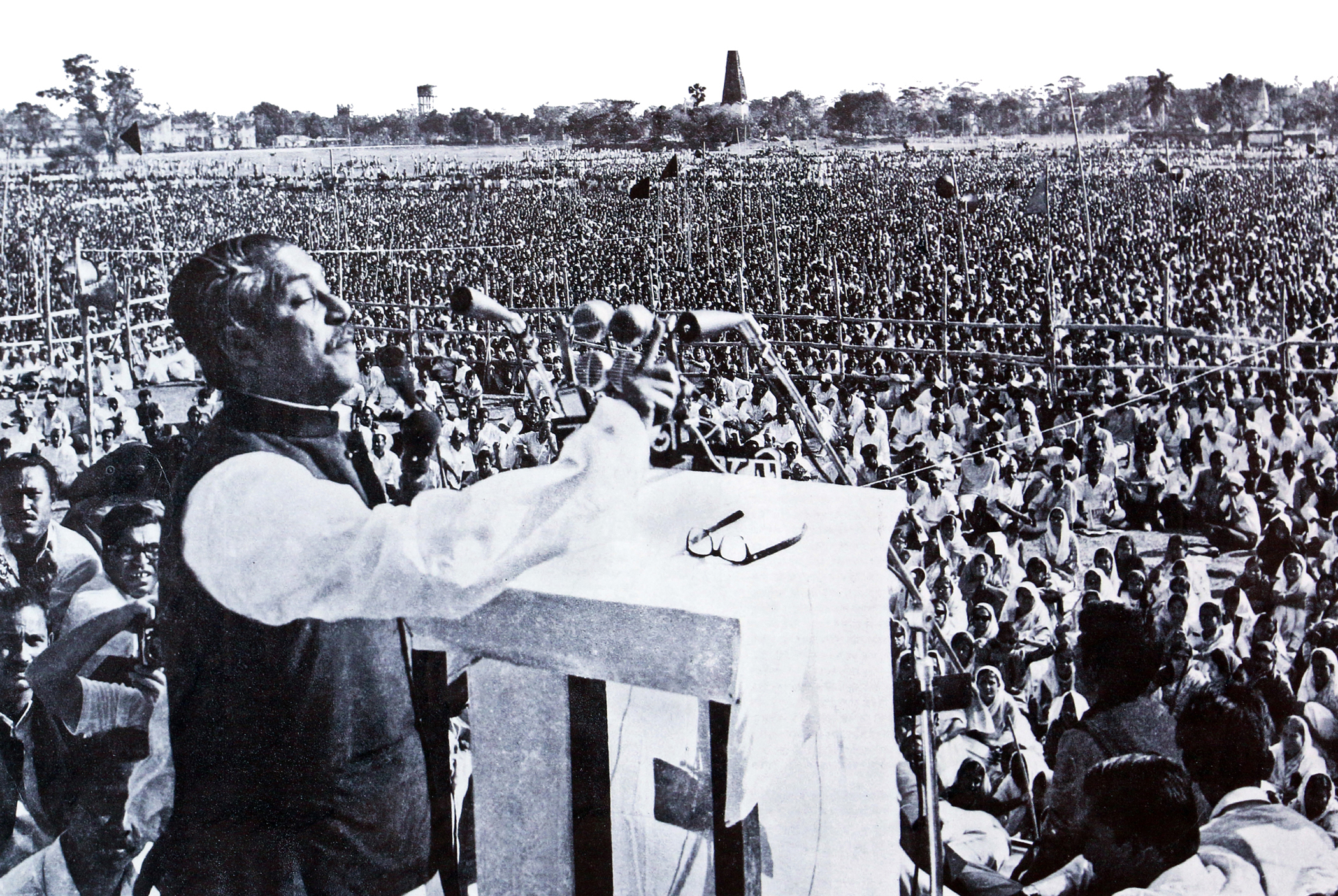
7 March Speech of Sheikh Mujibur Rahman
"The struggle this time, is a struggle for our liberty. The struggle this time, is a struggle for our independence." Sheikh Mujibur Rahman spoke these words on 7 March 1971 at the Ramna Race Course in Dhaka, standing before a crowd estimated at over one million. He did not formally declare independence. He did not need to. Eighteen days later, the Pakistan Army launched Operation Searchlight against Bengali civilians, and the war that his words had prepared a nation to fight began. In 2017, UNESCO added the speech to the Memory of the World Register, recognizing it as one of humanity's most significant documentary records. Bangladesh calls 7 March a Historic Day. The ground where Mujib stood is now called Suhrawardy Udyan, and the echoes have not faded.
A Country Divided by Geography and Power
Pakistan was born in 1947 as two halves of a single idea -- a Muslim homeland carved from the partition of British India. The two halves shared a religion but little else. West Pakistan held the political and military establishment. East Pakistan, separated by a thousand miles of Indian territory, held the majority of the population and the source of much of the nation's wealth, particularly in jute exports. When East Pakistanis reached the prime ministership -- Khawaja Nazimuddin, Muhammad Ali Bogra, Huseyn Shaheed Suhrawardy -- they were deposed by the West Pakistani establishment. Military dictators Ayub Khan and Yahya Khan deepened the resentment. In 1966, Sheikh Mujib and his Awami League launched the Six Point Movement demanding provincial autonomy. The government responded by arresting him and charging him with treason in the Agartala Conspiracy Case. He spent three years in prison before mass protests forced his release.
The Election That Changed Everything
In December 1970, the Awami League won a landslide in national elections, taking 167 of 169 seats allotted to East Pakistan and an outright majority in the 313-seat National Assembly. The result was unambiguous: Sheikh Mujib had the constitutional right to form the government. Zulfikar Ali Bhutto, leader of the Pakistan Peoples Party, refused to accept it. Following Bhutto's advice, President Yahya Khan postponed the swearing-in. Violence erupted across East Pakistan -- in Dhaka, Chittagong, Rangpur, Comilla, Rajshahi, Sylhet, and Khulna -- as security forces killed dozens of unarmed protesters. By early March 1971, the streets of the major cities were, in Mujib's own words, "dyed red with the blood of our brethren." The Awami League called a mass gathering at the Ramna Race Course for 7 March.
Nineteen Minutes That Shook a Subcontinent
The Pakistani government refused permission to broadcast the speech on radio or television. It did not matter. AHM Salahuddin, chairman of the Pakistan International Film Corporation, and M Abul Khayer, an East Pakistani member of the National Assembly, arranged to record both video and audio in secret. The speech lasted roughly nineteen minutes. Mujib laid out four conditions for East Pakistani participation in the National Assembly: the immediate lifting of martial law, the withdrawal of military personnel to barracks, the transfer of power to elected representatives, and a proper investigation into the killings. He called for civil disobedience and urged every house to become a fortress. It was, in the assessment of diplomats, historians, and the crowd itself, a de facto declaration of independence -- phrased with just enough ambiguity to deny the charge. The United States Embassy in Pakistan noted privately that Mujib was pushing for autonomy that the military would never accept and predicted a violent confrontation was inevitable.
From Speech to Sovereignty
On 25 March 1971, the Pakistan Army launched Operation Searchlight, targeting Bengali civilians, students, intellectuals, and Awami League leaders in a campaign that would become the Bangladesh genocide. The Liberation War that followed lasted nine months and cost hundreds of thousands of lives. Bangladesh won its independence on 16 December 1971. The speech that set it in motion survived because of those secret recordings. Three thousand copies of the audio were distributed worldwide by the Indian record label His Master's Voice. The documentary film Muktir Gaan by Tareque and Catherine Masud opens with footage of the address. The speech was later included in Jacob F. Field's anthology We Shall Fight on the Beaches: The Speeches That Inspired History. Today, Suhrawardy Udyan -- the former Ramna Race Course -- is preserved as a historic site. The court has ordered the government to protect it. Each year, the Joy Bangla Concert marks the anniversary. And the words endure: the struggle for liberty, the struggle for independence, spoken to a million people who carried them into a war and out the other side as citizens of a new country.
From the Air
Located at 23.733N, 90.398E at Suhrawardy Udyan (formerly Ramna Race Course) in central Dhaka. The park is a significant green space visible from low altitude amid the dense urban fabric. Best viewed at 2,000-3,000 feet. Nearby airport: Hazrat Shahjalal International Airport (VGHS), approximately 12 km north. Ramna Park and the University of Dhaka campus to the north provide visual references. The Buriganga River lies to the south.