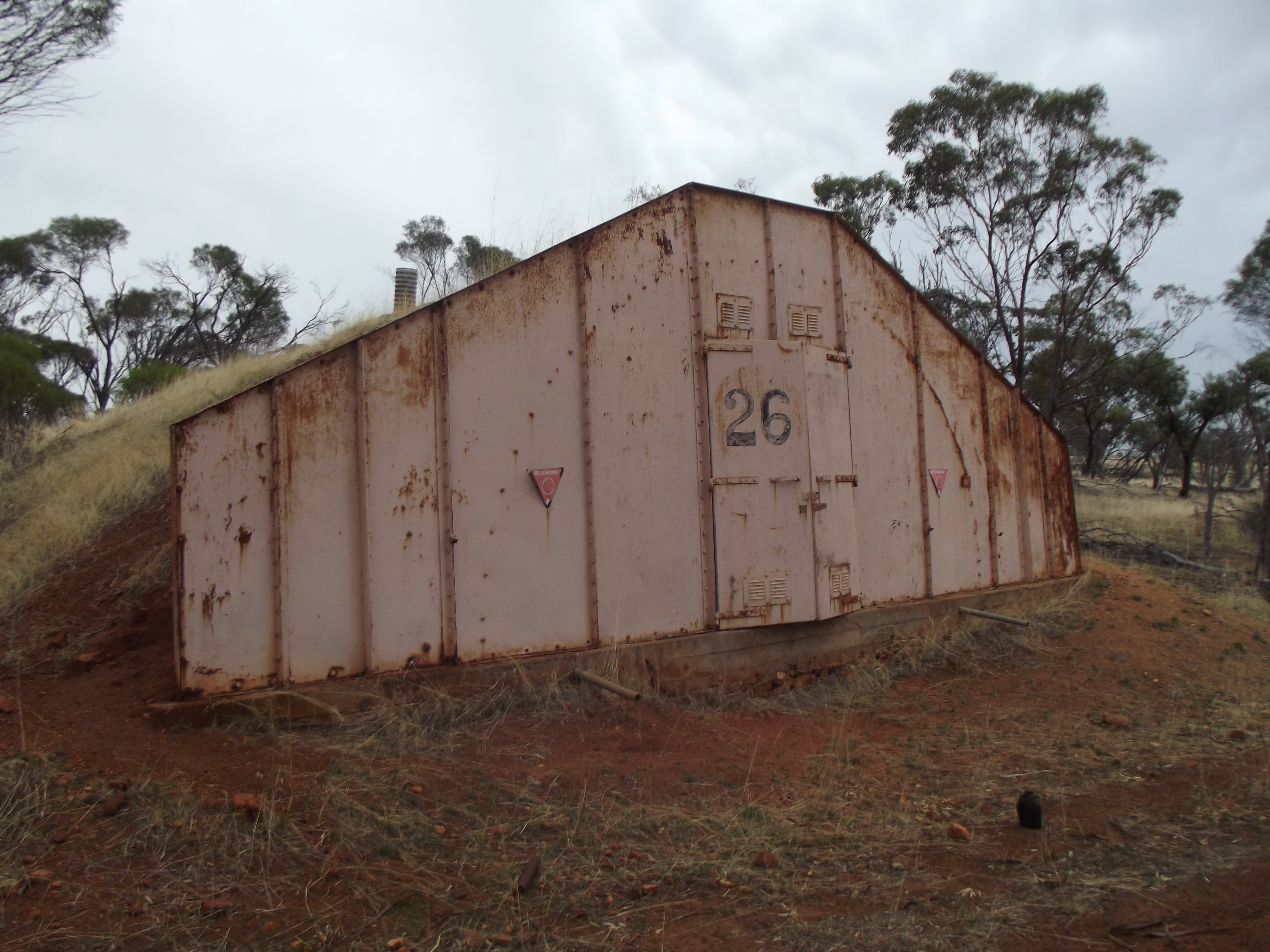
7 Naval Ammunition Depot
The wheat fields around Springhill, a hundred kilometers inland from Fremantle, seem like an unlikely place to store torpedoes. But in 1942, with Japanese bombs falling on Darwin, Broome, and Wyndham, the Australian and American militaries were looking for exactly this kind of obscurity. They needed a place far from the coast, connected by rail, and invisible from the air. Springhill fit every requirement. Within months, 202 hectares of compulsorily acquired farmland became the US Navy's 7 Naval Ammunition Depot, designated Navy 137, feeding ordnance to the largest submarine operation in the Southern Hemisphere.
When the War Came South
The story of Navy 137 begins with a cascade of retreats. After the bombing of Darwin on 19 February 1942, followed by sixty-four further raids on that city and strikes on Wyndham, Broome, and Onslow in Western Australia, the strategic calculus shifted south. American, British, and Dutch submarines and warships withdrew from the Philippines, Java, and eventually from forward bases in Darwin and Exmouth. The US Navy's 7th Fleet, under Task Force 71, relocated its submarine operations to Fremantle, which would grow into the second-largest submarine base in the world. Approximately 170 Allied submarines launched 416 war patrols from Fremantle during the conflict. Those submarines needed torpedoes, and the torpedoes needed to be stored somewhere the enemy could not reach.
A Depot Disguised as Farmland
The site at Springhill, near Northam, was selected for its distance from the Indian Ocean coast and its connection to the railway line that ran through to Midland and Fremantle Harbour. The farmland was divided: part became the Australian Army's 6 Central Ammunition Depot, and an adjacent section was purchased by the US Navy for 7 NAD. Navy 137 stored approximately 4,000 tons of ordnance, including torpedoes, naval gun ammunition, anti-tank mines, and small arms. Each rail delivery from Fremantle Harbour weighed 400 tons. Concrete anti-tank defences ringed the depot, and guards from the nearby 7 Supply Depot at Spencers Brook patrolled the perimeter. A torpedo technical workshop was established separately in Subiaco, in Perth's inner suburbs, where torpedoes were checked and readied before loading onto submarines at the harbour.
Life at the End of the Line
Lieutenant George Wickens commanded a small staff of one additional officer and fifty enlisted men, housed in nine Quonset huts among 109 ammunition magazines and support structures. The depot had its own swimming pool, a concrete structure apparently also used for scuba diving training, the remains of which still stand. Water came from wells on the adjacent Australian depot. A single household washing machine served all fifty men. Power ran off a diesel generator, and a septic tank handled sewage. The Americans described the facilities as "adequate," which, in the understated vocabulary of military logistics, meant they got the job done without complaint. Beyond the depot's fences, the men found something the military had not planned for: dance nights at the Lesser Town Hall in Northam, where several Americans began relationships with local women. Some of those romances produced among the first war brides to leave Australia.
From Torpedoes to Wine Cellars
The depot's 109 magazines were designed to exclude mechanical handling equipment and palletisation, a limitation that made them inconvenient for modern military logistics but unexpectedly perfect for other purposes. In the decades after the war, personnel from the Royal Australian Army Ordnance Corps discovered that the thick-walled, temperature-stable bunkers made excellent wine cellars and mushroom farms. It is a peculiarly Australian transformation: structures built to house weapons capable of sinking warships, repurposed for pinot noir and button mushrooms. The concrete pool, the anti-tank barriers, and the bunkers themselves remain as physical reminders of a time when the wheat country of Western Australia was among the most strategically important real estate in the Pacific war.
From the Air
Located at 31.73S, 116.68E near Springhill, about 100 km east of Fremantle and close to Northam, Western Australia. The depot site is visible as a cluster of low concrete structures amid agricultural land, connected by a rail spur to the Northam-Spencers Brook line. Northam airstrip is nearby. Perth Airport (YPPH) is approximately 80 km to the west. The terrain is flat to gently rolling wheat country, best viewed at 2,000-3,000 ft AGL.