798 Art Zone
The sawtooth rooftops give it away. From above, the factory complex in Beijing's Dashanzi neighborhood looks like any aging industrial site -- long parallel buildings with north-facing roof windows designed to flood workspaces with even, indirect light. But those Bauhaus-influenced structures, designed by East German architects and built with Soviet and Chinese labor between 1952 and 1957 to produce electronics for China's military, now house something their builders never imagined: the country's most important contemporary art district.
Factories of the Revolution
The complex began as Factory 718, part of a massive Cold War industrial project. East Germany provided the architectural plans, the Soviet Union contributed technical expertise, and China supplied the workforce. The facilities manufactured electronics components for the People's Liberation Army, including vacuum tubes, semiconductors, and eventually satellite communications equipment. At its peak during the Cultural Revolution, the factory employed thousands. But by the late 1980s and 1990s, as China's economy shifted, the state-owned enterprise downsized dramatically. Buildings emptied. The complex's official designation -- Joint Factory 718, with individual buildings numbered 706 through 798 -- became a relic of central planning. Factory 798, the largest single structure, eventually lent its name to the entire district.
Artists Move In
The transformation began almost by accident. In 2001, the Central Academy of Fine Arts needed temporary studio space for a sculpture department relocation and rented several buildings in the complex. Artists discovered the spaces were extraordinary: soaring ceilings, natural light streaming through those Bauhaus roof windows, and rents low enough for even struggling painters to afford. Word spread quickly through Beijing's art community. By 2002, Robert Bernell, an American publisher living in Beijing, opened the Timezone 8 bookstore and art space, anchoring what was becoming an informal creative colony. Huang Rui, one of the founders of the avant-garde Stars Group that had staged unauthorized exhibitions in 1979, established his studio and began organizing events. Galleries, cafes, and design firms followed in rapid succession.
The Battle to Survive
Success brought danger. The property's owner, the state electronics conglomerate Seven Star Group, had other plans -- the buildings sat on increasingly valuable Beijing real estate, and developers proposed demolishing the factories for commercial redevelopment. In 2003 and 2004, a fierce battle erupted between artists and the Seven Star Group. Eviction notices went out. Artists organized resistance, staging public exhibitions and courting international media attention. The dispute reached city government, and in a rare reversal, Beijing's municipal leadership sided with the artists. By 2006, the district was officially designated a creative industrial zone. What had been an underground squatter community gained protected status, though that protection came with its own transformations -- rising rents, commercial galleries replacing experimental spaces, and tourism reshaping the district's character.
The Art and the Architecture
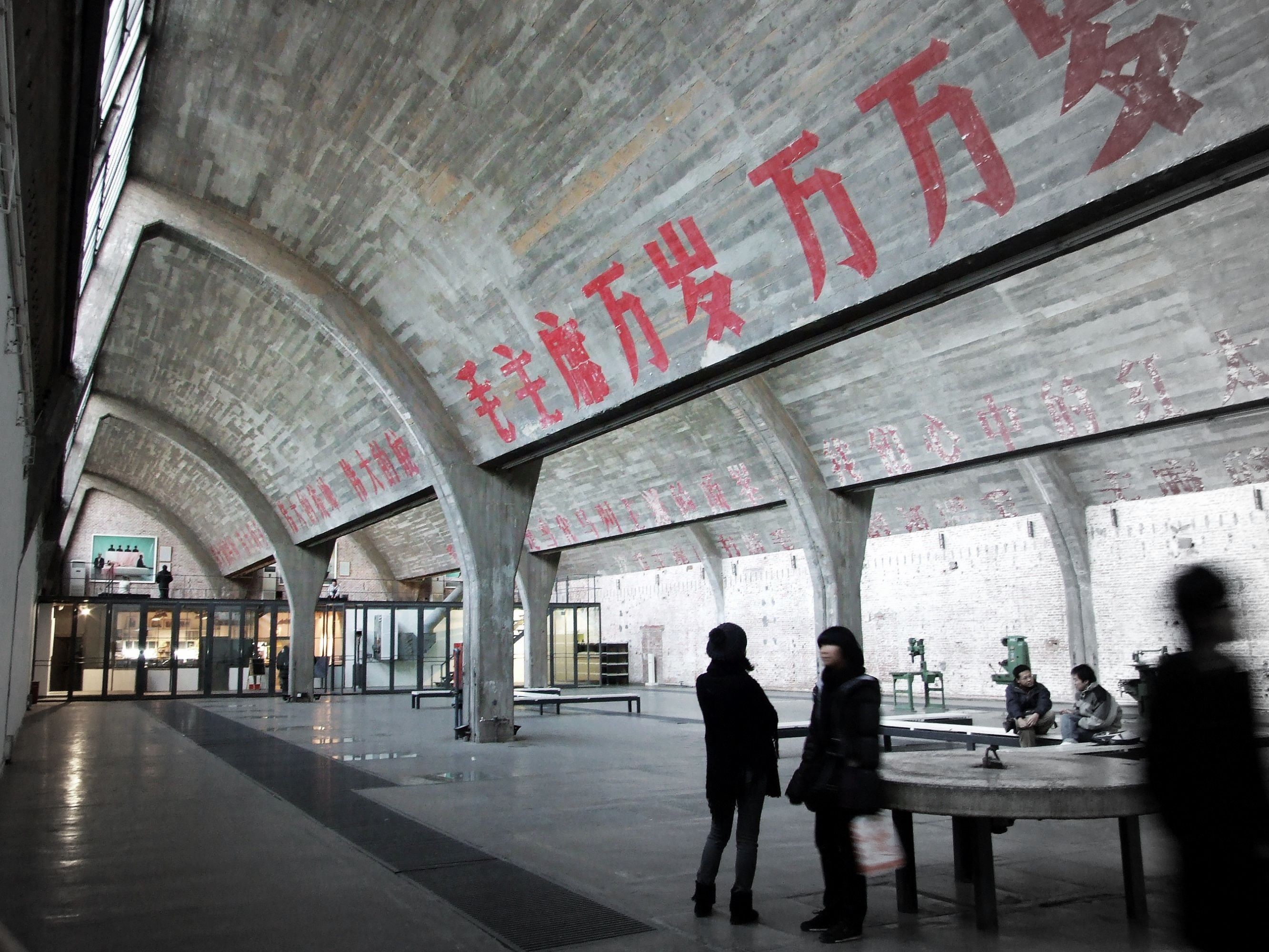
Today the 798 Art Zone anchors around the UCCA Center for Contemporary Art, the largest and most visited venue in the complex. The district hosts the annual Beijing Queer Film Festival and Beijing Design Week, and galleries rotate exhibitions that range from established Chinese artists to international names. But what makes the space truly distinctive is the architecture itself. The East German Bauhaus-style buildings, with their distinctive arched ceilings, exposed-brick walls, and industrial proportions, provide a physical language that no purpose-built gallery can replicate. Revolutionary-era slogans still visible on some walls create an unintentional conversation between Maoist aesthetics and contemporary art. Walking through the alleys off Jiuxianqiao Road, you encounter old propaganda murals adjacent to avant-garde installations -- the 20th century literally talking to the 21st.
Between Authenticity and Commerce
The tension that has always defined 798 persists. The district that once sheltered marginal, sometimes politically provocative art has become a tourist destination, complete with branded coffee shops and souvenir stalls. Rents have climbed so high that many of the original artists have relocated to cheaper neighborhoods on Beijing's periphery, replaced by commercial galleries and fashion boutiques. Critics argue the zone has been sanitized; defenders counter that institutional recognition is what saved the buildings from demolition. The truth lives somewhere in the concrete-and-brick structures themselves. Their walls absorbed decades of Cold War industry before absorbing decades of artistic experimentation. Whatever commerce surrounds them, the spaces remain -- Bauhaus bones built for one purpose, repurposed for another, still standing when everything around them has changed.
From the Air
Located at 39.98°N, 116.49°E in Chaoyang District, northeast Beijing. The factory complex is identifiable by its distinctive sawtooth-roofed industrial buildings among residential high-rises. Best viewed at 2,000-4,000 feet AGL. Beijing Capital International Airport (ZBAA/PEK) is approximately 8 nm to the northeast.