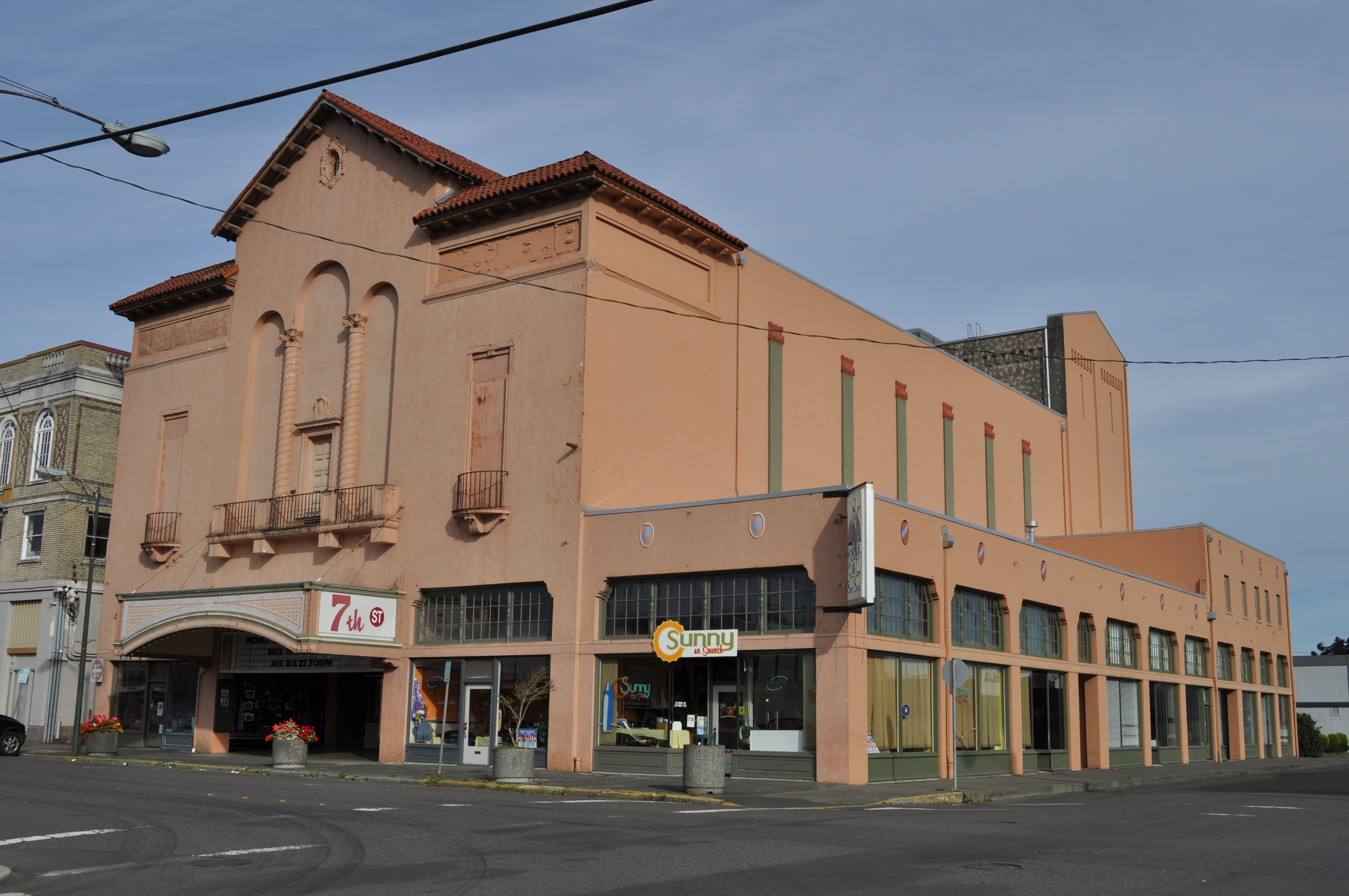
7th Street Theatre
Look up inside the 7th Street Theatre and you will not see a ceiling. You will see stars. Tiny lights embedded overhead simulate a night sky, the signature trick of atmospheric theatre design -- an architectural style that replaced the traditional proscenium box with the illusion of sitting outdoors in a Mediterranean courtyard. Built in 1928 in downtown Hoquiam, Washington, this theatre is one of the few atmospheric houses still standing in the United States, a survivor in a timber town that has seen better economic days. The building's persistence is not accidental. It is the work of volunteers who have spent decades repairing rigging, restoring seats, and tracking down the theatre's original organ after it spent sixty years in other people's hands.
A Courtyard Under Starlight
Edwin St. John Griffith designed the 7th Street Theatre as a Spanish atmospheric house, commissioned by builder Olaf T. Taylor and completed in 1928. The atmospheric style, popular in the late 1920s, aimed to transport audiences out of the auditorium entirely. Instead of ornate ceilings and chandeliers, atmospheric theatres used painted walls suggesting Mediterranean or Moorish architecture, with a deep blue overhead surface punctuated by tiny electric lights mimicking constellations. The lobby ceiling carries murals, and a fountain -- currently not in use -- once added the sound of running water to the illusion. The effect, when it works, is of stepping through a doorway in a Pacific Northwest logging town and finding yourself in an Andalusian plaza at night. Griffith understood that the magic of cinema begins before the projector starts.
The Organ's Sixty-Year Detour
By 1944, theatre organs had fallen out of fashion. The 7th Street's original instrument was sold to Trinity Lutheran Church in Parkland, Washington, through organ dealers Balcom and Vaughan. Three additional ranks were added, bringing it to a 2/7 configuration. In 1960, George Martin of Tacoma purchased the organ. Martin, who had studied with Martha Green and Arnold Leverenz in the Seattle-Tacoma area between 1951 and 1953, eventually moved the instrument to his home in Clute, Texas -- roughly 2,400 miles from where it had first played. There it sat for decades, an artifact of Hoquiam's past gathering dust on the Gulf Coast. Donations from Tom Quigg and Pat Oleachea funded its purchase and return. On March 20, 2008, volunteer staff unloaded a truck at the theatre's loading dock. The organ was home. Installation was completed around 2012, at a cost of approximately $12,000.
Keeping the Lights Twinkling
The 7th Street Theatre was placed on the National Register of Historic Places in 1987 and became the first building on Hoquiam's city historic register in 2008. The not-for-profit 7th Street Theatre Association operates the building, coordinating live shows and second-run feature films while pursuing restoration work that never seems to end. The rigging was replaced in 2008. The ceiling was repaired in 2009. Inmates at McNeil Island Correctional Institute restored the theatre's seats -- a detail that captures something about the community effort holding this building together. As of 2018, the board was raising funds to repair the back wall. Each repair addresses one piece of a ninety-year-old structure in a climate where rain is measured in feet, not inches. Hoquiam averages over 70 inches of precipitation a year, and a building designed to simulate an outdoor courtyard requires constant defense against the actual outdoors trying to get in.
A Lumber Town's Living Room
Hoquiam sits at the mouth of the Hoquiam River where it meets the Chehalis River and Grays Harbor, a working waterfront town that grew up around timber and fishing. The 7th Street Theatre opened during the last years of the region's logging boom, when Grays Harbor County mills processed millions of board feet annually and a town of a few thousand could support a movie palace. That economy contracted sharply in the decades that followed. Many of the grand commercial buildings from Hoquiam's prosperous era are gone. The 7th Street survives because people decided it was worth the trouble, and because atmospheric theatres, when they work, offer something that a multiplex cannot: the feeling that the room itself is part of the show. The stars still twinkle overhead. The organ plays again. In a town where the rain rarely stops, the illusion of a clear Mediterranean night remains worth preserving.
From the Air
The 7th Street Theatre sits at 46.978°N, 123.885°W in downtown Hoquiam, Washington, on the north shore of Grays Harbor. The nearest airport is Bowerman Field (KHQM), less than a mile south, making this an easy landmark to spot on approach. Hoquiam and its twin city Aberdeen are visible at the eastern end of Grays Harbor, where the Chehalis, Wishkah, and Hoquiam rivers converge. From altitude, the harbor's broad tidal flats and the grid of downtown Hoquiam provide clear orientation. The Olympic Mountains rise to the north, and the Pacific coastline stretches west.