A.V. Grigoriev Art and History Museum
In 1918, a traveling exhibition of 40 paintings left Kazan heading for towns along the Volga and Kama rivers. The works included pieces by the Russian Itinerants and contemporary Kazan artists, among them Nikolai Feshin, who would soon become one of the most celebrated portrait painters of the 20th century. When the paintings reached Kozmodemyansk, a small town in what is now the Mari El Republic, the Russian Civil War caught up with them. The White Guards entered Kazan. The exhibition could go no further. Those 40 stranded canvases became the foundation of what is today the A.V. Grigoriev Art and History Museum -- ranked in 2020 among the 10 best regional museums of Russian art.
The Artist Who Built a Museum
Alexander Vladimirovich Grigoriev arrived in Kozmodemyansk in the fall of 1919. He was one of the first professional artists of Mari heritage, and when he saw the paintings left behind by the stalled Volga-Kama exhibition, he recognized an opportunity that the war had accidentally created. On September 7, 1919, Grigoriev formally established a museum around those works. The collection moved through a series of homes: first the house of the merchant Torsuev, then the Smolensk Cathedral beginning in 1933, and finally, in 1998, the restored 19th-century house of the merchant Ponomarev -- built in 1883 and considered the most beautiful building in the city. On November 4, 1920, the museum was officially named after its founder, in honor of his contributions to public education.
Acquisitions and Connections
Grigoriev moved to Moscow in the 1920s but never abandoned the museum he had created. Working his connections in the capital, he acquired 50 paintings by well-known artists along with sculpture and porcelain. Fellow artists donated works directly -- pieces by Vitold Byalynitsky-Biruli, Pavel Radimov, and Filipp Malyavin entered the collection through personal friendships. His greatest coup involved Nikolai Feshin. In 1923, when Feshin emigrated to the United States, Grigoriev managed to purchase several of his works and received additional sketches of a Cheremis wedding as a gift. The museum now holds eleven works by Feshin, a concentration of one of Russia's most admired painters that would be remarkable in a major city, let alone a small Volga river town.
Erased and Restored
In 1938, Grigoriev became a victim of Stalinist repressions. He was arrested and sent to Kazakhstan, where he spent eight years. His name was stripped from the museum he had founded. Upon his release in 1946, the rehabilitation process was agonizingly slow -- not until 1954 did he succeed in clearing his record. The museum's name was restored to honor its founder only in 1966, decades after the injustice. The collection itself survived the political turmoil. Later directors -- Bochkarev, Puzyrnikov, Plandin, Mikheeva -- continued building the holdings through the mid-20th century, and acquisitions of Leningrad artists' works in the 1970s and 1980s further broadened the scope. Today the museum holds more than 43,000 items, of which 3,500 are fine art objects.
An Aivazovsky by the Volga
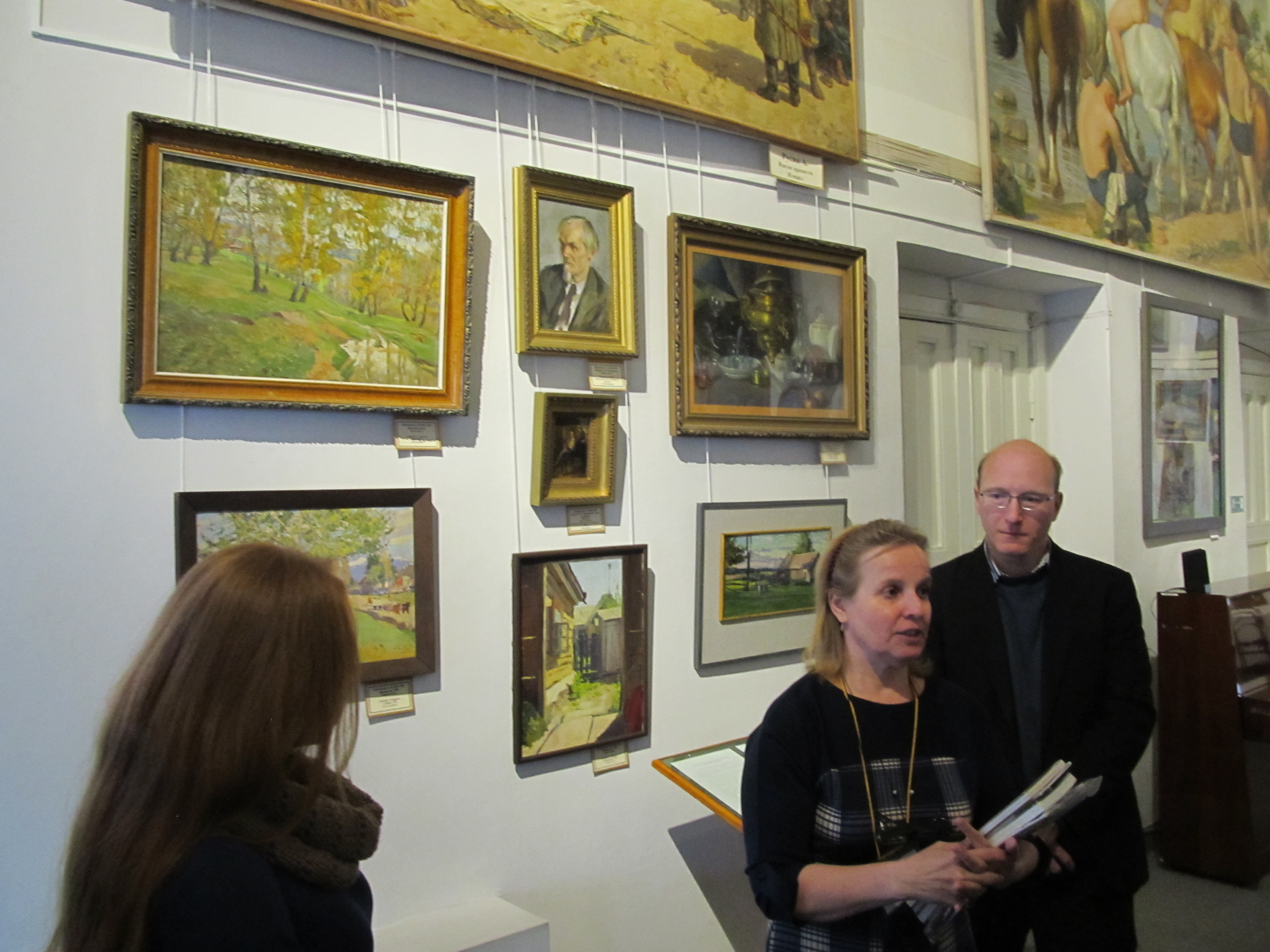
The depth of the collection consistently surprises visitors who expect a provincial curiosity. Ivan Aivazovsky's Moonlit Night on the Black Sea hangs here, alongside maritime works by Sudkovsky and Shroder. Academic painting from the early 19th century shares wall space with works by the Itinerants -- Tvorozhnikov's Poor Boy with a Basket, Kamenev's Pond, Korzukhin's Peasant Children. The historical department occupies three rooms covering regional nature, archaeology, and ethnography, plus collections of Oriental, European, and Russian porcelain from the 18th through 20th centuries. All of it exists because a civil war stranded 40 paintings in the right town at the right time, and one man had the vision to see a museum where others saw only a disrupted schedule.
From the Air
Located at 56.34N, 46.57E in Kozmodemyansk, Mari El Republic, on the right bank of the Volga River at its confluence with the Vetluga. The museum is housed in a restored 19th-century merchant's house in the town center. Nearest airports: Yoshkar-Ola (UWKJ) approximately 100 km east, Cheboksary (UWKS) approximately 70 km southeast. The town sits on high ground above the Volga -- look for the distinctive river confluence and the compact historic center. Best viewed at 2,000-3,000 feet AGL.