A-Z West
Andrea Zittel moved to Joshua Tree in 1999 to answer a question she had been asking since a 200-square-foot storefront in Williamsburg, Brooklyn: what does it actually mean to live? Not what do we want or aspire to, but what does the daily structure of existence require, and can that structure itself become something beautiful?
From Five Acres to Eighty
Zittel bought a five-acre parcel at first. The compound grew from there. By the time she left in 2022, A-Z West covered 80 acres in the Mojave Desert near Joshua Tree, California, and had become one of the most unusual artist's spaces in the country — part home, part studio, part exhibition, part laboratory. Four original homestead cabins became the A-Z West House, a library, a caretaker's quarters, and additional dwelling units. The house itself is filled with what Zittel calls "life practice" objects: furniture, tools, a chicken coop, functional aesthetics for everyday survival that also function as artworks. Nothing here is purely decorative. Nothing is purely utilitarian either.
The Studio and the Test Sites
The A-Z West Studio, completed in 2010 and 2011, holds a ceramics workshop, a wood shop, and a weaving studio with seven floor looms. A-Z West Works produces ceramics, textiles, and clothing. The studio store is part of the compound, which means you can buy something made here, which means the boundary between art object and commercial object is deliberately blurred — as it always was in Zittel's work.
In 2002, Zittel co-founded High Desert Test Sites with collaborators including Lisa Anne Auerbach. The nonprofit ran residencies, educational workshops, and art exhibitions across the desert region for two decades. When Zittel stepped back around 2022, the organization took over stewardship of A-Z West itself, continuing the programs she had started.
What the Desert Made Possible
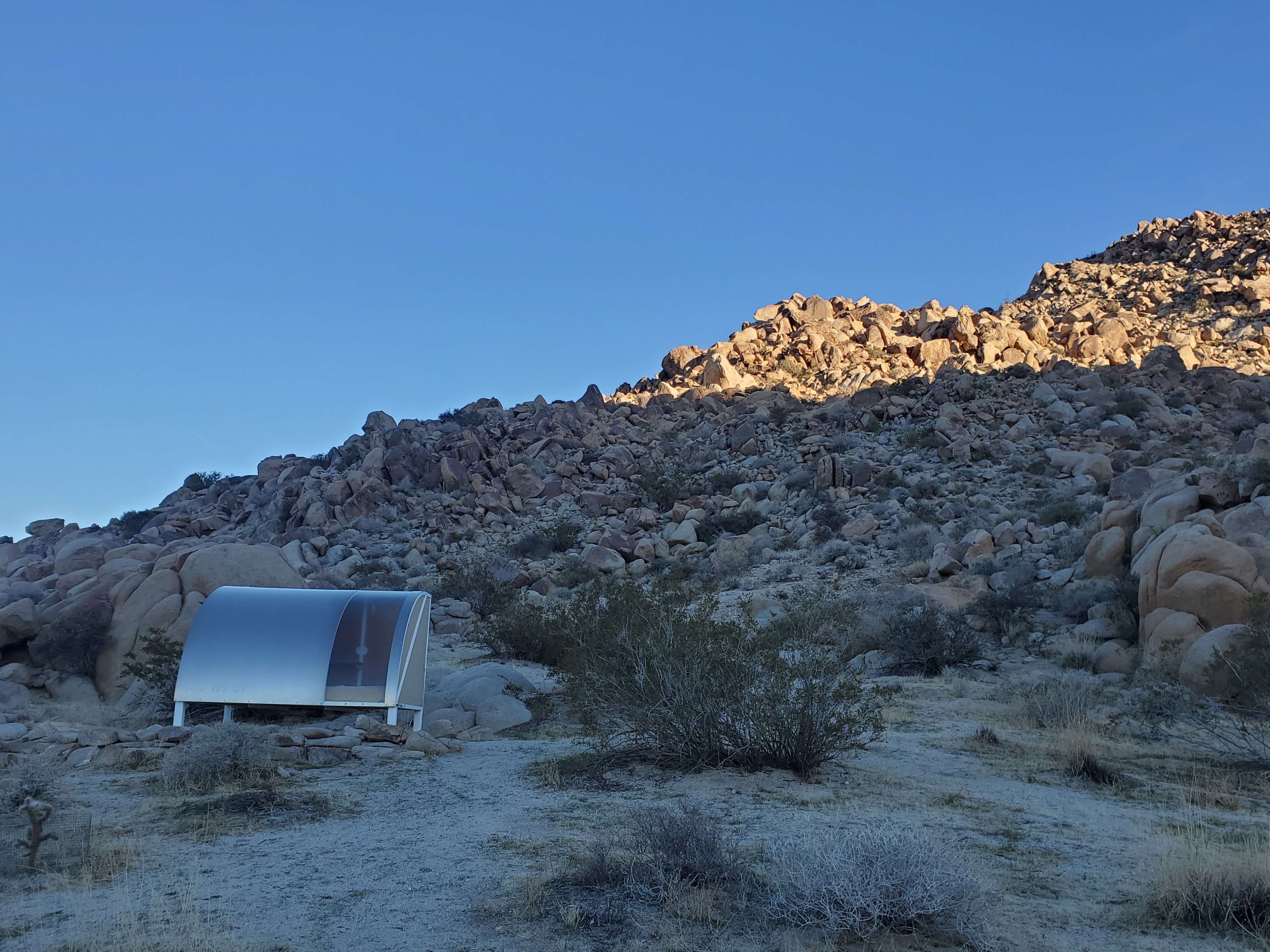
Art critics have placed Zittel's work in the lineage of Robert Rauschenberg — specifically his interest in the space between art and life. But the desert setting shifts the inquiry. In Brooklyn, the question of how to live is answered partly by proximity to everything else. In Joshua Tree, with the mountains visible in every direction and the nearest neighbor some distance away, the question becomes more urgent and more literal. Heat, water, shelter, food — the desert concentrates these. Zittel's presence here from 2000 to 2022 produced an ongoing body of work that includes Wagon Station Encampment shelters, Regenerating Field (2002), and Planar Pavilions at A-Z West (2017). The compound itself may be the largest single piece. It is also where she lived.
From the Air
Located at 34.13°N, 116.29°W near Joshua Tree, California. The compound is identifiable from above by its distinctive structures on the desert floor north of the park. Joshua Tree National Park's western entrance lies a few miles southeast. Nearest airports: Desert Resorts Regional (PSP) ~30 miles south, Twentynine Palms (TNP) ~20 miles east.