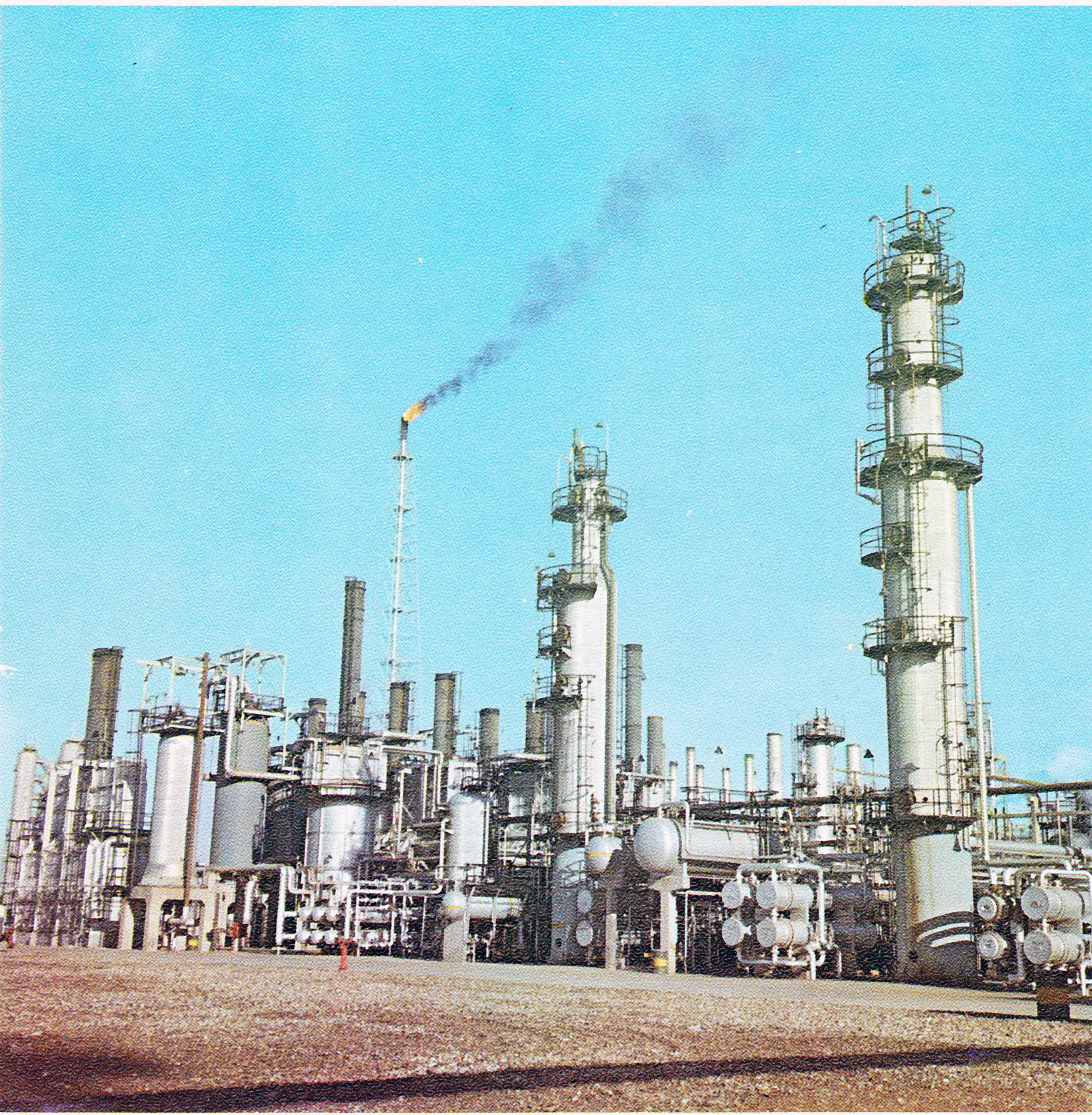
Abadan Refinery
In 1909, a British company secured a lease on a flat, swampy island where the Karun River meets the Arvand waterway near the Persian Gulf. Three years later, a pipeline terminus began processing crude oil at 2,500 barrels per day. That modest beginning produced one of the most consequential industrial sites of the twentieth century. The Abadan Refinery did not just process petroleum. It redrew the political map of the Middle East, triggered a CIA-backed coup, survived a year-long siege, and remains operational more than a century after its first barrel.
An Empire Built on Crude
The Anglo-Persian Oil Company, later renamed Anglo-Iranian and eventually BP, constructed the refinery on Abadan Island starting in 1910. By 1914, the British government recognized the strategic value of what was emerging in the Persian heat and acquired a 51 percent stake in the company. The refinery expanded relentlessly. By 1927, oil exports from Abadan totaled nearly 4.5 million tons annually. Workers from across Iran and the broader region flooded into a city that barely existed before petroleum. By mid-century, the Abadan complex had grown into the largest oil refinery on Earth, a sprawling industrial landscape of cracking towers, storage tanks, and flare stacks visible for miles across the flat Khuzestan plain.
Nationalization and the Crisis of 1951
The wealth flowing from Abadan's refinery went overwhelmingly to London. Iranian workers labored in extreme heat for modest wages while British employees lived in manicured compounds. Resentment grew for decades. In March 1951, the Iranian parliament voted to nationalize the Anglo-Iranian Oil Company, and Prime Minister Mohammad Mossadegh expelled Western companies from the refinery. Britain responded with a naval blockade and an international oil boycott. The standoff, known as the Abadan Crisis, paralyzed Iran's economy and became a Cold War flashpoint. In 1953, a joint CIA and MI6 operation overthrew Mossadegh and restored the Shah to full power. The refinery returned to international consortium control, but the grievance it represented never faded. The nationalization struggle remains a defining chapter in Iranian political memory.
Siege, Destruction, and Survival
On September 22, 1980, Iraqi forces launched a surprise attack on Khuzestan province. Abadan, with its massive refinery complex operating at 635,000 barrels per day, was a primary target. Iraqi artillery and air strikes hammered the facility. For twelve months, the city endured a full military siege. The refinery burned. Nearly the entire civilian population of 300,000 fled. But Abadan never fell. Iranian defenders held the city, and in September 1981, they broke the siege. The cost was staggering. Much of the refinery lay in ruins, and the city itself was gutted. What had been the world's largest refining operation was reduced to wreckage.
Slow Recovery
After the Iran-Iraq War ended in 1988, reconstruction began. The work was slow and expensive, hampered by international sanctions and the sheer scale of destruction. By 2013, the refinery had recovered to a capacity of approximately 429,000 barrels per day, still short of its prewar peak but once again a major contributor to Iran's domestic fuel supply. In December 2017, China's Sinopec signed a one-billion-dollar deal to expand the facility further. But the expansion stalled in March 2020 when the COVID-19 pandemic shut down construction. The refinery's trajectory mirrors the broader arc of modern Iran: ambition checked by conflict, isolation, and forces beyond any single nation's control.
A Century of Fire
From the air, the Abadan Refinery still dominates Abadan Island. Its flare stacks glow against the flat horizon of southern Khuzestan, burning off gas as they have for more than a hundred years. The facility has outlasted the empire that built it, the prime minister who tried to reclaim it, the dictator who tried to destroy it, and the sanctions that tried to starve it. It processes crude oil in temperatures that regularly exceed 45 degrees Celsius, in a city where sand storms blur the line between sky and earth. Every barrel that moves through those pipelines carries the weight of a century's worth of politics, war, and the stubborn human insistence on extracting value from the ground beneath their feet.
From the Air
Coordinates: 30.346N, 48.275E. The refinery complex sprawls across the northwest portion of Abadan Island, visible as a dense industrial zone with flare stacks, storage tanks, and processing towers. Abadan Island is approximately 68 km long and 3-19 km wide, bounded by the Arvand waterway (Shatt al-Arab) to the west and the Bahmanshir outlet of the Karun River to the east. Abadan International Airport (OIAG) is nearby. The Persian Gulf lies 53 km to the south. The Iranian-Iraqi border runs along the Arvand waterway. Expect extreme heat in summer months with temperatures exceeding 50C. Best aerial visibility in cooler winter months.