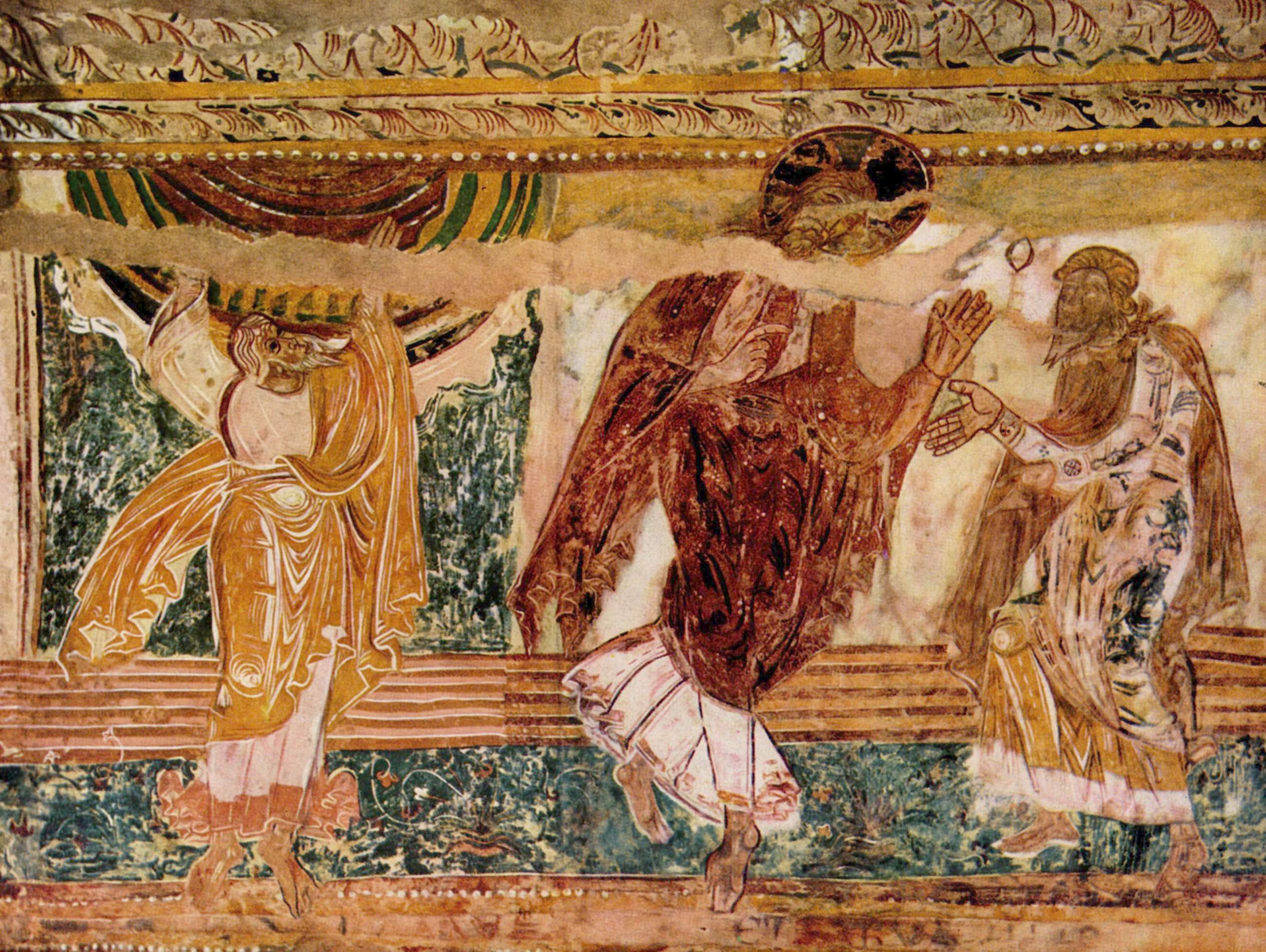
Abbey Church of Saint-Savin-sur-Gartempe
Walk into the Abbey Church of Saint-Savin-sur-Gartempe and look up. Stretching across the barrel vault of the nave, painted figures act out scenes from Genesis and Exodus in colors that have barely faded in nine centuries. God speaks to Noah. The Tower of Babel rises. The stories unfold in a continuous visual narrative that predates the Sistine Chapel by four hundred years. UNESCO inscribed this church as a World Heritage Site in 1983, calling it one of the finest and best-preserved examples of Romanesque mural painting in Europe. The nickname it carries, the "Romanesque Sistine Chapel," is not hyperbole.
Born from Martyrs' Bones
The abbey's origins reach back to the age of Charlemagne, when the bones of two 5th-century martyrs, Savin and Cyprian, were reportedly discovered by Baidilius, Abbot of Marmoutier. The monastery that grew around their relics is thought to have been founded by Saint Benedict of Aniane under Charlemagne's protection, though the early history remains fragmentary. The current church was begun during a rebuilding campaign starting in the mid-11th century, part of the great flowering of Romanesque architecture across the Poitou region. By the early 12th century, the building that stands today was largely complete: a cruciform plan with a tall nave, transept, and apse, its proportions designed not merely for worship but as a surface for painting.
A Bible on the Ceiling
The paintings that make Saint-Savin extraordinary were executed between approximately 1095 and 1115. They are distributed throughout the church with deliberate theological organization. The nave vault carries scenes from Genesis and Exodus, the largest and most spectacular cycle. The narthex doorway depicts the Apocalypse. The gallery holds scenes from the Passion of Christ. In the choir and on the piers of the transept, images of saints preside over the liturgical heart of the church. The crypt, accessible beneath the choir, contains frescoes depicting the martyrdom of Saints Savin and Cyprian themselves. The artists worked in the Angevin style, characterized by linear designs, flat color silhouettes, and bold contrasts between light and dark grounds. The colors remain astonishingly vivid, offering a rare glimpse of how medieval churches actually looked when every surface was painted.
Survival Against the Odds
That these paintings survive at all is remarkable. The Hundred Years' War, the Wars of Religion, the French Revolution, and simple neglect each threatened them. Unlike most Romanesque murals across France, which were whitewashed, scraped off, or painted over during successive renovations, Saint-Savin's frescoes were largely left alone, perhaps because the church was remote enough to escape the worst of each era's destructive impulses. The building suffered damage but the paintings on the high vault were beyond easy reach of anyone who might have wanted to destroy them. Restoration campaigns have addressed structural concerns and stabilized the paintings without attempting to repaint or embellish them. What visitors see today is largely what the 11th-century painters left behind: original pigment on original plaster, faded only slightly by the passage of nine hundred years.
Light and Stone on the Gartempe
The church stands beside the River Gartempe in the small town of Saint-Savin, in the Vienne department of the Poitou region. The setting is modest: a quiet market town in the rural heart of western France, far from the tourist circuits of Paris or the Loire chateaux. This remoteness has been the paintings' best guardian. The town itself is built around the abbey, its streets radiating outward from the church in the organic pattern of a settlement that grew in the shadow of a monastery. Inside, the Romanesque architecture works in concert with the murals. The barrel vault that carries the Genesis cycle provides an uninterrupted surface that reads like an enormous scroll, the eye drawn from scene to scene as it moves along the nave. The effect is both intimate and overwhelming: a small-town church that contains one of the most important artistic achievements of medieval Europe.
From the Air
Located at 46.565N, 0.866E beside the River Gartempe in the town of Saint-Savin, Vienne department, Poitou region. The abbey church is the dominant structure in the small town, identifiable from the air by its Romanesque tower and cruciform plan. Nearest airport: Poitiers-Biard (LFBI) approximately 40 km west. The Gartempe River, a tributary of the Creuse, provides a useful navigation reference flowing north past the town. The surrounding landscape is gently rolling farmland and river valley. Best viewed at low altitude in clear conditions.