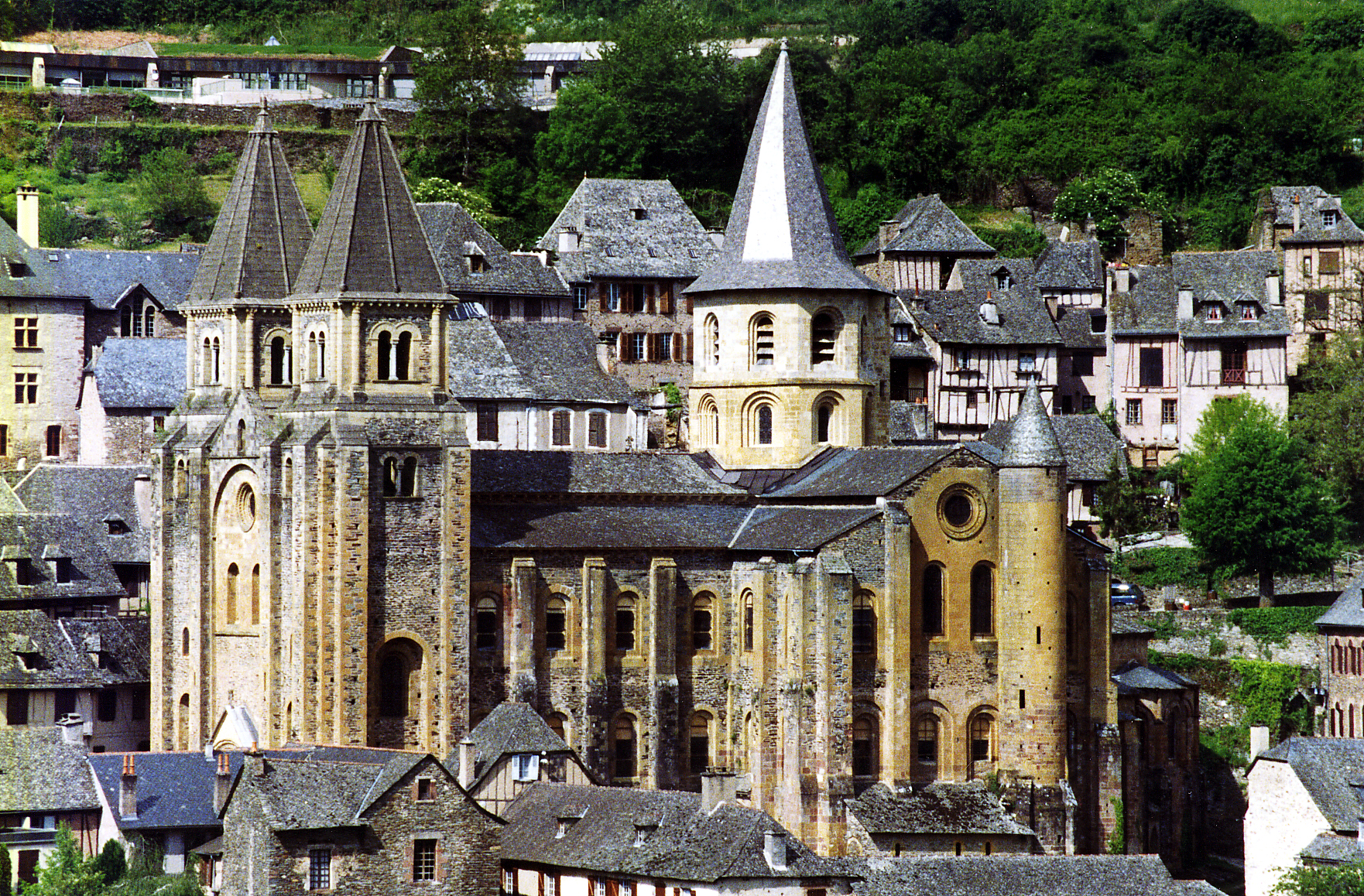
Abbey Church of Sainte-Foy
It took nearly a decade of deception to steal the bones of a twelve-year-old martyr. A monk from the abbey of Conques infiltrated a rival monastery in Agen, posing as a loyal brother for years, waiting for the moment he could slip away with the relics of Sainte Foy. When he finally succeeded in 866, he triggered one of the great pilgrimage redirections of the Middle Ages. The road to Santiago de Compostela, which had bypassed this remote valley in the Aveyron, suddenly bent toward Conques. The abbey church built to receive the stolen saint still stands, its Romanesque stone nestled into a steep hillside, as much a monument to medieval audacity as to medieval faith.
The Holy Robbery
Conques had tried legitimate means first. The abbey attempted to acquire the relics of Saint Vincent of Saragossa, then those of Saint Vincent Pompejac in Agen -- both efforts failed. So the monks resorted to what the medieval world called a furtum sacrum, a holy robbery justified by the belief that saints desired to be where they would be most venerated. The Conques community opened a priory next to the shrine in Agen and planted their agent. His patience paid off: the relics arrived in Conques, and pilgrims followed. The golden reliquary statue of Sainte Foy -- depicting the girl who, during the Roman persecution of Christians in the fourth century, chose torture and death by burning on a brazier rather than renounce her faith -- became the church's most treasured object. Catching a glimpse of it was the primary goal of every pilgrim who climbed the valley.
Stone and Shackles
The church that rose to house the relics is a masterwork of Romanesque architecture, 56 meters long inside with a crossing tower reaching 26.4 meters. Galleries run above the side aisles, and the raised roof over transept and choir allowed pilgrims to circulate at the upper level even during services. The ambulatory offered views into the sanctuary through a metal grill with an unusual origin: it was forged from the shackles donated by former prisoners who credited Sainte Foy with their freedom. At the west end, the great tympanum carves the Last Judgment in stone, with the saved ascending on one side and the damned dragged to hell on the other. Among the treasury's curiosities is an arm reliquary of Saint George, claimed -- with characteristic medieval confidence -- to be the very arm with which he slew the dragon.
Decline, Revolution, and Rescue
By the thirteenth century, Sainte Foy's star was fading, eclipsed by newer saints and undermined by Conques' isolation. The Benedictine order lost control of the abbey in 1537. During the Wars of Religion in 1568, Protestants seized Conques and burned much of the complex, destroying the original towers. The French Revolution delivered the final blow: the monks were expelled, and impoverished villagers quarried the buildings for stone. The relics and treasures, however, were secretly removed by locals and hidden nearby, while the sanctuary was converted into a Temple of Reason. When the writer and antiquary Prosper Merimee visited in 1833 as France's Inspector of Historical Monuments, he found the abbey beyond repair -- yet his report inspired the thorough restoration that followed.
A Living Pilgrimage
In 1873, the Premonstratensian order took over as caretakers, and the church returned to its devotional purpose. UNESCO inscribed it in 1998 as part of the World Heritage Sites of the Routes of Santiago de Compostela in France, placing it alongside churches across the country that sustained pilgrims walking toward Spain. Today, Conques remains a functioning parish and pilgrimage church. Monks still sing in the choir. The golden reliquary of Sainte Foy, its head containing an authenticated piece of skull, is still brought out in procession on the saint's feast day in October, decorated with roses. Self-guided tours of the upper level sometimes take place at night, with live music and adjusted lighting that transforms the Romanesque interior into something close to what those first pilgrims would have experienced by candlelight.
From the Air
Located at 44.599N, 2.398E in the steep Dourdou valley near Conques, Aveyron. The abbey church is prominent against the hillside village. Rodez-Marcillac Airport (LFCR) lies 35 km northeast. Best viewed from 2,000-4,000 ft AGL, approaching from the west to see the church's position in the narrow valley.