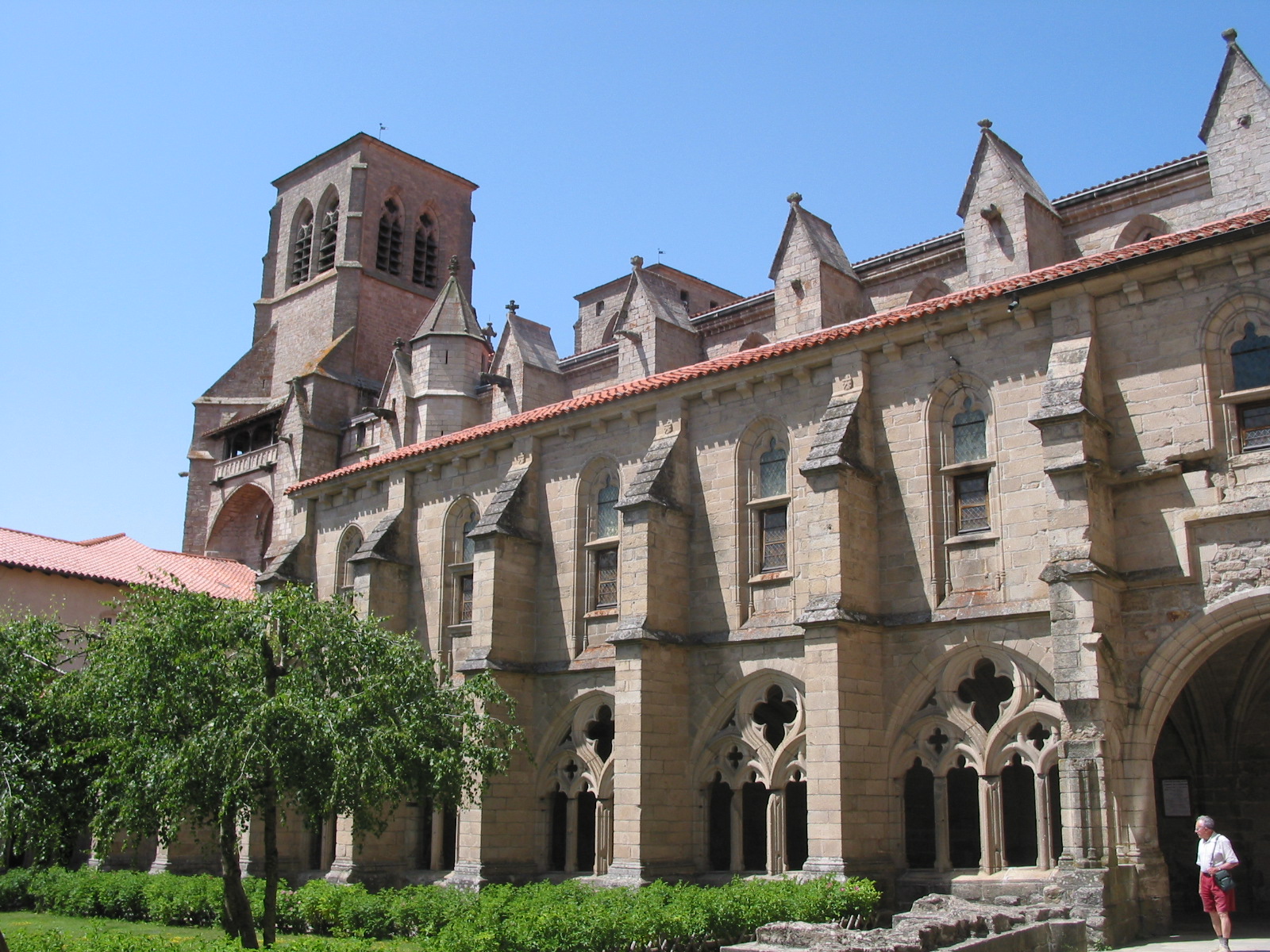
Abbey of La Chaise-Dieu
The name says it plainly: Casa Dei, the House of God. In 1043, a hermit named Robert de Turlande climbed to this remote plateau in the Auvergne highlands and, with a companion named Étienne de Chaliers and a handful of disciples, established a monastery that would grow into one of the most influential Benedictine foundations in France. The Latin name softened over centuries into La Chaise-Dieu, but the ambition embedded in those original words never diminished.
From Hermitage to Holy See
Robert de Turlande secured powerful protections early. By 1052, he held both a papal endorsement from the Holy See and a royal diploma from Henry I of France confirming his foundation's status as a full abbey. The monastery prospered, and in 1095 Pope Urban II himself visited to dedicate the abbey church in honor of Saint Vital of Bologna and Saint Agricola. But the event that transformed the abbey from regional importance to international significance came in May 1342, when Pierre Rogier, a former monk of La Chaise-Dieu, ascended to the papacy in Avignon as Clement VI.
A Pope's Final Resting Place
Clement VI never forgot his monastic home. He financed the demolition of the old Romanesque church and commissioned a grand new abbey church in the Gothic style, specifically designed to house his tomb. The architects Hugues Morel and Pierre Falciat began construction in 1344, working in the Rayonnant Gothic idiom but with a striking austerity that set the building apart from the ornate cathedrals of northern France. The abbey church was completed in 1378, during the pontificate of Gregory XI, who was Clement's own nephew. Today the pope's tomb and carved effigy still occupy the choir, surrounded by twelve Flemish tapestries from the early 16th century that depict biblical scenes in rich color.
The Dance of Death
The abbey's most haunting possession is its Danse Macabre, a painted frieze in which skeletal figures lead the living toward death. Nobles, clergy, merchants, peasants — all are shown in the grip of the same inevitable partner. This genre flourished across medieval Europe as a reminder of mortality's democracy, but the version at La Chaise-Dieu is among the most accomplished surviving examples. Its presence within the same church that a pope built to ensure his eternal rest adds a layer of irony that the medieval mind would have appreciated. In the Hall of Echoes, another curiosity: two people standing in opposite corners can whisper to each other across the room, their voices carried by the curved stone walls.
Stone and Sound
The west facade approaches through a flight of steps flanked by two massive towers, giving the church a fortress-like solemnity. Inside, the nave and aisles rise to equal height, separated from the choir by a stone rood screen. The apse terminates in radiating chapels, and a ruined cloister stands along the south side, a reminder of the monastic community that once filled these spaces with prayer and labor. Since 1966, the abbey has hosted a music festival founded by the Hungarian pianist György Cziffra, who recognized that the building's acoustics matched the grandeur of its architecture. The festival transforms this remote highland abbey into a summer concert hall, proving that Casa Dei can still fill with sound worthy of its name.
From the Air
Located at 45.32°N, 3.70°E on the Auvergne plateau in the Haute-Loire department. The abbey sits at approximately 1,080m elevation in the commune of La Chaise-Dieu. Nearest airport is Clermont-Ferrand Auvergne (LFLC), about 75 km to the northwest. Le Puy-en-Velay Loudes Airport (LFHP) is closer but offers limited service. The abbey complex is visible from low altitude as a prominent stone structure in the small highland town. Recommend viewing at 3,000-5,000 ft AGL.