Abbey of Saint-Martin-du-Canigou
Count Guifred II of Cerdanya killed his own son. The historical record does not explain the circumstances — whether it was a political act, a battlefield error, or something darker — but it does record what he did about it. Between 1005 and 1009, on the steep flank of Mount Canigó in the eastern Pyrenees, he built a monastery. The Abbey of Saint-Martin-du-Canigou was his atonement, and it has clung to this mountainside for more than a thousand years through earthquakes, revolution, looting, and abandonment — outlasting by centuries the guilt that brought it into existence.
A Monk's Penance in Stone
The abbey sits on the territory of the commune of Casteil, in the Pyrénées-Orientales département of southern France, near the Spanish border in a region known as Northern Catalonia. Guifred II populated his new monastery with Benedictine monks, and the building rose in the First Romanesque style — austere, thick-walled, rooted to the rock. Fifteen years after its consecration, Guifred himself took monastic vows and entered the community he had founded. He died there in 1050, having traded a count's authority for a monk's obedience. The following year, a messenger carried a parchment — a mortuary roll — across Europe, visiting religious houses to solicit prayers for the dead count. At each stop, the monks added words of prayer and respect. That parchment survives, and scholars have used it to study the cultural differences between northern and southern Europe in a single year: the south more bound by tradition, the north more experimental in language and form.
Two Churches, One Mountain
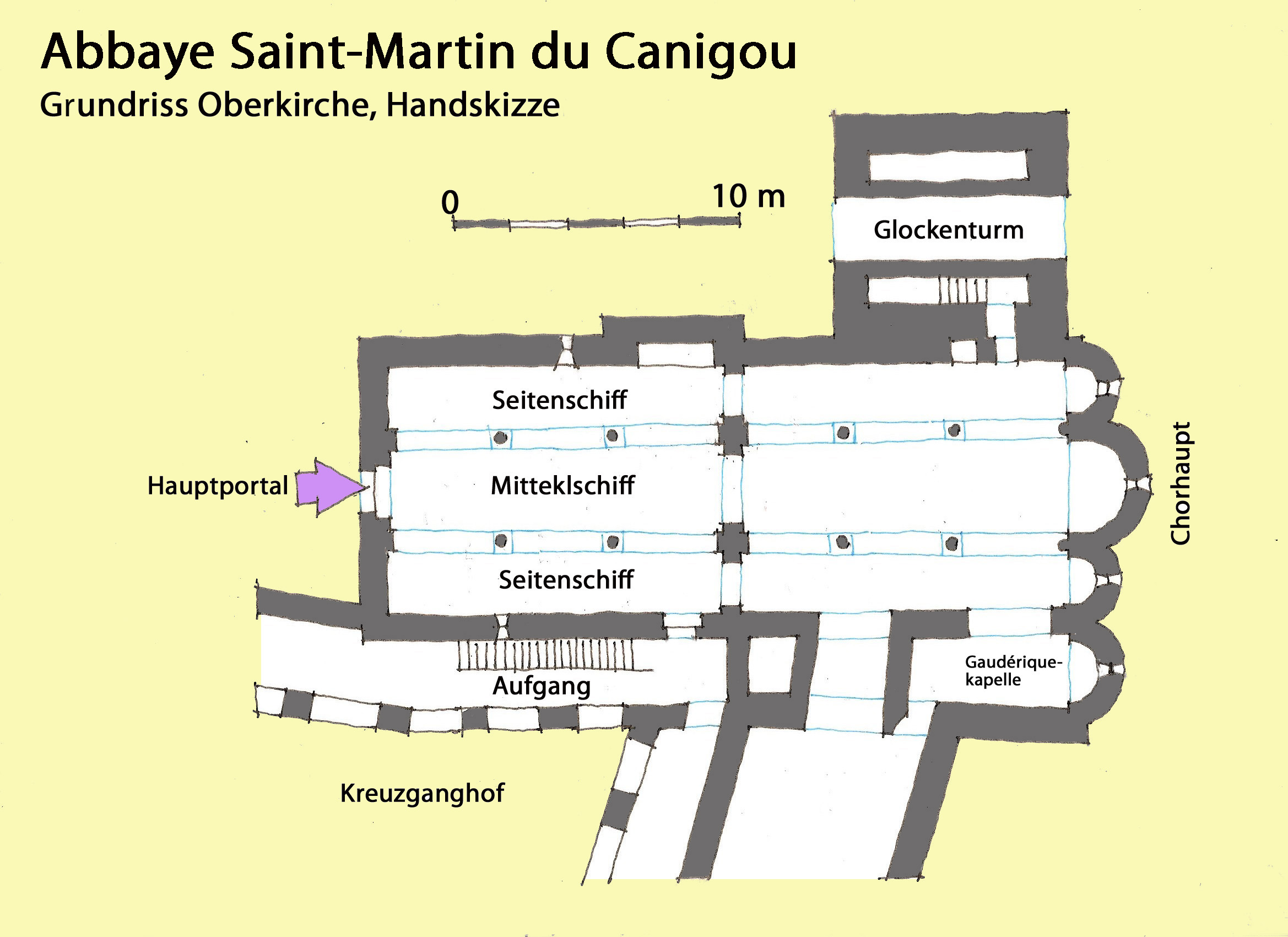
The abbey consists of two churches stacked one above the other, both in the First Romanesque style. The lower church, dedicated to the Virgin Mary, is predominantly dark, its barrel-vaulted ceilings rarely exceeding three meters in height. The eastern apses likely date to the original 1009 consecration, while the western portions were expanded between 1010 and 1020 after the community acquired the relics of Saint Ganders. The upper church, dedicated to Saint Martin, was built simultaneously with the lower church's expansion, requiring the original columns below to be reinforced and enclosed in square piles. Both churches are divided into three naves separated by monolithic columns — single blocks of stone that have carried the weight of the mountain for a millennium. The gatehouse, shortened after the Catalan earthquake of 1428, was never fully restored. Walking through these spaces, you move between darkness and the thin Pyrenean light that slices through narrow windows, each transition a reminder of how deliberately the builders controlled what you could and could not see.
Ruin and Resurrection
The earthquake of 1428 damaged the monastery, but it was the French Revolution that nearly destroyed it. Louis XVI secularized the abbey in 1782, and by 1785 the monks had abandoned it entirely. During the Reign of Terror in 1793-1794, the abbey was closed and its contents scattered. What followed was worse than neglect: the buildings became a stone quarry for nearby villages. Locals carted away the cloister's carved capitals, sculptures, and furniture. The upper cloister had once featured marble capitals of considerable artistry; they disappeared into private collections or were simply lost. For over a century, the abbey decayed. Then in 1902, the Bishop of Elne and Perpignan — motivated in part by his Catalan heritage — began a radical restoration that continued until 1932. The work was thorough enough to save the structure, though the original character of the cloister, which once had two levels built across two centuries, is now difficult to imagine beneath the heavy restorations.
The Mountain Still Prays
Today the abbey is occupied by the Catholic Community of the Beatitudes, and monastic life has returned to Canigó after an absence of more than two centuries. The cloister retains three restored galleries, and a few recovered marble capitals from the dispersed upper level have been incorporated into the new southern gallery. The rest of the convent buildings date from the early 20th-century restoration. The cellist Pau Casals composed a piece titled "Sant Martí del Canigó" for orchestra — a tribute from one Catalan to the Catalan heritage embedded in these walls. Mount Canigó itself, sacred to the Catalans, rises above the abbey to 2,784 meters, and on the feast of Saint John each June, bonfires are lit on its summit in a tradition that predates Christianity. The abbey exists in a landscape where faith, guilt, memory, and stone have been inseparable for a thousand years. Guifred's penance endures, long after anyone remembers the name of the son he killed.
From the Air
Located at 42.53°N, 2.40°E on the slopes of Mount Canigó in the eastern Pyrenees. The monastery is nestled into steep mountain terrain and can be difficult to spot without low-altitude passes. Best viewed at 3,000-5,000 ft AGL in clear weather. Nearest airports: LFMP (Perpignan-Rivesaltes), LFMT (Montpellier-Méditerranée). Mountain terrain creates significant turbulence; approach with caution.