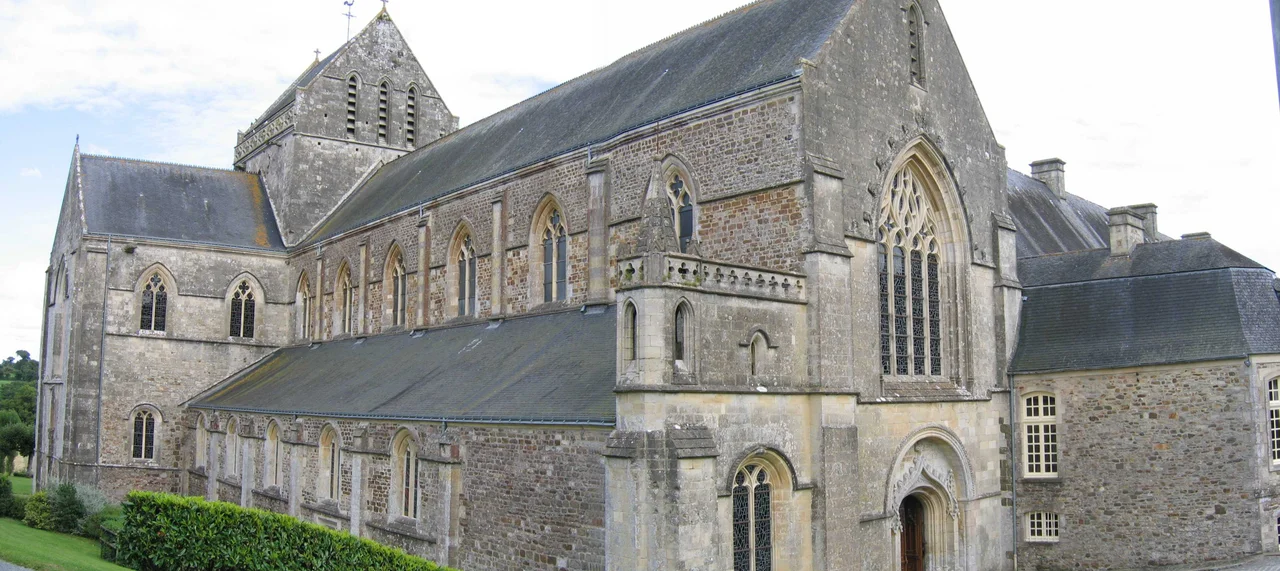

Abbey of Saint-Sauveur-le-Vicomte
On 23 May 1793, in the second year of the French Republic, the abbey church of Saint-Sauveur-le-Vicomte was sold for 8,525 livres - not as a place of worship but as raw material. The bailiff Hector Louis Amédée Ango, grandfather of the writer Barbey d'Aurevilly, had tried to save it by moving the parish service into the abbey, but the local constitutional priest Father Nigault de Lecange fought him on it. The deal went through. For the next decades the church was a quarry: villagers carted away stones for their houses, and the great Norman fabric founded by Néel de Néhou in 1067 came down piece by piece. By 1825 the demolition was already 'advanced.' In 1842 the bell tower the workers had reconstructed collapsed in a violent storm, taking the transept and the first bays of the choir with it. And then a nun in her eighties decided to rebuild it.
An 11th-Century Foundation
Néel de Néhou - Vicomte of Saint-Sauveur, one of the great Norman barons of his day - founded the abbey in 1067, the year after the Conquest of England. The monks of Jumièges Abbey on the lower Seine were brought in to build it. The Vicomte wanted a proper Benedictine community to replace the secular clergy who had been officiating in his castle chapel. Construction took most of a century. The abbey was consecrated in the early years of the second half of the twelfth century by Bishop Algare, and around 1180 the first windmill was installed on the site - early enough that windmills in this part of Normandy were still a novelty. The location mattered: Saint-Sauveur-le-Vicomte sits in the heart of the Cotentin peninsula, on the same low ground that would later become a battlefield in 1944, and the abbey had longstanding ties to the Channel Islands across the water. The list of medieval abbots that survives - from Benign of Jumièges, the first, to Aimar-Claude Nicolaï, the 47th and last - covers seven centuries of one community trying to keep itself going through Norman, English, and French politics.
The Decree That Ended It
A decree of 13 February 1790 prohibiting monastic vows in France ended the community at Saint-Sauveur. The abbey buildings were declared national property and put up for sale on 4 June 1791. Two years later the church itself was sold for use as a quarry. The Benedictine community that had occupied the site for seven hundred years simply ceased to exist. The records went elsewhere or vanished. Some of the manuscripts had already left the abbey long before - Charles II of Montchal, the 40th abbot in the early 1600s, had quietly removed many of them to enrich his own library. By the early 19th century the abbey was open sky and rubble walls. Most visitors assumed that was the end of the story.
Mother Marie-Madeleine Postel
Marie-Madeleine Postel was a Norman nun who had been quietly running a religious teaching congregation - the Sisters of the Christian Schools of Mercy - and looking for a permanent mother house. In 1832 she acquired what was left of the abbey of Saint-Sauveur-le-Vicomte. She was 76 years old. When the 1842 storm brought down the reconstructed bell tower and devastated the partial restoration, she did not give up. She entrusted the rebuilding to François Halley, a local architect and sculptor, and sent her niece, Sister Placide Viel, to Paris to ask Queen Marie-Amélie - the wife of King Louis-Philippe I - for funds. The queen helped. Sister Placide was later beatified for her role; the work continued through Marie-Madeleine's own death in 1846. The reconstruction was finished in 1855, nine years after she died. Her relics now rest in the north transept of the rebuilt church, in a tomb carved by Halley. Two of her sisters - Blessed Placide Viel and Blessed Marthe Le Bouteiller - rest in the same chapel.
The Congregation That Still Lives Here
The community Marie-Madeleine founded is still based at Saint-Sauveur-le-Vicomte, now under the name Congregation of Saint Marie-Madeleine Postel. The abbey has been continuously inhabited since the reconstruction - longer, now, than the gap between dissolution and refounding. The buildings the sisters use are partly medieval and partly mid-19th century, and the rhythm of the place owes more to a 76-year-old nun's refusal to accept ruin than to its original Norman founder. Stand in the rebuilt nave and the seam shows: ancient walls below, 1855 stonework above, the architectural equivalent of grafted bone. Outside, the Cotentin landscape rolls north toward the Channel and east toward Saint-Lô. In 1944 the war would come through here too, and a third generation of damage would have to be repaired. But that is another story. This one is about a place that was twice nearly erased and twice put back together by people who did not consider erasure the final word.
From the Air
The Abbey of Saint-Sauveur-le-Vicomte sits in the western Cotentin peninsula of Normandy at 49.382°N, 1.526°W, in the commune of Saint-Sauveur-le-Vicomte. From the air it appears as a stone complex with a long nave and visible cloister buildings just south-east of the small town, set in rolling agricultural land. Nearby airports: Cherbourg-Maupertus (LFRC) 19 nm north, Lessay (LFOM) 16 nm south, Granville (LFRF) 32 nm south. Best viewing altitude 1,000-2,500 ft. The medieval castle of Saint-Sauveur, on a separate site in the town, is also clearly visible. The whole area was fought over heavily during the Normandy campaign of 1944 - the Battle of La Haye-du-Puits, fought just to the south, ended on 14 July of that year.
Nearby Stories
- Action at Cherbourg (1692) 7.2 km away
- Grosnez Castle 11 km away
- Alderney Society Museum 17 km away
- Mont Saint-Michel: The Abbey That Becomes an Island Twice a Day 46 km away
- D-Day: The Longest Day 57 km away
- Fishbourne Roman Palace 142 km away
- Battle of Verneuil 149 km away
- 1941 Santander Fire 634 km away