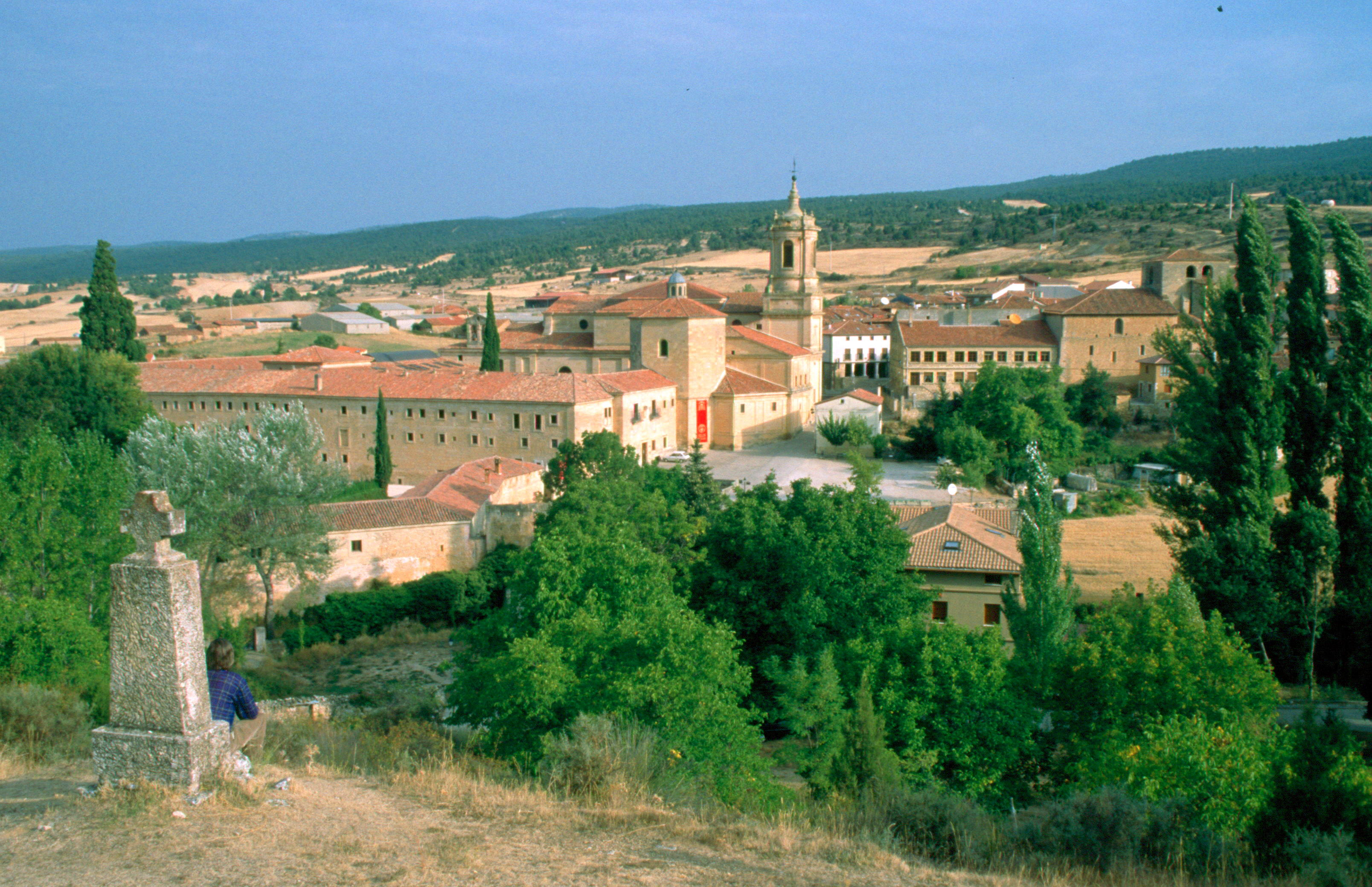
Abbey of Santo Domingo de Silos
In 1994, a choir of Benedictine monks from a village in the hills south of Burgos released an album called Chant. It peaked at number three on the Billboard 200, was certified triple platinum, and became the best-selling Gregorian chant recording ever made. A reviewer in Gramophone captured the paradox: "The ensemble is not always perfect, but if these are not professional singers, they are, and they sound like, truly professional monks." The Abbey of Santo Domingo de Silos had been producing remarkable things for thirteen centuries -- illuminated manuscripts, Romanesque sculpture, liturgical scholarship -- but it took a pop-chart anomaly to make the wider world pay attention.
An Abbot Driven Into Exile
The monastery traces its origins to the Visigothic period of the seventh century, when it was known as San Sebastian de Silos. It acquired its current name in the eleventh century, when a monk named Dominic was sent to renovate it by Fernando the Great, King of Castile and Leon. Dominic had been prior at the Monasteries of San Millan de la Cogolla, one of Spain's most important religious houses, before King Garcia Sanchez III of Navarre drove him out for opposing the crown's attempt to annex the monastery's lands. Exile turned into purpose. Dominic redesigned the church with a central nave, two side aisles, and five chapels, and began work on the cloister that would become the abbey's masterpiece. When he died in 1073, pilgrims were already arriving at his shrine in such numbers that construction had to pause to accommodate them.
Stone Stories in the Cloister
The two-story Romanesque cloister is considered one of the finest achievements of medieval European sculpture. The lower story, begun in the last quarter of the eleventh century and completed in the second half of the twelfth, features paired columns sharing uniquely decorated capitals -- dragons, centaurs, lattices, mermaids -- and six-foot-tall corner piers carved with Post-Passion biblical scenes in medium relief. The Doubting Thomas, the Road to Emmaus, the Ascension, the Descent from the Cross -- all were originally painted in bright colors. Art historian Meyer Schapiro devoted extensive study to these carvings, and the craftsman who carved the pier panels is believed to be the same sculptor who worked at the Abbey of St. Pierre de Moissac in France. Construction of the cloister was interrupted between 1109 and 1120 by political upheaval, and when work resumed, a different workshop completed the south and west galleries in a noticeably different style -- making the cloister a record of both artistic achievement and historical disruption.
Manuscripts, Medicine, and Music
The abbey's library, together with Toledo Cathedral's, was the principal repository of Mozarabic liturgical manuscripts until many were auctioned off in 1878. It still holds the Missal of Silos, the oldest known Western manuscript written on paper. The scriptorium produced an illuminated Beatus manuscript -- a commentary on the Apocalypse -- whose text was completed by two related monks in 1091, with illustrations finished by the prior in 1109. This manuscript, including an important map of the Mediterranean, is now in the British Library. A historic pharmacy with its own specialist library also survives within the monastery walls. The monks originally sang Mozarabic chant before switching to Gregorian chant around the eleventh century. When Benedictine monks from Solesmes in France revived the abbey in 1880 -- it had been shuttered in 1835 along with other Spanish monasteries -- they brought with them the Solesmes tradition of Gregorian performance that would eventually produce those chart-topping recordings.
Thirteen Centuries and Counting
Today, visitors can walk the cloisters and visit the historic pharmacy. They can attend vespers in the abbey church and hear the same chant tradition that sold millions of albums. Access to the library is restricted to researchers, protecting manuscripts that have survived wars, suppression, and auction. The village of Santo Domingo de Silos wraps around the monastery in the quiet hills of southern Burgos province, a place where the loudest sounds are still bells and birdsong and voices lifted in plainchant. What makes the abbey remarkable is not any single element but the accumulation -- Visigothic foundations, Romanesque sculpture that rivals anything in France, a manuscript tradition stretching across centuries, a pharmaceutical heritage, and monks who can sell more records than most pop artists while singing prayers they would sing whether anyone was recording or not.
From the Air
Located at 41.96N, 3.42W in the hills south of Burgos in the province of Burgos, Castile and Leon. The village of Santo Domingo de Silos is small, nestled in a narrow valley. Nearest significant airport is Burgos (LEBG), approximately 60 km north. The terrain is hilly, with elevations around 1,000 m. The monastery and its cloister are not easily distinguishable from altitude, but the village pattern in the valley is identifiable. Best viewed at 2,000-4,000 ft AGL.