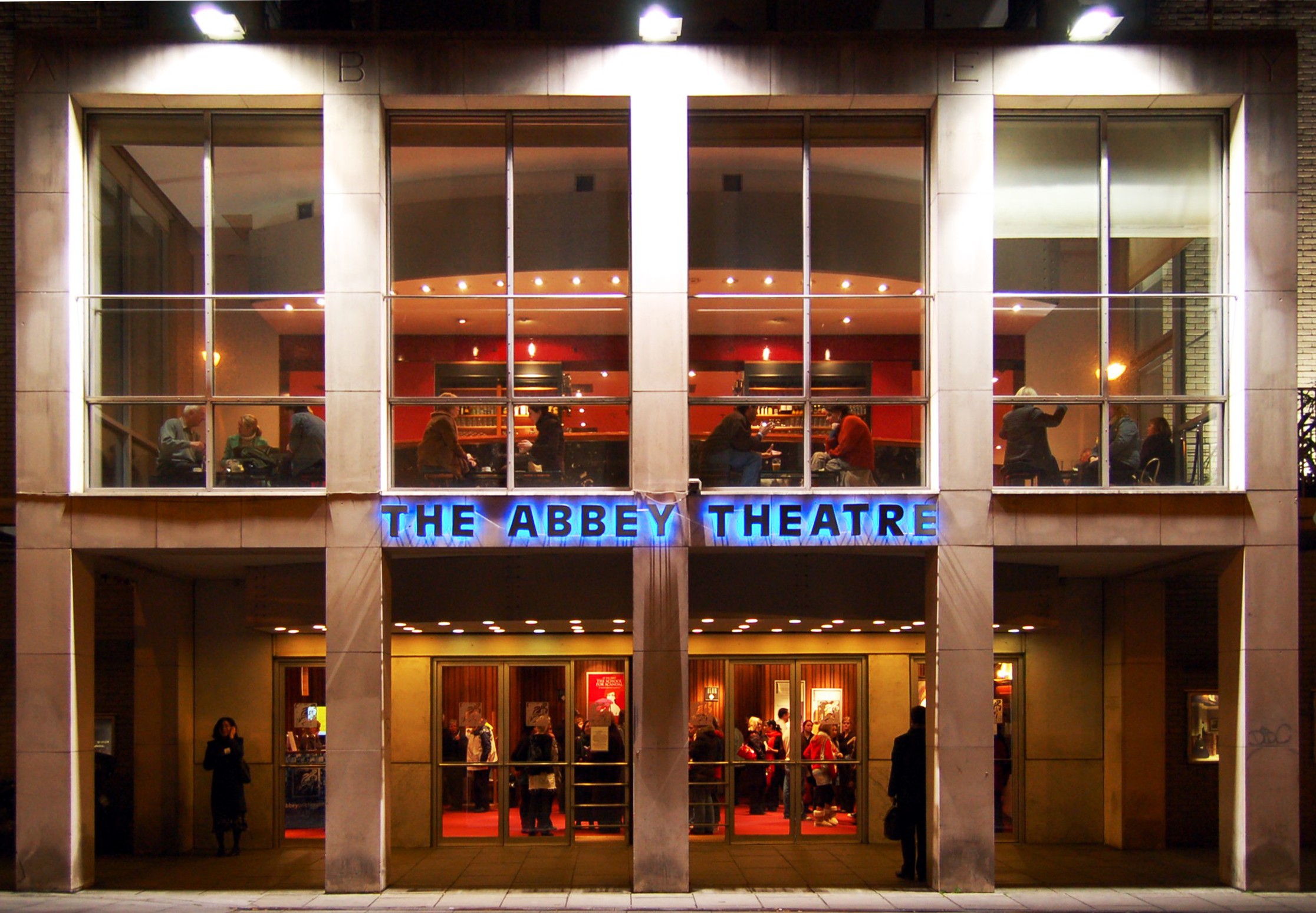
Abbey Theatre
On the opening night of The Playboy of the Western World in January 1907, the audience rioted. They objected to John Millington Synge's depiction of rural Irish life, and particularly to the word "shift" -- a woman's undergarment -- spoken onstage. W.B. Yeats, who co-founded the theatre, stood before the crowd and declared: "You have disgraced yourselves again." The Abbey Theatre was three years old. It had already found its purpose: to stage Irish stories so honestly that they made people uncomfortable.
Yeats, Gregory, and a Mechanic's Institute
The Abbey Theatre grew from the Irish Literary Theatre, founded in 1899 by Yeats, Lady Augusta Gregory, and Edward Martyn to produce plays in Irish and about Ireland. By 1904, with financial backing from English heiress Annie Horniman, they acquired the Mechanics' Institute building and the adjacent city morgue on Abbey Street, converting both into a small but functional theatre. It opened on 27 December 1904 with Yeats's On Baile's Strand and Lady Gregory's Spreading the News. From the beginning, the Abbey's ambition exceeded its modest surroundings. Horniman funded the venture until 1910, when she withdrew support partly over political disagreements about Irish nationalism.
The Stage That Made Enemies
Controversy was the Abbey's constant companion. After the Playboy riots of 1907, Sean O'Casey's The Plough and the Stars provoked another uproar in 1926 when audiences objected to its depiction of the 1916 Easter Rising, including a scene where a prostitute appeared alongside the Irish tricolour. Yeats again confronted the crowd, asking whether they were going to "rock the cradle of genius." But the Abbey also rejected work that would have enhanced its legacy. Yeats turned down O'Casey's The Silver Tassie in 1928, a decision that permanently damaged the relationship between the theatre and one of its greatest playwrights. O'Casey never again permitted his plays to be staged at the Abbey during his lifetime.
A State-Subsidized Revolution
In 1925, the Abbey became the first state-subsidized theatre in the English-speaking world when it received an annual grant from the Irish Free State. The subsidy came with complications. Ernest Blythe, who served as managing director from 1941 to 1967, imposed a policy requiring all actors to be competent in Irish, which some critics argued limited the pool of available talent. Yet the theatre continued to produce landmark work. Brendan Behan's The Quare Fellow premiered here in 1954. Tom Murphy, Brian Friel, and Marina Carr all had plays staged on its boards. The peacock stage, a smaller experimental space, opened in 1927 and provided a venue for riskier, less commercial productions.
Fire, Exile, and Return
On 17 July 1951, fire destroyed the original Abbey building. The company spent fifteen years in exile at the Queen's Theatre on Pearse Street before a new purpose-built theatre opened on Lower Abbey Street in July 1966. The new building, designed by Michael Scott and Partners, was larger and more technically capable, but it lacked the intimate charm of the original. In 2017, the Irish government announced a major redevelopment project for the site, intended to modernize the theatre while preserving its cultural significance. The Abbey remains Ireland's national theatre, producing new Irish plays alongside revivals and international work.
The American Tours and a Global Reputation
From its earliest years, the Abbey toured extensively, and its American visits did as much to shape perceptions of Irish culture as anything happening on Abbey Street itself. The first American tour in 1911 took the Playboy controversy across the Atlantic, where Irish-American audiences proved equally capable of outrage. Later tours established the Abbey as a cultural institution of international significance, introducing American audiences to Irish dramatic voices they would not otherwise have encountered. The theatre's alumni list reads like a roll call of Irish acting talent: Sara Allgood, Barry Fitzgerald, Cyril Cusack, Siobhan McKenna. Fitzgerald won an Academy Award in 1945 for Going My Way, a career that began on the Abbey's cramped original stage.
From the Air
Located at 53.35N, 6.26W on Lower Abbey Street in central Dublin, north of the River Liffey. The theatre is part of the dense urban fabric of Dublin's north inner city and not individually distinguishable from the air, but the O'Connell Street area and Ha'penny Bridge are nearby landmarks. Nearest airports: Dublin (EIDW) 10km north, Weston (EIWT) 15km west. Best viewed in context of a Dublin city overflight at 2,000-3,000 feet.