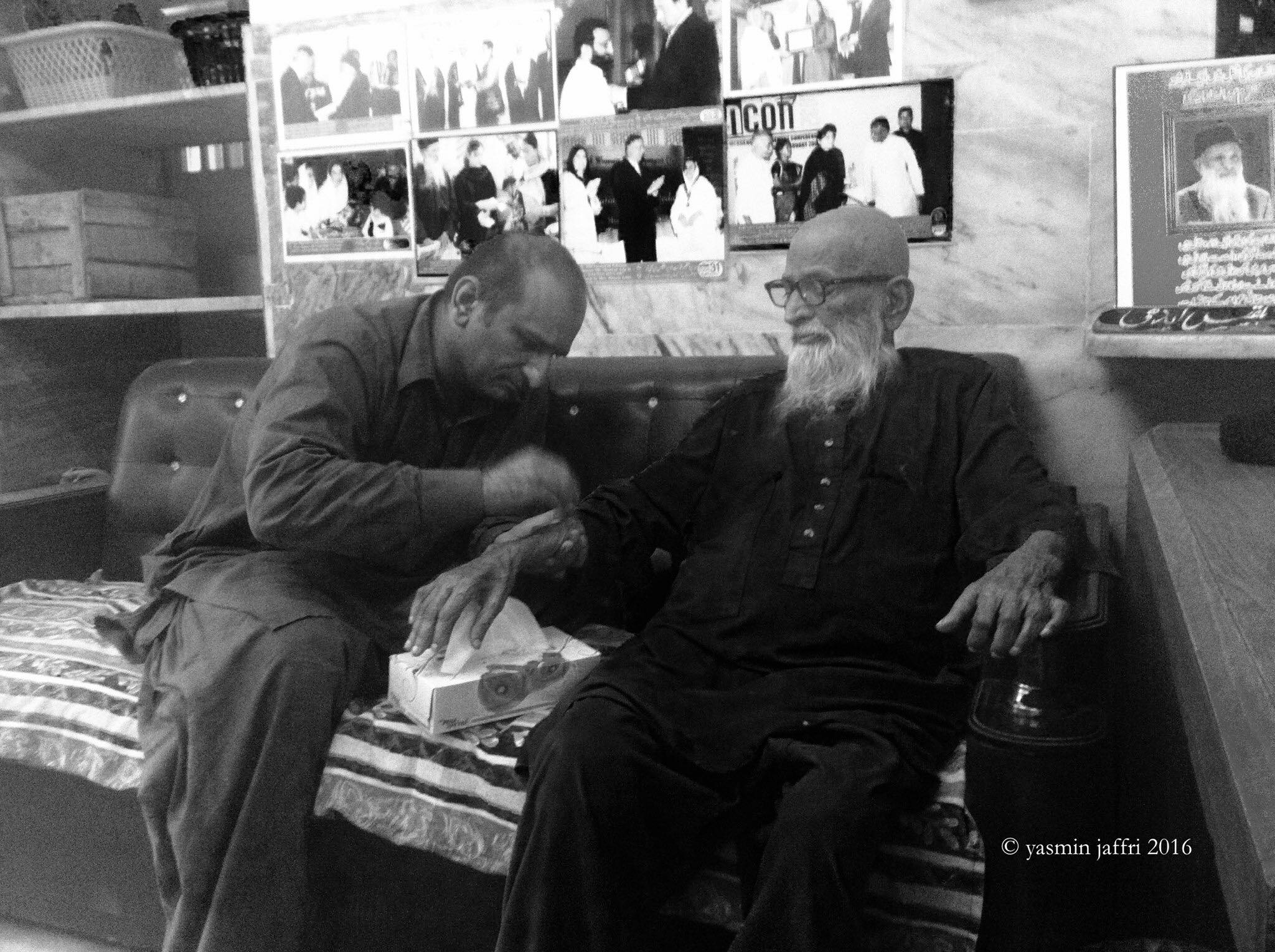
Abdul Sattar Edhi
When Abdul Sattar Edhi died on July 8, 2016, he received a state funeral with a 19-gun salute at the National Stadium in Karachi. He was the third person in Pakistan's history to be honored with a gun-carriage procession, after Muhammad Ali Jinnah and Zia-ul-Haq, and the only one who had never held a government position. His last wish was that his organs be donated. His body was too frail for most harvesting, but his corneas were given to two blind people.
From Bantva to Karachi
Edhi was born on February 28, 1928, into a Memon Muslim family in Bantva, a small town in Gujarat, India. His mother, who shaped his worldview, taught him to divide his daily pocket money: half for himself, half for someone in need. The family migrated to Pakistan after Partition, settling in Karachi. The young Edhi found work in the wholesale cloth market, but the poverty he witnessed in the new nation's largest city consumed him. He started a small free dispensary. Then, in 1957, an Asian flu pandemic swept through Pakistan. Donations poured in. Edhi bought his first ambulance. A one-man charity was becoming an institution.
1,800 Ambulances and Counting
The Edhi Foundation grew into something without parallel. Funded entirely by private donations from Pakistani citizens of every class, it operates the world's largest volunteer ambulance network -- over 1,800 vehicles at the time of Edhi's death. The foundation runs more than 330 welfare centers across rural and urban Pakistan, functioning as food kitchens, orphanages, women's shelters, clinics for the mentally and physically challenged, and rehabilitation centers for drug addicts. Since its founding, the organization has rescued over 20,000 abandoned infants, rehabilitated over 50,000 orphans, and trained over 40,000 nurses. Edhi himself was registered as parent or guardian of nearly 20,000 adopted children. The Huffington Post called him, in 2013, 'the world's greatest living humanitarian.'
The Ascetic Who Embarrassed Presidents
Edhi lived with radical simplicity. He wore the same black sherwani for years, slept in a room attached to his office, and was openly critical of corruption among religious leaders and politicians. He described himself as 'neither for religion nor against it,' telling others that 'empty words and long phrases do not impress God -- show Him your faith.' His lack of political alignment made him equally uncomfortable for every faction. When Hurricane Katrina struck the United States in 2005, the Edhi Foundation -- a charity from one of the world's poorest nations -- donated US$100,000 to American relief efforts. Edhi extended the same principle to the 1985 Ethiopian famine. In 2004, Pakistani militants robbed his foundation of approximately US$500,000, and right-wing extremist groups repeatedly targeted his operations.
The Beard and the Borders
Edhi's traditional Pakistani clothing and long beard repeatedly made him a target of security profiling abroad. Israeli troops detained him entering Lebanon in the early 1980s. Canadian authorities held him for sixteen hours in Toronto in 2006. US immigration officials at JFK Airport in New York questioned him for eight hours in January 2008, seizing his passport and documents. When asked why he was repeatedly detained, Edhi answered simply: 'The only explanation I can think of is my beard and my dress.' Malala Yousafzai nominated him for the Nobel Peace Prize, saying 'even the coveted Nobel Prize cannot be a befitting tribute to Edhi's services for humanity.' He never won. Google honored him with a Doodle on his birthday in 2017. A commemorative coin, a renamed avenue in Clifton Beach, and a postage stamp followed. But the truest monuments to Edhi are the ambulances, still answering calls across Pakistan.
From the Air
Edhi's headquarters and primary operations center are located at approximately 25.05N, 67.49E in Karachi, Sindh province. The Edhi Village where he is buried lies on the outskirts of Karachi. From altitude, Karachi sprawls along the Arabian Sea coast with Jinnah International Airport (ICAO: OPKC) visible to the west. The Edhi Foundation's white ambulances are a ubiquitous sight on Karachi's streets.