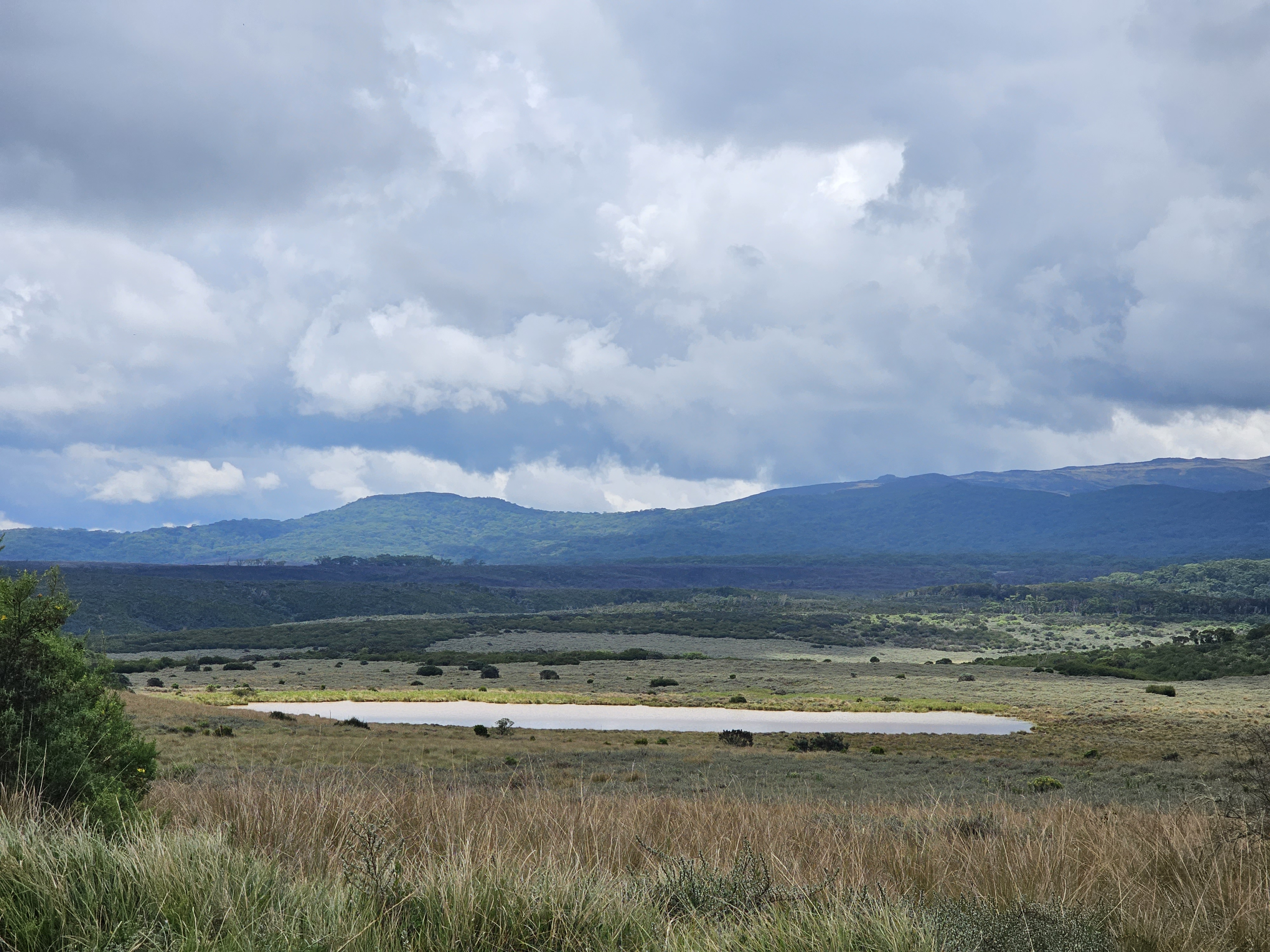
Aberdare National Park
The buzzer sounds at 3 AM. In the darkness of The Ark, guests stumble from beds to viewing platforms, where floodlights illuminate an elephant drinking at the salt lick below. This is the peculiar magic of Aberdare National Park - wildlife watching from colonial-era lodges perched above clearings where animals congregate, each creature's arrival announced by an alert system that treats leopards and lions with equal urgency. The park sprawls across 767 square kilometers of Kenya's central highlands, a landscape of bamboo forests and alpine moorland west of Mount Kenya. Here the rare eastern bongo antelope survives in numbers so small that park authorities removed the lions to protect them. The waterfalls plunge through forest so dense that 4WD is mandatory. The weather is cool, the mist is constant, and the animals come on their own schedule.
The Tree Hotels
Treetops made the Aberdare famous before the park itself existed. On February 6, 1952, Princess Elizabeth climbed into this elevated viewing platform as heir to the throne; her father died that night in London, and she descended the next morning as Queen Elizabeth II. The lodge has been rebuilt since, but the concept endures: guests sleep above a watering hole, watching wildlife appear through the night.
The Ark operates on the same principle with more comfort. Three viewing decks overlook a salt lick where buffalo, elephants, and forest hogs congregate after dark. Each room has a buzzer connected to the night watchman, who triggers alerts when interesting animals appear. Sleep is intermittent by design. The rooms themselves are basic - Treetops has communal toilets except in suites - because no one comes here for the plumbing. They come to see what visits in the darkness.
The Rare Bongo
The eastern bongo is a ghost. This large forest antelope, with its chestnut coat and white stripes, survives in the wild in perhaps four locations on Earth, all in Kenya's central highlands. Aberdare holds the most significant population - though 'significant' means perhaps 100 animals hiding in bamboo so dense that even researchers rarely see them. Camera traps provide most evidence of their continued existence.
The bongo's rarity forced a brutal management decision. When lions were reintroduced to the park in the 1990s, bongo numbers crashed - the antelope had evolved without lion predation and had no defensive behaviors to cope. Park authorities removed the lions entirely. Today Aberdare has four of the Big Five - elephant, buffalo, black rhino, and leopard - but the lion that appears on park literature is a historical artifact. Some conservation choices have no good answers.
Forest and Moorland
The Aberdare range rises from 2,000 to 4,000 meters, a gradient that produces distinct ecological zones. The lower slopes support dense montane forest - ancient hardwoods draped with moss, understory thick enough to hide everything. Higher up, the forest gives way to bamboo zones where elephant paths tunnel through stems thick as drainpipes. Above that, alpine moorland spreads toward peaks that collect the mist that feeds the waterfalls below.
Karuru Falls drops 273 meters in three steps. Gura Falls plunges 300 meters in a single cascade. The Chania and Magura falls add their thunder to a park that runs wet from March through June and again from September through December. The streams are stocked with brown and rainbow trout - a British colonial legacy that now provides fishing permits from the Information Center. The trout care nothing about the politics of their introduction.
Wildlife in the Mist
Elephants and buffalo are common, their dung on every trail evidence of constant movement through the forest. Black rhino and leopard are present but rarely seen - the vegetation swallows them within meters. Giant forest hogs emerge at dusk, their massive bodies surprisingly delicate in movement. The golden cat, one of Africa's rarest predators, prowls these forests though almost no visitor will ever see one.
The bird list runs to 250 species, including the Aberdare cisticola found nowhere else on Earth. Colobus monkeys crash through the canopy in their black-and-white coats. Blue monkeys forage in troops that tolerate human observation. The park requires 4WD because the roads become impassable in rain, and it rains here often. No entry on foot is permitted; the animals that hide in this forest include leopards that view humans as opportunity, not obstacle.
Getting There and Getting In
The park lies 180 kilometers from Nairobi via the A2 highway through Thika and Nyeri. The drive takes three to four hours depending on traffic and road conditions. The nearest airstrip is at Mweiga, serviceable by small aircraft but without scheduled flights. Most visitors arrive by road, often as part of a circuit that includes Mount Kenya or the northern conservancies.
Entry fees for non-residents run $52 for adults, $20 for children - payable by smartcard only, obtainable at the main gate. The park opens 6 AM to 7 PM; no entry after 6:15 PM, no exceptions. Bring your own food unless staying at the lodges, where meals are included. Bring your own drinks unless staying at the lodges, where drinks are included. Bring patience: the animals here do not perform on schedule, and the greatest reward goes to those who wait.
From the Air
Aberdare National Park (0.38S, 36.70E) covers 767 square kilometers in Kenya's central highlands, west of Mount Kenya and 180km north of Nairobi. Terrain is extremely rugged: volcanic peaks rise to 4,000m, with deep valleys and dense forest creating complex terrain. The nearest airstrip is at Mweiga (unattended, grass strip, approximately 0.15S, 36.92E). Wilson Airport (HKNW) in Nairobi is the primary access for charter flights to the region. Jomo Kenyatta International (HKJK/NBO) lies 200km south-southeast. The park sits at 2,000-4,000m elevation - expect density altitude effects. Weather is frequently misty and rainy (March-June, September-December). The Aberdare range creates significant orographic effects; approach with caution. Mount Kenya (5,199m) rises prominently to the east and serves as a major visual reference.