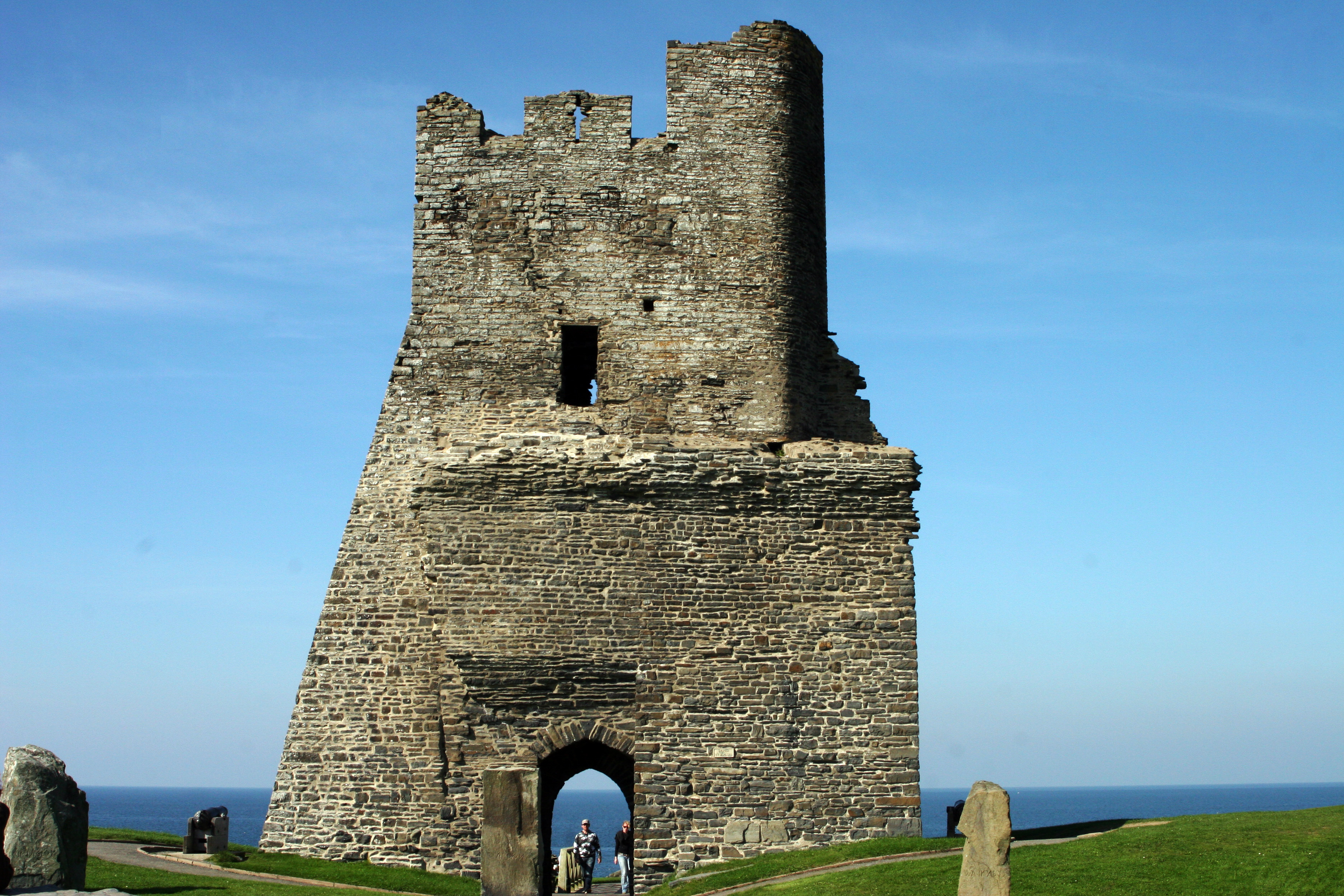
Aberystwyth Castle
Few castles in Wales have changed hands as violently or as often as Aberystwyth. Built, burned, rebuilt, captured, minted coins, and finally blown apart by Cromwell's engineers, the fortress on the Ceredigion coast has lived more lives than most. The ruins that stand today overlook Cardigan Bay from a headland where Edward I planted his flag in 1277, but the site's story of siege, rebellion, and reinvention stretches back further and runs deeper than any single king's ambition.
Before Edward's Stone
The first castle here was not Edward I's. Around 1110, the Marcher lord Gilbert de Clare raised a motte-and-bailey fortification a mile south of the present ruins. It changed hands repeatedly over the next century, a barometer of Welsh-Norman power struggles. Gruffydd ap Rhys, King of Deheubarth, failed to take it in 1116 but succeeded in 1136, burning it to the ground with the help of Owain Gwynedd's forces. Rebuilding, burning, and rebuilding again followed -- a cycle as predictable as the tides. By 1221, Llywelyn the Great held the original site, but its strategic value had been overtaken by Edward I's far grander ambitions.
Edward's Diamond Fortress
Construction of the present castle began in 1277, part of Edward I's systematic effort to ring Wales with stone. Master mason James of St George likely oversaw the design: a diamond-shaped concentric castle with twin D-shaped gatehouse towers and a narrow outer ward. Building started simultaneously with work at Flint, Rhuddlan, and Builth Wells. Progress was slow, and in 1282 the Welsh seized and burned both the castle and its adjoining walled town before the defenses were complete. Edward pressed on regardless, and by 1289 the castle was finished at a cost of 4,000 pounds. Its location on the coast proved critical during Madog ap Llywelyn's revolt in 1294-95, when the garrison withstood a prolonged siege because supply ships from Ireland could still reach the walls.
Glyndwr's Parliament
By the time of the Black Prince in 1343, the castle was already crumbling. Gateways, drawbridges, the king's hall, and the outer bailey were all falling down. Yet the fortress still mattered enough to fight over. In 1404, Owain Glyndwr captured Aberystwyth during his national uprising against English rule and made it a seat of government. The following year, a treaty was signed here between Glyndwr and the King of France, a diplomatic coup that briefly elevated this Welsh coastal ruin to the stage of European politics. Four years later the English retook it, but Glyndwr's occupation had etched the castle into the mythology of Welsh independence.
Silver Coins and Cromwell's Gunpowder
Aberystwyth Castle's final chapter of active use came during the English Civil War. In 1637, Thomas Bushell persuaded Charles I to establish a Royal Mint within the castle hall, striking coins -- half-crowns, shillings, groats, and pennies -- from silver mined locally in Ceredigion. When war broke out, Bushell raised a regiment of Royalist soldiers, and the mint ceased operations in September 1642. Bullion and equipment were evacuated to Shrewsbury and then Oxford. Cromwell's forces took the castle in 1646, and three years later it was slighted -- deliberately demolished to prevent any future military use. The ruins that remain are fragments of that demolition: broken walls, the stumps of D-shaped towers, and the echo of a fortress that served kings, rebels, and minters alike.
From the Air
Located at 52.41N, 4.09W on the headland at Aberystwyth, directly overlooking Cardigan Bay. The castle ruins are visible from the air adjacent to the seafront promenade and the Old College building. Nearest airport: West Wales Airport (EGFE) at Haverfordwest, approximately 40nm south. Recommended altitude: 1,500-2,500 ft for clear views of the headland and bay.