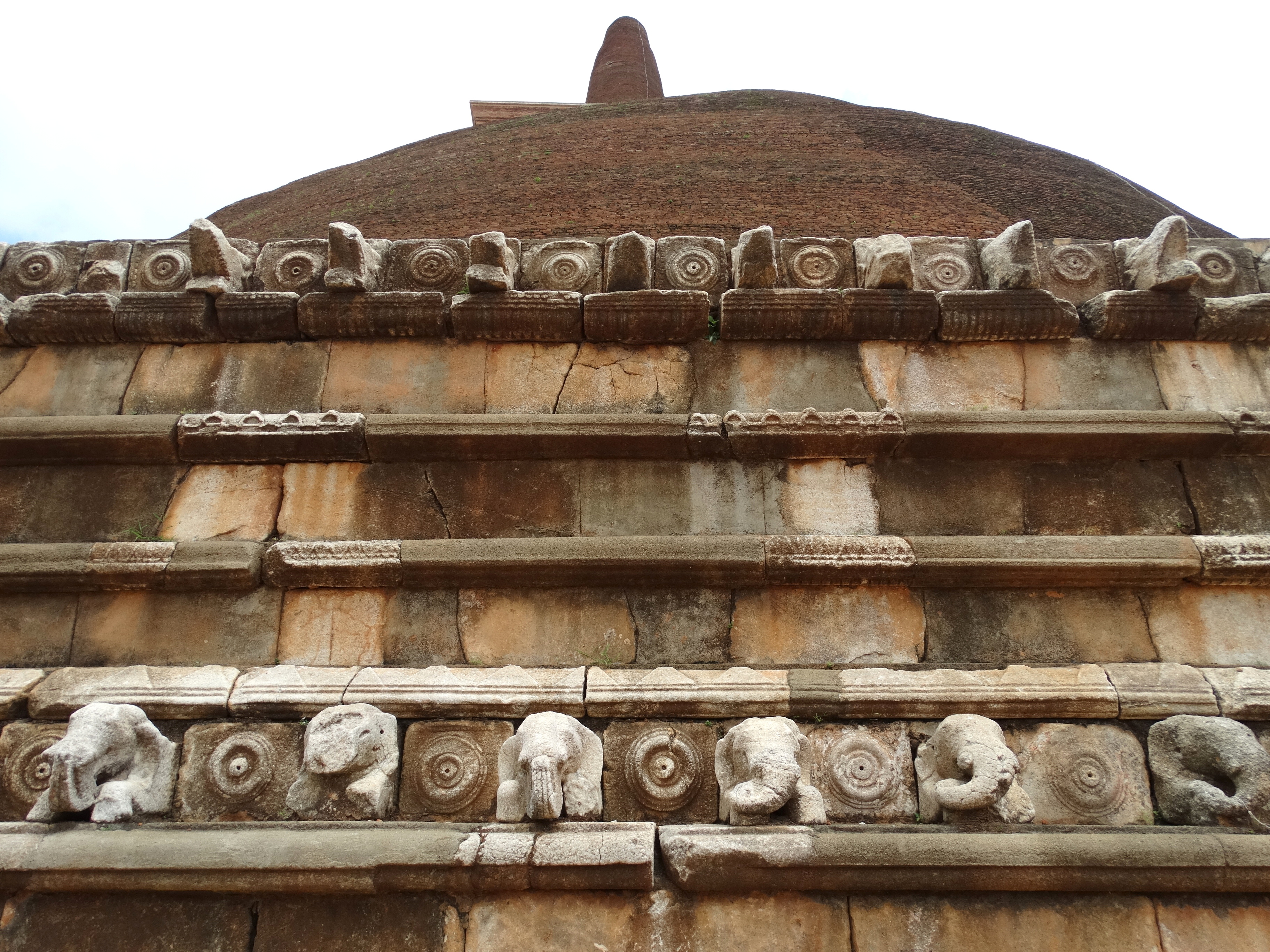
Abhayagiri Vihara
As King Valagamba fled Anuradhapura in defeat, a Jain monk named Giri stood at the northern gate and shouted after him: "The great Sinhala is fleeing!" The king did not stop. But he made a vow. Fourteen years later, Valagamba marched back into the city, overthrew his enemies, and built a monastery on the exact site where Giri had mocked him. He named it Abhayagiri -- combining his own name with that of the monk whose insult he had never forgotten. That act of defiant piety in 89 BC created what would become one of the largest and most influential Buddhist institutions the world has ever known. At its height, Abhayagiri housed 5,000 monks, attracted scholars from China and Kashmir, and embraced every current of Buddhist thought -- Theravada, Mahayana, and Vajrayana -- under a single compound's walls.
The Vow Fulfilled
The founding story reads like political thriller. Seven Tamil chiefs had landed at Mahatittha with a formidable army. Valagamba, facing both them and a Brahmin rebel named Tiya, tried to turn his enemies against each other by offering Tiya the kingdom if he could defeat the invaders. Tiya failed, and the Tamils advanced on Anuradhapura. The king fled into the mountains for more than fourteen years, gathering forces during what the chronicles call the Beminitiya Seya -- a period of famine and south Indian rule. When he finally retook the capital in 89 BC, defeating the Tamil king Bhatiya, one of his first acts was to build a vihara on the site of Giri's monastery. He appointed Mahatissa Thera of Kupikkala as Chief Incumbent, rewarding the monk's loyalty during the long exile. From its first day, Abhayagiri carried a double meaning: it was a religious foundation, but it was also a declaration of national resurgence, the end of Brahmin and Jain influence in the country.
Where All Buddhisms Met
What made Abhayagiri extraordinary was not its orthodoxy but its openness. While the rival Mahavihara monastery in Anuradhapura held strictly to Theravada tradition, Abhayagiri welcomed the full spectrum of Buddhist philosophy. The 7th-century Chinese pilgrim Xuanzang described the monks of Mahavihara as "Hinayana Sthaviras" and those of Abhayagiri as "Mahayana Sthaviras" -- a distinction that captures the theological tension between the two institutions. By the 8th century, Vajrayana practices had also taken root within the complex. Scholars working in both Sanskrit and Pali produced influential texts here: Upatissa wrote the Vimuttimagga, a guide to the path of liberation, while tantric masters like Jayabhadra and Candramali practiced and taught within its walls. This was not a monastery that chose one path. It was a university that studied them all.
Nuns Across the Sea
Abhayagiri's influence reached far beyond Sri Lanka. By the 5th and 6th centuries, the monastery maintained formal relationships with institutions in China, Java, and Kashmir. One of the most remarkable connections involved the ordination of Buddhist nuns. In 426 AD, eight Sinhala nuns arrived in Nanjing, capital of China's Liu Song dynasty, aboard a merchant ship. Three more nuns followed, led by a woman named Tissara. In 434 AD, more than three thousand Chinese women received their higher ordination in the presence of over ten Sinhala nuns at a temple in Nanjing. The women of Abhayagiri did not merely practice their faith at home -- they carried it across the Indian Ocean and established it in one of the world's great civilizations. A fragmentary inscription from the Ratubaka plateau in central Java records the establishment of an "Abhayagiri Vihara of Sinhalese ascetics," evidence that the monastery's reach extended into Southeast Asia as well.
The Tooth and the Dagaba
The physical heart of the complex was the Abhayagiri Dagaba, a massive stupa that dominated the northern quarter of Anuradhapura. The monastery surrounded it -- encircled by great walls, containing elaborate bathing ponds like the famous Kuttam Pokuna (twin ponds), carved balustrades, and moonstones at every threshold. When the Buddha's Tooth Relic arrived in Sri Lanka in the 4th century, Abhayagiri was chosen to house it. The Chinese monk Faxian, visiting in 412 AD, described the spectacle: the relic carried in procession to the monastery while the king set out images of the Five Hundred Forms the Buddha had assumed in previous lives along both sides of the road. By Faxian's time, the complex had grown into four distinct fraternities -- Uttara-mula, Kapara-mula, Mahanethpa-mula, and Vahadu-mula -- each identified through archaeological excavation.
Silenced but Not Erased
In the 12th century, King Parakramabahu I threw his political weight behind the Mahavihara and ended the Abhayagiri tradition. Monks were defrocked and given a choice: return to lay life permanently or re-ordain as novices under Mahavihara rules. The Jetavana tradition suffered the same fate. A Sangharaja -- King of the Sangha -- was appointed to preside over a unified monastic order. Abhayagiri's 1,300 years as an independent institution were over. But erasure proved incomplete. The veneration of the Bodhisattva Avalokitesvara, a Mahayana practice fostered at Abhayagiri, continues in Sri Lanka to this day under the name Natha. European visitors in the 18th century still found monks reciting mantras and counting with mala beads -- practices rooted in Mahayana and Vajrayana traditions that Abhayagiri had nurtured. The ruins themselves remain among the most extensive in the world, covering a vast area north of modern Anuradhapura. The dagaba has been restored. The twin ponds still hold water. The walls still stand.
From the Air
Abhayagiri Vihara (8.371N, 80.395E) is located in the northern sector of the ancient city of Anuradhapura in North Central Sri Lanka. The restored Abhayagiri Dagaba (stupa) is clearly visible from the air as a large white hemispherical structure. The Kuttam Pokuna (twin ponds) and extensive monastery ruins spread across the surrounding landscape. The complex is part of the UNESCO World Heritage site of Anuradhapura. Nearest major airport is Bandaranaike International (VCBI/CMB), approximately 170km southwest. Best viewed at low to medium altitude in clear conditions.