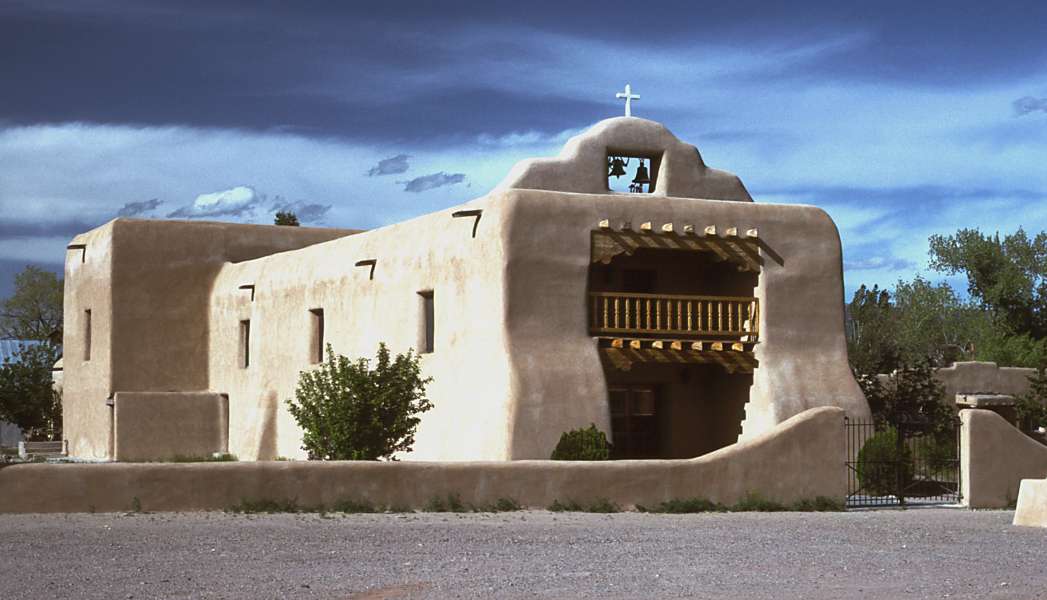
Abiquiu
Georgia O'Keeffe first visited this corner of New Mexico in 1929 and never really left. The red and yellow cliffs, the bleached bones scattered across the desert, the massive formations she called 'my backyard' - they became the subject of her most iconic paintings, images that defined how America sees the Southwest. O'Keeffe lived and worked in Abiquiu for nearly four decades, and you can visit her home here. But even without the artistic connection, this village of a few hundred souls would draw travelers. The landscape is simply extraordinary: painted desert geology on a scale that makes words inadequate.
Ghost Ranch
Ghost Ranch sprawls across 21,000 acres of high desert northwest of the village, its colorful cliffs instantly recognizable from O'Keeffe's canvases. The Presbyterian conference center welcomes day visitors to hike trails that wind through the same red-rock formations the artist painted for decades. The ranch's Museum of Paleontology holds another surprise - fossils of Coelophysis, a small dinosaur discovered here in one of the world's richest Triassic deposits. Chimney Rock, Kitchen Mesa, the box canyons along small creeks - each trail offers another angle on landscape that seems almost impossibly vivid, as if someone saturated the color settings on reality.
The O'Keeffe Home
In the village proper, Georgia O'Keeffe's adobe home opens for guided tours. She bought the ruined hacienda in 1945, spending three years restoring it before making it her primary residence. The house is modest - O'Keeffe lived simply - but the views from her studio explain everything about why she stayed. The Pedernal, a flat-topped mountain she painted obsessively, dominates the southwestern horizon. O'Keeffe once said she wanted the mountain's essence to be scattered there when she died, and it was. The tours book months in advance; this is pilgrimage country for art lovers.
Echo Amphitheater
A few miles north of Ghost Ranch, a short trail leads to one of the region's geological curiosities. Echo Amphitheater is exactly what the name suggests - a natural bowl carved into yellow sandstone cliffs that bounces sound back with startling clarity. Shout, and your voice returns from the curved walls. The acoustics are remarkable, the colors more so. This is camping country too; a small campground offers sites beneath the cliffs. The highway from Santa Fe to Colorado passes right through, making Abiquiu an easy stop on a longer journey - though the landscape tends to keep visitors longer than planned.
High Desert Waters
Abiquiu Lake lies downstream where the Rio Chama has been dammed for flood control, creating an oasis in the high desert. The fishing here is considered among New Mexico's best - bass, trout, catfish in waters surrounded by red cliffs. Kayakers and paddleboarders share the reservoir with fishing boats. The Jemez Mountains rise to the south, offering backcountry hiking into San Pedro Parks Wilderness for those with high-clearance vehicles and a tolerance for rough roads. This is empty country, harsh and beautiful, where the light changes the colors of the cliffs from hour to hour and Georgia O'Keeffe found a lifetime of subjects.
From the Air
Located at 36.21°N, 106.32°W in north-central New Mexico's Rio Chama valley. From altitude, Abiquiu appears where red and yellow cliffs meet the river valley floor, approximately 60 miles north of Santa Fe. Ghost Ranch's distinctive red formations are visible northwest of the village. Abiquiu Lake is identifiable as a reservoir in the canyon downstream. The Jemez Mountains rise to the south. Nearest significant airport is Santa Fe Municipal (KSAF), with Albuquerque International (KABQ) about 90 miles south. High desert terrain with variable winds; summer thunderstorms build rapidly over the mountains.