Abkhazia
The train from Moscow rolls through the night for two days before reaching Sukhumi, capital of a country that technically does not exist. Abkhazia occupies a sliver of the eastern Black Sea coast where the Greater Caucasus mountains plunge toward subtropical shores, a land of alpine lakes and seaside resorts that once drew Soviet vacationers by the millions. Today, this territory claimed by Georgia but controlled by its own government with Russian backing welcomes tourists who navigate a labyrinth of visa requirements and disputed borders. The reward is a landscape of startling contrasts: the world's deepest known cave, medieval churches where Christianity has endured for nearly two millennia, wine valleys that predate written history, and beach towns frozen in Soviet amber. Only Russia, Venezuela, Nicaragua, Syria, and Nauru recognize Abkhazia's independence, but the palm trees and warm waters care nothing for geopolitics.
Where Mountains Meet the Sea
The geography of Abkhazia reads like a fantasy. Within forty-four hundred square kilometers, the terrain rises from Black Sea beaches to peaks exceeding four thousand meters. The Krubera Cave (also called Voronya) in the Arabika Massif plunges over 2,190 meters into the earth, one of the two deepest explored caves in the world. Lake Ritsa sits high in the mountains, its turquoise waters reflecting surrounding cliffs where Stalin maintained a dacha, now open to curious visitors. The coastal strip enjoys a subtropical climate thanks to the protection of the mountain ranges, allowing cultivation of tobacco, tea, and grapes for the local wine industry. Hot, humid summers give way to mild winters where temperatures rarely drop below freezing at sea level, making Abkhazia one of the warmest regions in the former Soviet space.
A History Written in Blood
The story of Abkhazia is one of displacement and survival. For centuries, the Abkhaz people dominated this coast, comprising 85 percent of the population in 1886. The Ottoman-Russian wars of 1864-1883 triggered a mass exodus of Muslim Abkhazians to the Ottoman Empire, and Georgians settled on the vacated lands under Tsarist rule. By the final Soviet census of 1989, Georgians comprised nearly half the population while ethnic Abkhaz had dwindled to eighteen percent. The collapse of the Soviet Union ignited conflict, and war erupted in 1992. When the fighting ended in 1993, approximately 250,000 people had fled, including nearly 200,000 Georgians. Ethnic cleansing scarred the land. Russia recognized Abkhazian independence after the 2008 South Ossetian War, but to most of the world, this remains Georgian territory under occupation.
Remnants of Faith and Empire
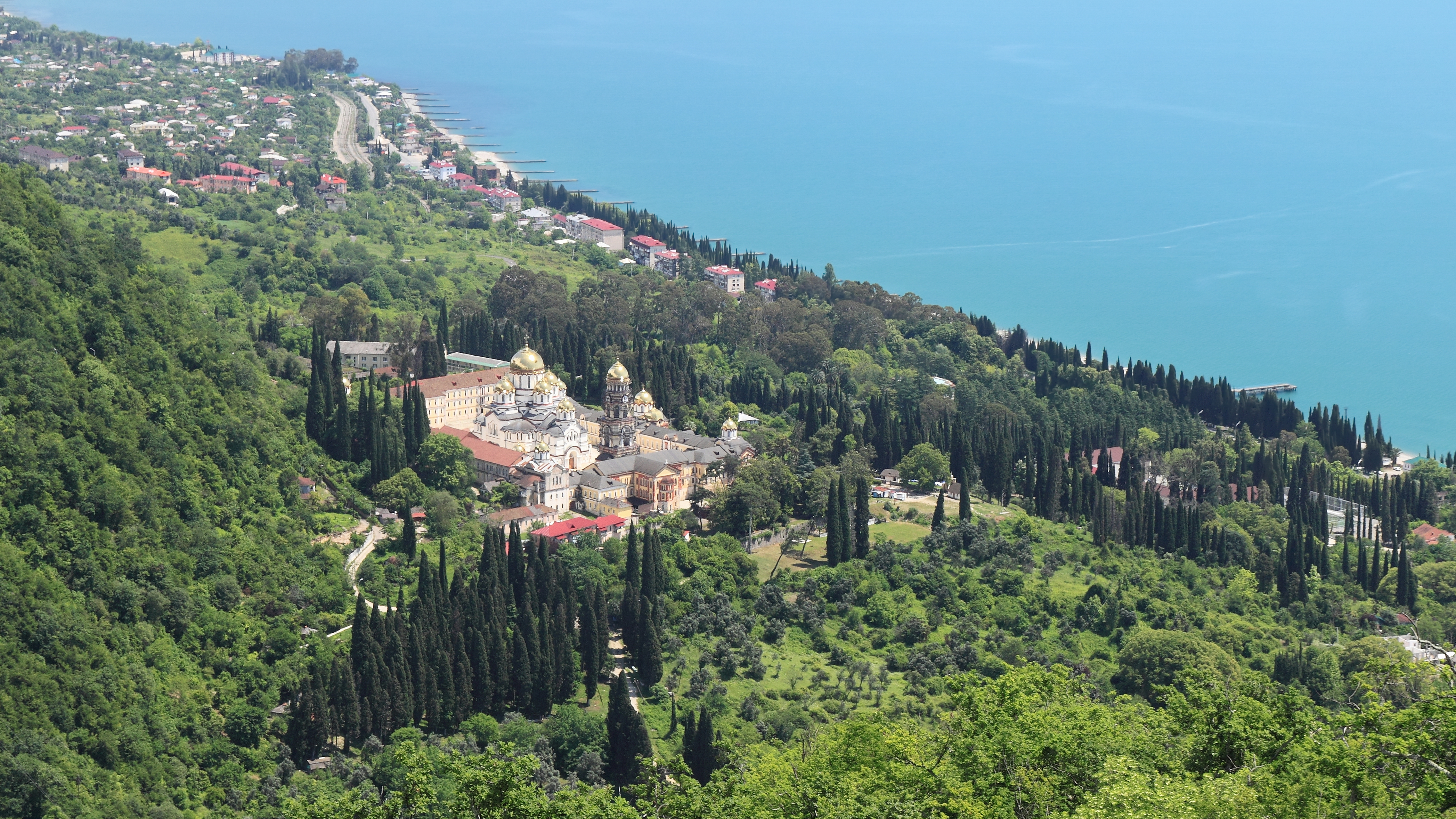
Christianity arrived early on these shores. According to tradition, the apostles Andrew and Simon the Zealot preached here in the first century AD, making Abkhazia one of the oldest Christian regions in the world. The evidence survives in medieval churches scattered across the landscape: Lykhny village, more than a thousand years old, contains ruins of a sixth-century temple and the Church of the Assumption. Kaman village claims the tombs of the holy martyr Basiliscus and St. John Chrysostom. New Athos, or Novi Afon, draws pilgrims to its nineteenth-century Russian Orthodox cathedral and an underground cave system so vast that a special train carries visitors through its halls of stalagmites and stalactites. The famous Gagripsh restaurant in the resort town of Gagra, imported piece by piece from Norway in 1902, embodies the faded grandeur of the pre-revolutionary era.
Navigating the Unrecognized
Visiting Abkhazia requires careful planning and acceptance of legal ambiguity. Two borders exist: one with Russia near Sochi, crossed by hundreds daily, and one with Georgia at the Enguri River, a dilapidated bridge where passport checks can stretch for hours. Entering via Russia is considered a criminal offense by Georgia, potentially resulting in fines or imprisonment if you later visit Georgian territory. The currency is the Russian ruble, ATMs are unreliable, and bringing sufficient cash is essential. Mobile phones may not recognize the one-hour time difference from Georgia. Yet millions make the journey annually, mostly Russians and citizens of CIS countries seeking beaches, mountain air, and wines like Apsny and Lykhni. The local cuisine blends Mediterranean and Caucasian influences, featuring spicy bean sauces, corn porridge with cheese, and kebabs served everywhere. This is travel at its most complicated and, for the adventurous, most rewarding.
From the Air
Located at 43.00N, 40.98E on the eastern Black Sea coast in the Caucasus region. The territory extends from sea level to peaks over 4000m in the Greater Caucasus mountains. Sukhum Babushara Airport (UGSS) reopened in May 2025 with flights from Moscow. The coastline stretches approximately 210km. Major landmarks include Lake Ritsa in the mountains and the resort towns of Gagra and Pitsunda along the coast. The Psou River marks the Russian border to the northwest near Sochi; the Enguri River marks the Georgian boundary to the east near Zugdidi.