Abney Park Cemetery: London's Dissenting Garden of the Dead
Most of London's great cemeteries were built for Anglicans. Abney Park was built for everyone else. When it opened in 1840, this Stoke Newington burial ground broke with centuries of religious exclusion by welcoming Baptists, Methodists, Congregationalists, Quakers, and anyone else the established church had no room for. It was not merely a cemetery but a triple experiment: a garden of the dead, a public arboretum containing 2,500 species of trees and shrubs, and an educational institute. Nearly two centuries later, the 31 acres have gone gloriously feral, the monuments listing and ivy-wrapped, the arboretum returned to urban woodland. It is one of London's 'Magnificent Seven' cemeteries and a Local Nature Reserve, a place where 196,843 burials coexist with foxes, woodpeckers, and the persistent push of roots through stone.
Roots of Dissent
The land takes its name from Sir Thomas Abney, Lord Mayor of London in 1700, whose manor house once stood on the site. Abney was a devout Nonconformist who gave refuge to the hymn writer Isaac Watts for an extraordinary 36 years. Watts lived in Abney House from 1712 until his death in 1748, composing hymns that would become cornerstones of Protestant worship worldwide. When the cemetery company chose this ground, the connection was deliberate. The cemetery's approach grew from the Congregational church's role in the London Missionary Society, whose principle was to develop a wholly non-sectarian mission. Where other Magnificent Seven cemeteries required Anglican consecration for much of their ground, Abney Park refused any consecration at all, making it unique among London's great Victorian cemeteries.
A Living Catalogue
The cemetery's designer, George Loddiges, was not primarily a landscape architect but a nurseryman. His family ran the famous Loddiges nursery in Hackney, and he conceived Abney Park as a grand outdoor botanical catalogue. The original plantings included 2,500 varieties of trees and shrubs arranged in a circuit, each one labeled, making the cemetery grounds the most comprehensive arboretum in Britain at the time. Egyptian-style entrance gates designed by Joseph Bonomi the Younger gave way to Gothic chapel by William Hosking. The effect was intentionally eclectic, a Victorian confidence that all knowledge and all traditions could coexist within a single designed landscape. Visitors came to study botany as much as to mourn.
The Dissenters' Resting Place
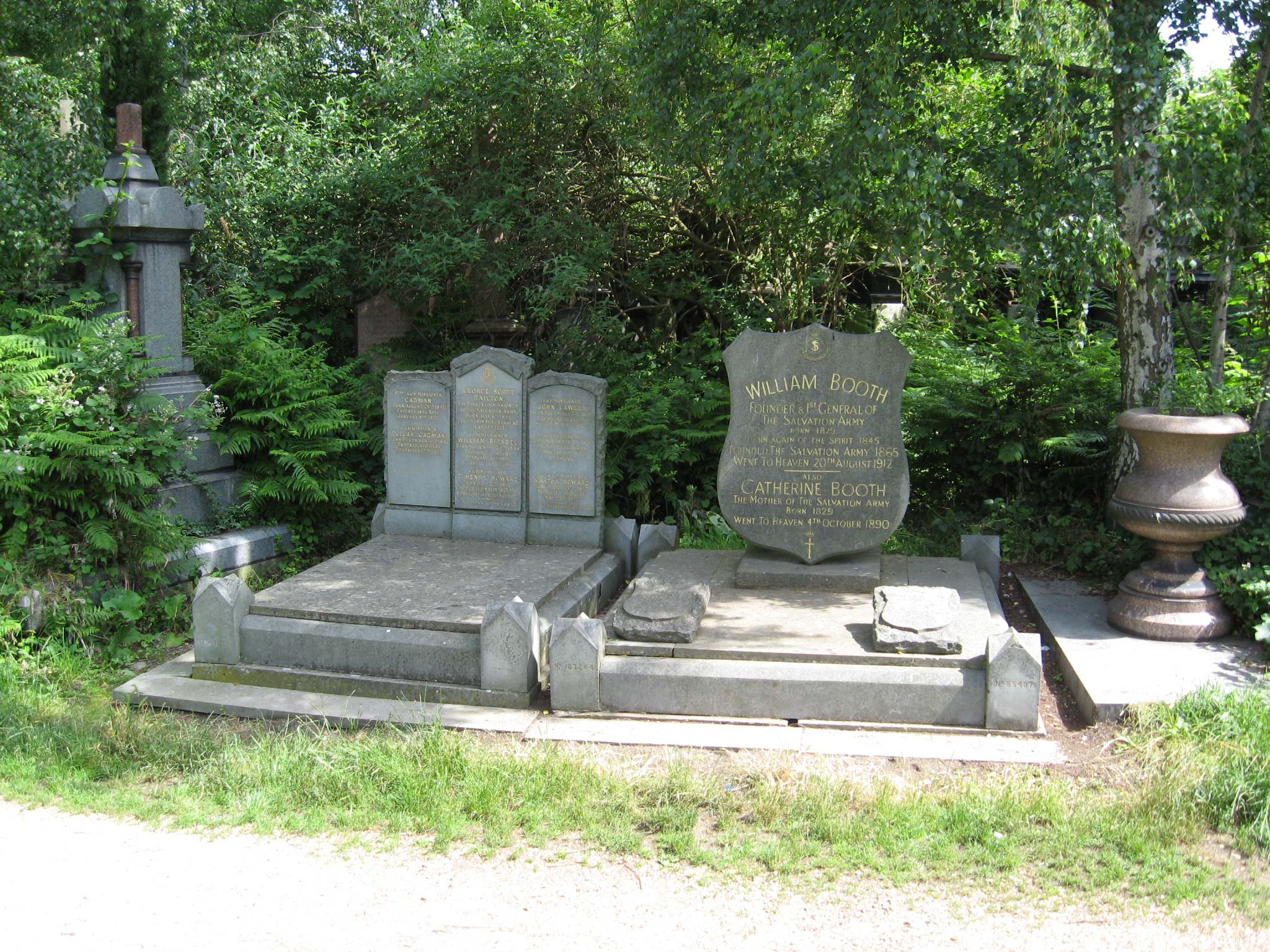
Abney Park became the final home for generations of people who had reshaped British society from the margins. William Booth, founder of the Salvation Army, was buried here in 1912, his funeral procession through the streets of London drawing more than a million mourners, and 150,000 filing past his coffin as he lay in state. His wife Catherine, herself a pioneering preacher who argued for women's right to preach, lies beside him. The cemetery holds prominent abolitionists, missionaries, and social reformers, people who had challenged the status quo in life and were denied space in the churchyards of the establishment in death. It is also the resting place of many ordinary Londoners from the surrounding neighborhoods of Stoke Newington and Hackney, their stories less recorded but no less real.
Beautiful Decay
By the mid-twentieth century, Abney Park had fallen into disrepair. The chapel burned down in 1972, leaving only a shell. Monuments cracked, paths disappeared under bramble, and the carefully labeled arboretum became an unmanaged wilderness. What might have been a tragedy became something unexpected: the cemetery transformed into one of inner London's richest habitats. At least 33 bird species nest among the ruins. Stag beetles burrow in the decaying timber. The ruined chapel, roofless and carpeted in moss, became an accidental cathedral of nature. In 2010, the London Borough of Hackney began a restoration project, reopening paths and stabilizing monuments while preserving the wildness that had made the place extraordinary. Today it is both a managed heritage site and a genuine urban woodland, a place where London's living and dead share the same tangled, resilient ground.
From the Air
Abney Park Cemetery is located in Stoke Newington, northeast London (51.56N, 0.075W), visible as a dense patch of urban woodland bounded by Stoke Newington High Street and Church Street. The nearest airports are London City (EGLC) approximately 12km southeast and London Stansted (EGSS) 45km north. From the air, the cemetery appears as a distinctive green canopy amid the terraced streets of Hackney, roughly 6km north of the Thames and 3km east of Highgate Cemetery.