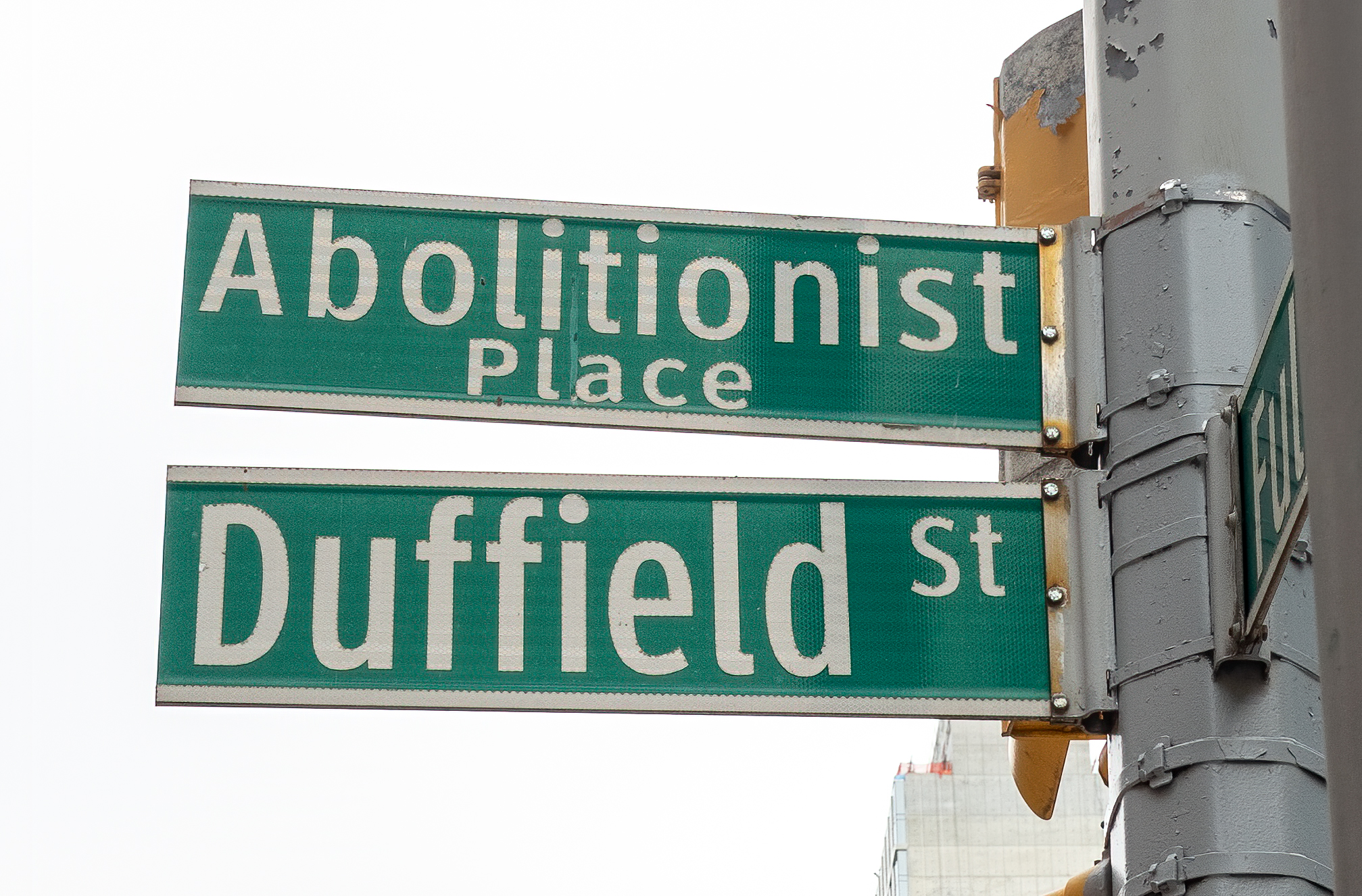
Abolitionist Place
Beneath the glass towers of downtown Brooklyn, a three-story Greek Revival rowhouse stands squeezed between new construction like a stubborn tooth the city could not pull. Number 227 Duffield Street was built around 1847 and looks its age -- a storefront addition from 1933 obscures the lower floors, leaving only the third-story facade to hint at what the building once was. What it was, according to oral histories passed down through generations, was a stop on the Underground Railroad. The street itself now carries a second name: Abolitionist Place.
The Truesdells of Duffield Street
Harriet and Thomas Truesdell moved to 227 Duffield Street in 1851, bringing with them decades of abolitionist conviction. Harriet had served as a delegate and committee organizer at the Anti-Slavery Convention of American Women in Philadelphia in 1838 and served as treasurer of the Providence Ladies Anti-Slavery Society. Thomas was a founding member of the Rhode Island Anti-Slavery Society. Their friend William Lloyd Garrison, one of America's most prominent abolitionists, stayed with the couple in Brooklyn before traveling to the World Anti-Slavery Convention in London. The evidence that their home sheltered freedom seekers includes artifacts found in the basement, a sealed doorway and arch leading to a tunnel beneath the building, and the house's proximity to other documented Underground Railroad stops like Plymouth Church and the Bridge Street African Wesleyan Methodist Episcopal Church. Slavery had been outlawed in New York since 1827, but the Fugitive Slave Act of 1850 criminalized helping escaped people, pushing the work deep underground -- in some cases, literally.
The City Comes for the Street
In the mid-2000s, the New York City Economic Development Corporation announced plans to seize several Duffield Street properties through eminent domain to build a public square and underground parking. The community mobilized. Joy Chatel, owner of 227 Duffield, and Lewis Greenstein of 233 Duffield led the opposition, arguing the homes had historical significance that merited preservation, not a wrecking ball. A city-commissioned archaeological report concluded the Underground Railroad claims were insufficiently supported -- but eight of twelve peer reviewers disagreed, citing incomplete investigation and the difficulty of documenting an activity that was by definition clandestine. As Lewis Greenstein told the New York Times, the hidden tunnels and their use by enslaved people seeking freedom had been "treated as common knowledge" in the neighborhood. The Bloomberg administration offered a compromise of sorts: $2 million for an abolitionist history panel and an official alternative street name, Abolitionist Place. The renaming granted no legal protection.
Black Landmarks Matter
By 2019, every house on the block with claimed abolitionist connections had been demolished -- except 227 Duffield. When demolition permits were filed for that last holdout, community organizations including Families United for Racial and Economic Equality and the Circle for Justice Innovations rallied again. Protests intensified through 2020, with activists adopting the slogan "Black Landmarks Matter" and the hashtag #Save227Duffield. Borough president Eric Adams, Mayor Bill de Blasio, and Attorney General Letitia James all expressed support for preservation. In February 2021, the Landmarks Preservation Commission designated the building as the Harriet and Thomas Truesdell House. The following month, the city purchased it for $3.2 million. The fight had taken more than fifteen years.
A Place Still Taking Shape
Today, the intersection of Duffield and Willoughby Streets carries the Abolitionist Place name not just as a street sign but as a planned public space. In June 2021, the city allocated $15 million for a 1.15-acre site honoring Brooklyn's abolitionist history. Artist Kameelah Janan Rasheed designed a concept incorporating questions and ideas written into the pavement -- though some preservationists criticized the abstraction, preferring direct depictions of historical figures. The name itself was contested: activists pushed for "Abolitionist Place" over the original "Willoughby Square Park," eventually winning the point. The broader story of Duffield Street is one of tension between development and memory, between a city hungry for new construction and a community insisting that what happened in these basements -- even if it cannot be conclusively proven to a scholar's satisfaction -- matters enough to preserve. The tunnel under 227 Duffield is sealed now. The story it represents is not.
From the Air
Abolitionist Place is located at approximately 40.691N, 73.984W in downtown Brooklyn, roughly 0.5 nm south of the Brooklyn Bridge landing. The area sits between the Brooklyn Bridge and the Manhattan Bridge, with Fort Greene Park visible to the east. JFK International Airport (KJFK) is 11 nm to the southeast; LaGuardia (KLGA) is 7 nm to the northeast. Recommended viewing altitude: 2,000-3,000 ft AGL.