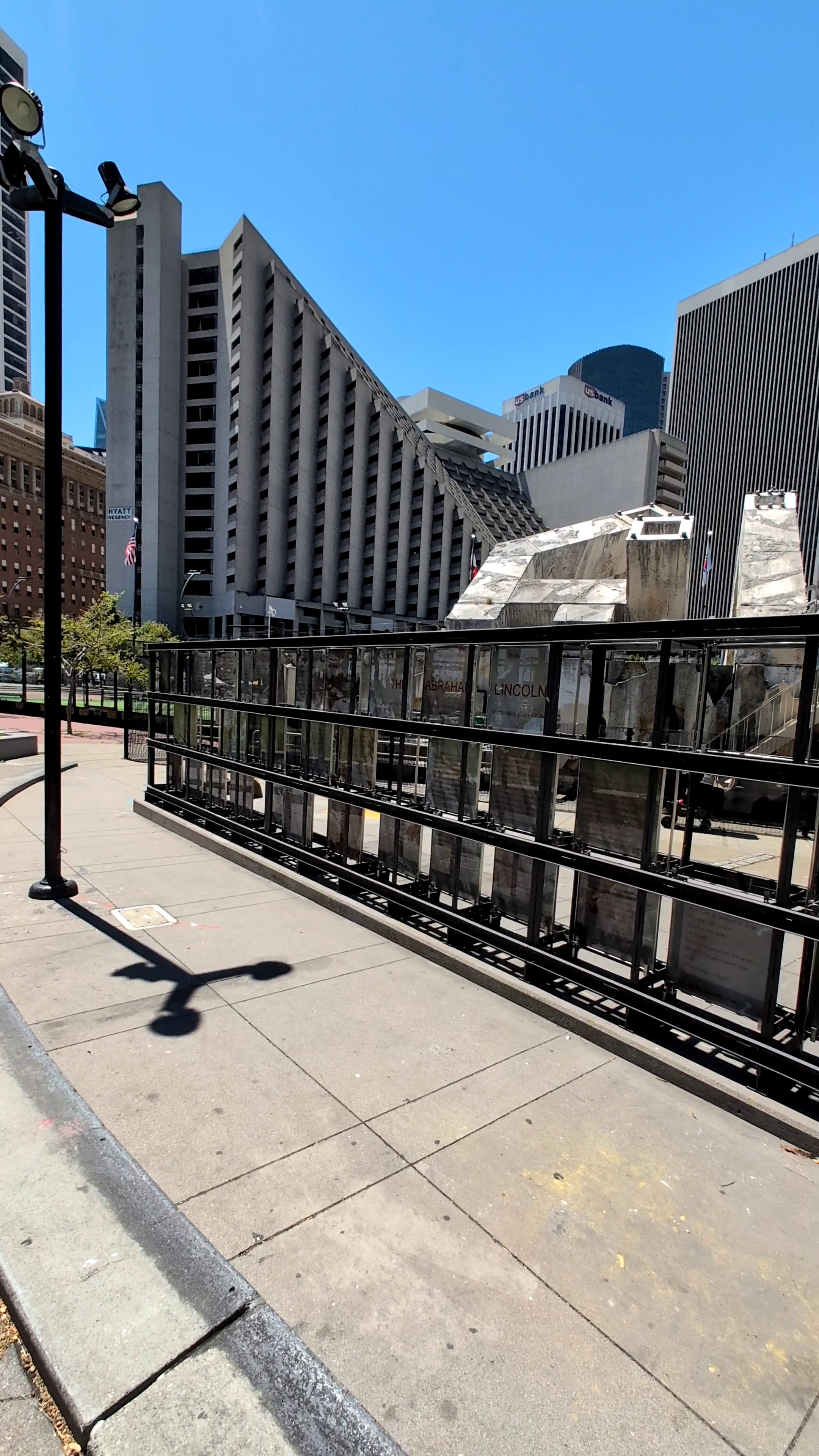
Abraham Lincoln Brigade Monument
Most war memorials honor soldiers who fought under their own country's flag. The Abraham Lincoln Brigade Monument, standing in Embarcadero Plaza in San Francisco's Financial District, honors Americans who fought under someone else's -- volunteers who traveled to Spain between 1936 and 1938 to defend the Republic against Francisco Franco's Nationalist forces and their German and Italian allies. They were not ordered to go. Many were labeled subversive when they returned. Their monument, dedicated seventy years after the war ended, sits a few steps from the waterfront where many of them shipped out.
Steel, Onyx, and Memory
Designed by Ann Chamberlain and landscape architect Walter J. Hood, the monument was funded with $400,000 from the Abraham Lincoln Brigade Archives and dedicated on 30 March 2008. It is part of the San Francisco Arts Commission's permanent collection. The installation uses panels of steel and onyx -- materials chosen for their weight and permanence -- to carry the faces and words of the volunteers into the present. One side of the panels displays portraits of brigade members. The other side shows annotated maps of the Spanish front lines between 1936 and 1938, tracing the campaigns where these Americans fought, were wounded, and died.
Voices from the Front
The monument lets the volunteers speak for themselves. Quotes from brigade members Abe Osheroff, Dave Smith, Alvah Bessie, Edwin Rolfe, Frederick Martin, Ruth Davidow, Robert Colodny, and Steve Nelson are inscribed on the panels, capturing the idealism and urgency that drove ordinary Americans to cross an ocean and pick up rifles for a foreign cause. Additional panels carry words from figures who witnessed or interpreted the conflict: the Spanish Communist leader Dolores Ibarruri, whose cry of 'No pasaran!' became the Republic's rallying call; Albert Camus, who saw in Spain a rehearsal for the larger war to come; Ernest Hemingway, who covered the fighting as a correspondent; and Paul Robeson, whose activism connected the brigade's cause to struggles for justice at home.
The Brigade's Complicated Legacy
Roughly 2,800 Americans volunteered for the Abraham Lincoln Battalion and the XV International Brigade during the Spanish Civil War. About a third of them died in combat. Those who returned faced suspicion rather than gratitude -- many were investigated during the McCarthy era for Communist affiliations, since the brigades had been organized largely through Communist Party networks. The veterans occupied an uncomfortable position in American memory: heroes to the left, suspected traitors to the right, largely forgotten by everyone else. San Francisco's monument was one of the first public artworks in the United States to honor them without qualification, acknowledging both their courage and the political complexity of their cause.
Weathering and Restoration
The monument's physical materials proved as difficult to maintain as its subjects' reputations. Within a decade of installation, the onyx panels had deteriorated from a combination of design vulnerabilities and weathering by the salt air blowing off San Francisco Bay. In August 2018, the damaged panels were removed and taken offsite for repair. The restoration took nearly two years, with the monument reopening in May 2020 -- just as another global crisis was making people reconsider who they called heroes and what causes they considered worth fighting for. The restored monument stands today as it was intended: a permanent acknowledgment that some Americans chose to fight fascism before their own government did, and paid for that choice in ways that lasted long after the bullets stopped.
From the Air
Located at 37.80N, 122.40W in Embarcadero Plaza, San Francisco's Financial District, California. Note: the coordinates in the source data show 122.40E, but the monument is in San Francisco at 122.40W. Visible from low altitude near the Embarcadero waterfront. Nearest airports: San Francisco International Airport (KSFO), approximately 13 miles south; Oakland International Airport (KOAK), approximately 10 miles east. Best viewed on approach along the San Francisco waterfront.