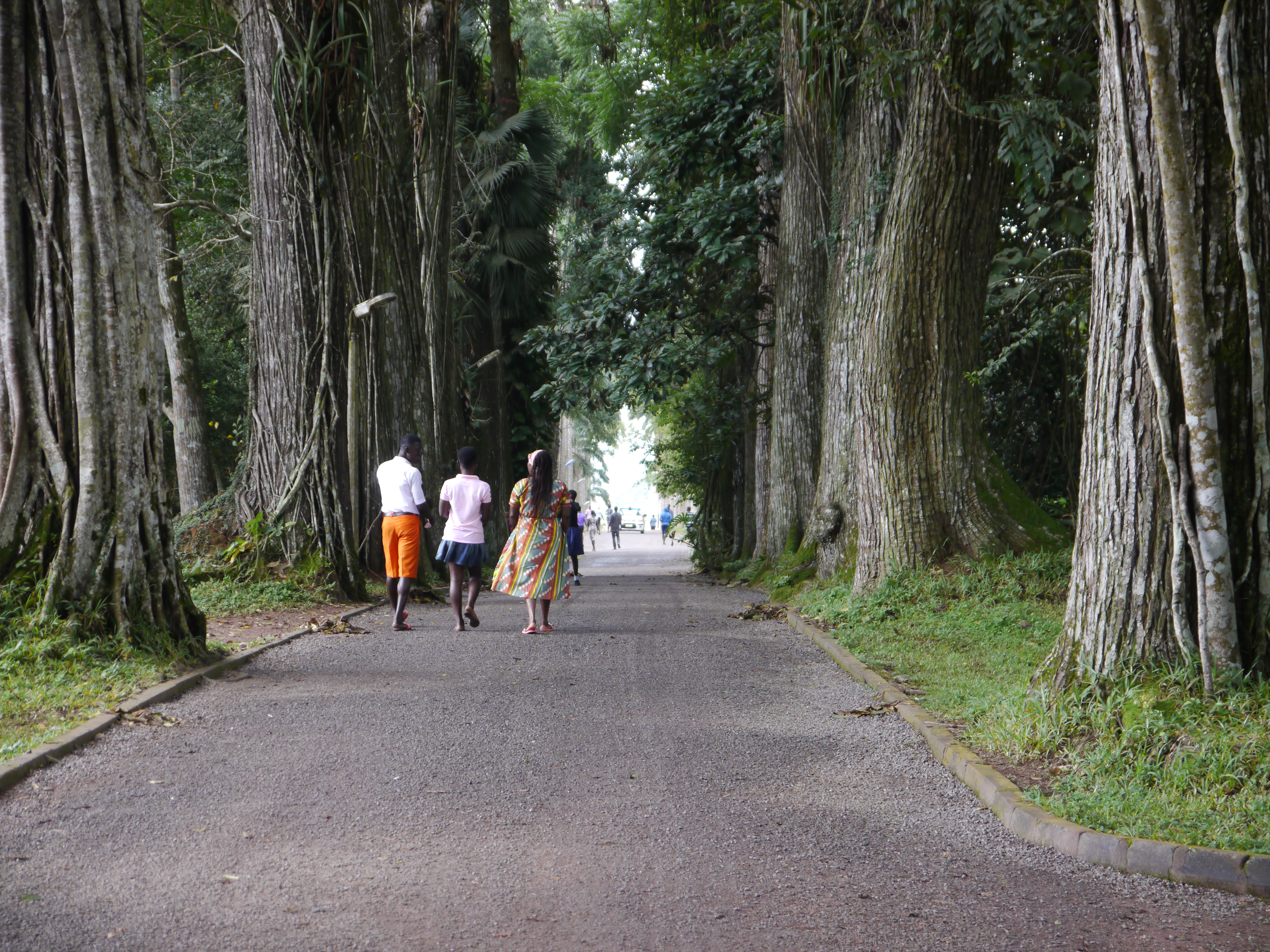
Aburi Botanical Gardens
Before there were gardens here, there was sickness and the search for cooler air. In 1875, the British colonial government built a sanatorium on the Akuapem Ridge above Accra, seeking relief from the coastal heat and malaria that plagued Gold Coast officials stationed at sea level. Fifteen years later, that hilltop retreat became something else entirely. The Aburi Botanical Gardens, opened in March 1890, would grow into one of West Africa's most important horticultural institutions -- the place where Ghana's cocoa industry found its seedlings and its methods, and where rubber trees from the Amazon first took root in Ghanaian soil.
A Doctor, a Governor, and a Missionary's Clearing
The gardens owe their existence to an unlikely collaboration. Governor William Brandford-Griffith provided the political will. Dr. John Farrell Easmon, a Sierra Leonean medical doctor stationed on the Gold Coast, provided the scientific vision. And Alexander Worthy Clerk, a Jamaican Moravian missionary associated with the Basel Mission, supervised the physical work of clearing land around the old sanatorium to create the botanic department. In 1890, the Royal Botanic Gardens at Kew sent William Crowther, one of its students, to serve as the garden's first curator. The Kew connection was more than ceremonial. London's premier botanical institution provided plant materials, expertise, and a systematic approach to tropical agriculture that would transform the Gold Coast's economy in ways none of the founders fully anticipated.
The Seeds That Changed an Economy
Cocoa was not native to Ghana. The gardens at Aburi became the nursery that made it Ghanaian. By supplying cheap cocoa seedlings and disseminating information about scientific farming methods, Aburi helped catalyze what would become one of the world's largest cocoa-producing industries. The impact is difficult to overstate: cocoa remains one of Ghana's most important exports more than a century later. Rubber followed a similar path. In 1893, Hevea brasiliensis -- the Para rubber tree, native to the Amazon basin -- was shipped to Aburi from Kew. The gardens tested whether it could thrive in West African conditions, and it could. Rubber production in Ghana traces its origins to those initial plantings on the ridge. What began as an experimental station for a colonial administration became, in practice, a launching pad for the agricultural economy of an independent nation.
Sixty-Four Hectares on a Mountaintop
The gardens occupy 64.8 hectares along the Akuapem Ridge, at an elevation that provides noticeably cooler temperatures than Accra below. Walk the grounds today and you move through a catalog of tropical and subtropical species: silk cotton trees whose buttressed trunks rise like cathedral pillars, mahogany, cedar, silver oak. The sausage tree, Kigelia, hangs its heavy fruit from long, pendulous stalks. Spine palms bristle with needles. An old helicopter sits among the plantings, a relic of uncertain provenance that has become an attraction in its own right. Termite mounds rise like sculptures, and at least one dead tree has been carved into one deliberately. The garden's geographical position on the ridge, combined with its botanical diversity, has made it a destination for both foreign tourists and Ghanaians from the lowlands seeking shade and mountain air.
Guardians of What Grows
The Aburi Botanical Gardens have reinvented themselves across three centuries. What started as a sanatorium became an experimental farm, then a nursery for cash crops, then a center for horticultural training and environmental education. Today, the gardens are one of many institutions working to save plant diversity through research, propagation of endangered species, and public outreach. The challenges are real. In 2019, the chief of Aburi, Otoobour Djan Kwasi II, called for privatization, arguing that private investment could revitalize the gardens and enhance their tourism potential. The proposal reflected a broader tension between preservation and commercialization that faces botanical gardens worldwide. Whether the answer is public funding, private partnership, or some hybrid, the gardens' mission has only grown more urgent as West Africa's forests face pressure from development and climate change. One hundred and thirty-five years after William Crowther arrived from Kew with a mandate to catalog and cultivate, the work continues.
From the Air
Located at 5.87N, 0.18W on the Akuapem Ridge in the Eastern Region of Ghana, approximately 35 km north of Accra. The gardens appear as a dense green area on the ridgeline, contrasting with surrounding development. Nearest major airport is Kotoka International Airport (DGAA) in Accra, roughly 40 km to the south. Best viewed at 3,000-5,000 feet AGL. The Akuapem Ridge runs north-south and is visible as a prominent escarpment rising from the Accra plains.