Abushiri Revolt
Emil von Zelewski made the mistake on a sweltering day in Pangani. The German administrator, freshly installed by the German East Africa Company, ordered the company's flag raised over the old Swahili trading port. The town's residents -- Arab merchants, Swahili families, African laborers -- watched this act of possession with a fury that had been building for months. Zelewski's flag was the final provocation in a chain of indignities: land seizures, new taxes, slashed salaries for the Sultan's former officials. Within days, the coast from Tanga to Lindi was in open revolt, and a plantation owner named Abushiri ibn Salim al-Harthi had become the unlikely face of resistance against an empire.
The Scramble Reaches Zanzibar
The seeds of rebellion were planted four years earlier, in 1884, when Carl Peters led an expedition from the Society for German Colonization to Zanzibar. Peters induced inland chiefs to sign "protection contracts" that signed away vast territories they barely understood were being claimed. His German East Africa Company then pushed its holdings to the Uluguru and Usambara Mountains. Sultan Barghash bin Said of Zanzibar protested, but capitulated when a German naval squadron appeared off his coast. By April 1888, Sultan Khalifah bin Said had signed a treaty leasing the coastal strip -- a ten-mile-wide ribbon that had been reserved for Zanzibar under an 1886 Anglo-German agreement -- to the company. The company's administrator, Ernst Vohsen, wasted no time making enemies. He decreed that landowners must register and prove ownership or forfeit their holdings to the company. The Arab elite saw their slave and ivory trades threatened. Swahili townspeople saw their livelihoods endangered. Africans across the social spectrum saw foreign arrogance that made even Omani Arab dominance look preferable.
A Coast United in Defiance
What the Germans later dismissed as an "Arab Rebellion" was something far more complex. Abushiri, whose father was an ethnic Arab and whose mother was Oromo, rallied a coalition that cut across the coast's tangled social hierarchy -- Shirazi patricians, Swahili townspeople, and African communities from the interior. In the south, Yao warriors took a leading role. The rebels expelled the Germans from Lindi and Mikindani, and killed those stationed in Kilwa. Only Dar es Salaam and Bagamoyo remained in German hands. The breadth of the uprising stunned Berlin. As historian Jonathan Glassman later demonstrated, the coastal population had initially tolerated the Germans as a counterweight to Omani dominance. But the 1888 treaty made the Germans appear to be clients of the Sultan, and suddenly their former allies turned against them -- contesting both German and Omani authority in one sweeping act of defiance.
Wissmann's Schutztruppe
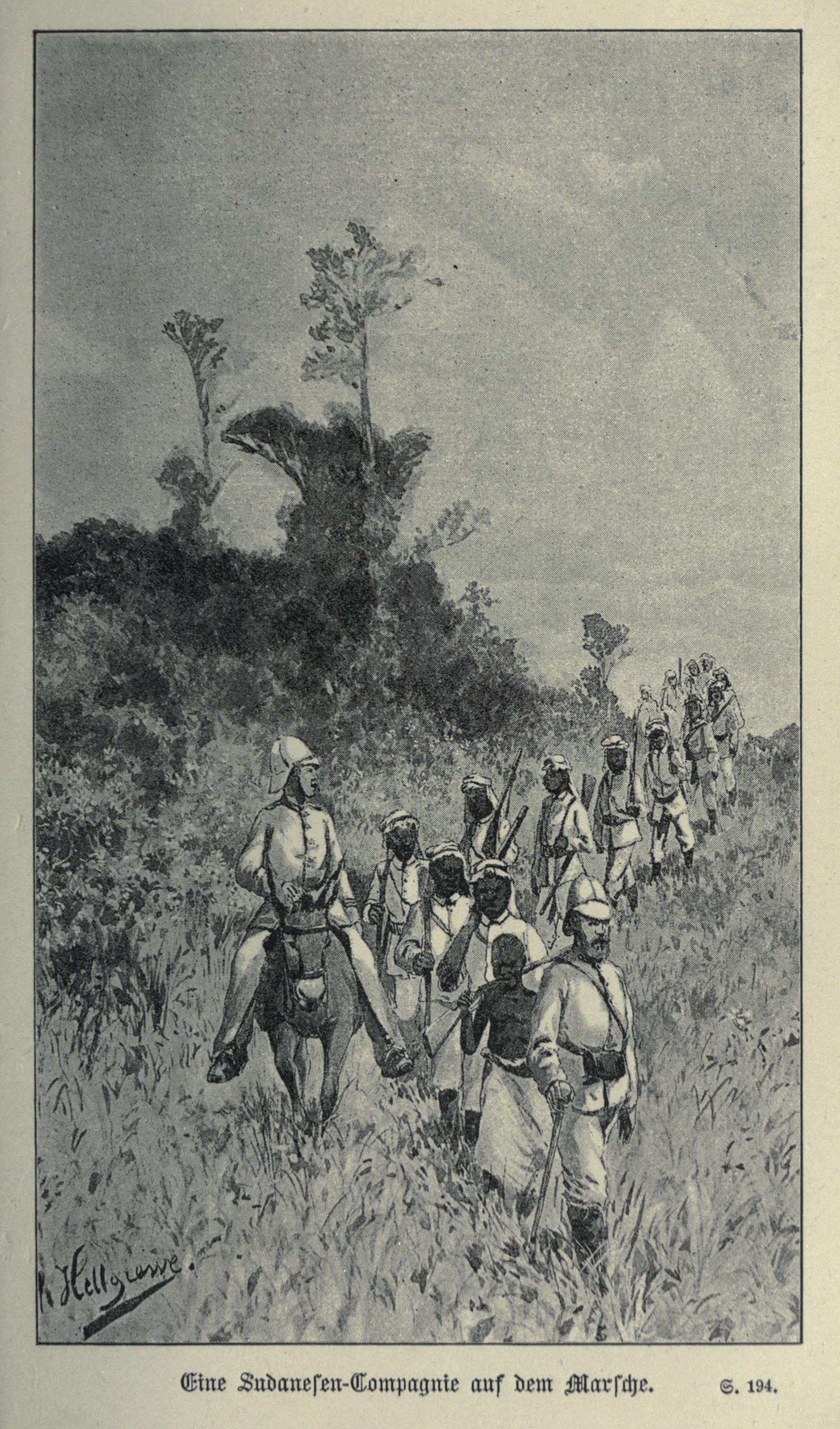
Chancellor Otto von Bismarck responded by appointing Lieutenant Hermann Wissmann as Reichskommissar for German East Africa in February 1889. Wissmann assembled a Schutztruppe of German officers commanding African askari soldiers recruited from Egypt and Mozambique -- men with no ties to the local population and no hesitation about fighting them. The German and British navies jointly blockaded the East African coast, choking off supplies to the rebels. Wissmann's force landed at Bagamoyo in May 1889 and advanced on Abushiri's fort. The assault succeeded with devastating casualties among the defenders. Abushiri fled inland but was hunted relentlessly. He was captured and hanged on 15 December 1889. In the north, the rebel leader Bwana Heri held out until early 1890 before surrendering. In the south, the Yao chief Machemba proved harder to break. Operating from the Makonde Plateau, he repelled every German expedition sent against him and did not negotiate peace until May 1891.
The Rebellion's Long Shadow
The revolt laid bare the German East Africa Company's total inability to govern. On 1 January 1891, the German Imperial government assumed direct control of the territory, compensating the company generously for its failure. Wissmann's improvised fighting force became the Kaiserliche Schutztruppe fur Deutsch-Ostafrika, the colonial army that would go on to subjugate the caravan routes to Kilimanjaro and Lake Tanganyika. For a century, the rebellion was known primarily through the lens of its German victors, who cast it as a simple "Arab uprising" to protect the slave trade. It was not until Glassman's 1995 work that a fuller picture emerged -- one revealing a broad social revolt rooted in overlapping grievances among diverse communities. The people of the coast were not fighting for any single cause. They were fighting against being made into subjects, and that resistance cost many of them their lives.
From the Air
Centered on the Zanzibar coast at approximately 6.12S, 39.31E. The revolt stretched from Tanga in the north to Lindi and Mikindani in the south along the Tanzanian coastline. From altitude, the narrow coastal strip -- the ten-mile-wide band leased to Germany -- is visible between the Indian Ocean and the green interior. Nearby airports include Julius Nyerere International Airport (HTDA) at Dar es Salaam and Abeid Amani Karume International Airport (HTZA) on Zanzibar. Best viewed at 5,000-10,000 feet to appreciate the stretch of coast that rose in rebellion.