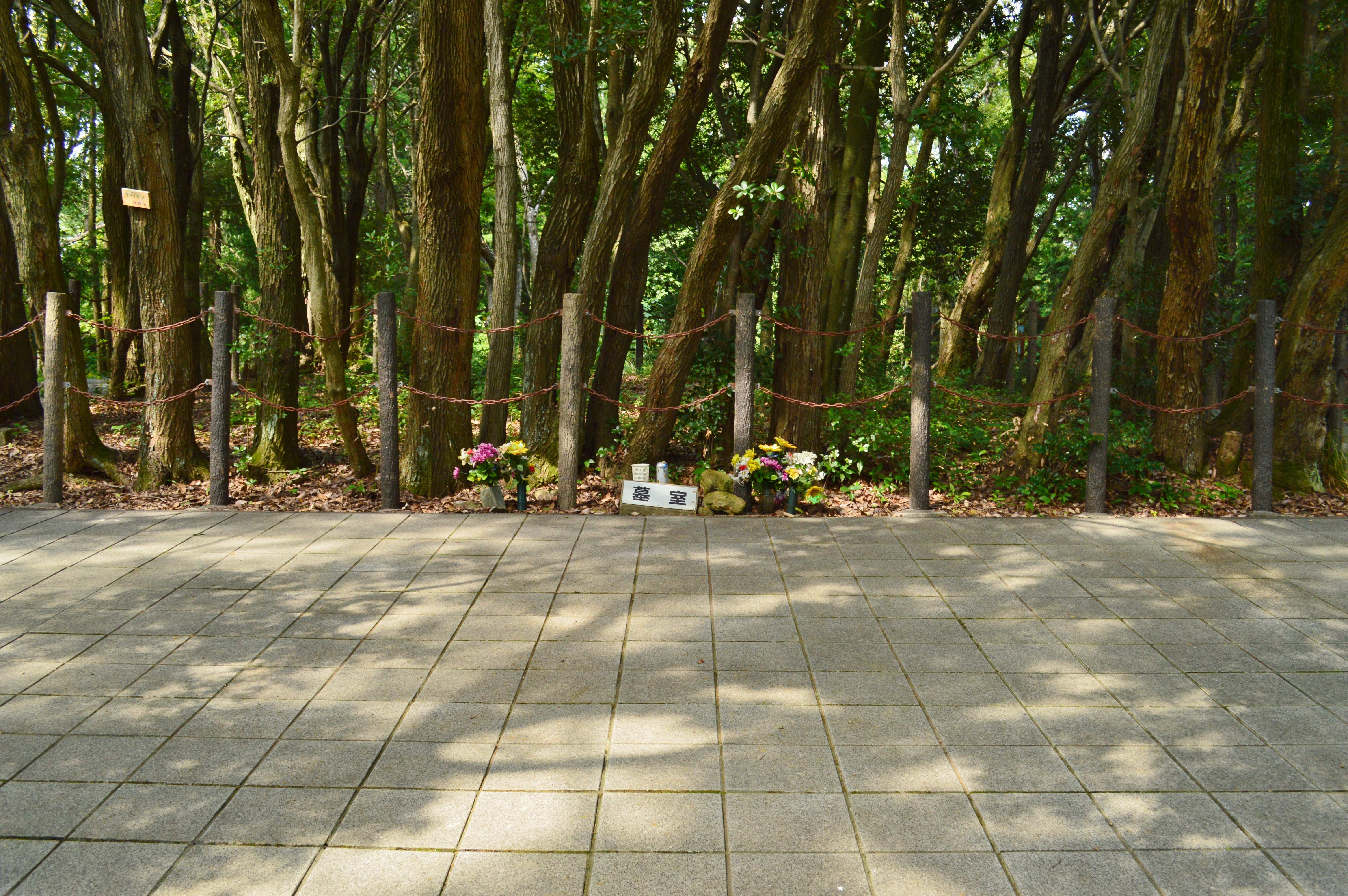
Abuyama Kofun
The earthquake scientists were not looking for a grave. In 1934, construction crews building a seismic observatory for Kyoto Imperial University on 281-meter Mount Abu broke through into an ancient stone burial chamber that had left no trace whatsoever on the surface above. What they found inside would ignite a media frenzy, a bitter academic turf war, and one of the strangest government orders in Japanese archaeological history: stop digging, because this body might be connected to the imperial family, and further investigation would constitute lese majesty. The tomb was ordered backfilled. The data was locked in a basement. And the mummified remains of a man who may have been Fujiwara no Kamatari -- founder of the most powerful clan in Japanese history -- were returned to the darkness they had occupied for thirteen centuries.
The Body in the Lacquer Coffin
The burial chamber held no swords, no mirrors, no jewels -- the usual grave goods of a high-ranking kofun burial were conspicuously absent. Instead, on a coffin stand rested a sarcophagus unlike any previously discovered in Japan: cloth hardened with layer upon layer of lacquer, painted black on the outside and red within. Inside lay the almost perfectly preserved mummified remains of a man in his sixties, complete with hair and clothing. His body had been wrapped in brocade, and gold threads were scattered from his chest to his head, which rested on a pillow woven from glass beads. The sophistication of the burial -- the lacquer coffin technique, the glass-bead pillow, the gold-threaded brocade -- pointed to someone of extraordinary status during the Asuka period, roughly the 7th century. On April 29, 1934, the Osaka Asahi Shimbun broke the news, and crowds descended on Mount Abu.
A Turf War That Sealed a Tomb
The discovery immediately became a bureaucratic disaster. Kyoto University's Faculty of Science had led the excavation through its Earthquake Observatory, but the scientists lacked archaeological training and handled the fragile site roughly. The Kyoto University Archeology Laboratory -- initially consulted but then barred from entering the excavation -- protested to the Ministry of Education. The Osaka Prefectural Government, watching the remains deteriorate in real time, filed its own complaints with the Ministry of Home Affairs and the Imperial Household Agency. The speculation that this might be the tomb of Fujiwara no Kamatari -- the 7th-century statesman who engineered the Taika Reform and founded the Fujiwara clan that would dominate Japanese politics for centuries -- only raised the stakes. The central government's ruling was decisive and extraordinary: the buried individual was unquestionably of the highest rank, possibly connected to the imperial line. Further investigation was declared lese majesty. The tomb was to be completely backfilled.
Data in the Basement
Before the order came down, the earthquake observatory had managed to take radiographic images and samples from the burial. But institutional rivalry trumped scientific inquiry. Rather than share this data with the archaeology department that could have analyzed it properly, the observatory filed everything away in its basement, where it sat unexamined. The circular tumulus itself -- originally 82 meters in diameter, ringed by a dry moat and rows of cylindrical haniwa clay figures -- was covered over and returned to anonymity. It was not until decades later that the accumulated evidence was reconsidered. The lacquer coffin construction, the glass-bead pillow, the gold-threaded garments, and the sheer scale of the tumulus all supported the Fujiwara no Kamatari hypothesis. In 1983, the site was designated a National Historic Site of Japan, and in 1989 the area was developed into a historic park.
The Founder Beneath the Mountain
Fujiwara no Kamatari, if indeed he rests beneath Mount Abu, was no ordinary nobleman. He was the architect of the Taika Reform of 645, a sweeping restructuring of Japanese government that centralized power under the emperor and dismantled the old clan-based political system. For this he was rewarded with the surname Fujiwara on his deathbed -- a name that would become synonymous with political power in Japan for the next five centuries. That a man of such consequence might lie in an unmarked hill between the cities of Takatsuki and Ibaraki, on the border of Osaka Prefecture's suburban sprawl, is a reminder that even the most powerful legacies can vanish beneath ordinary ground. The kofun sits quietly on Mount Abu today, its contents reburied, its questions officially unanswered -- a tomb that was found, then deliberately forgotten.
From the Air
Located at 34.86N, 135.57E on Mount Abu, on the boundary between the cities of Takatsuki and Ibaraki in Osaka Prefecture. The tumulus sits at roughly 280 meters elevation on a wooded hillside and is not easily distinguishable from the air. The surrounding Mishima Plain and urban sprawl of the Osaka-Kyoto corridor stretch in all directions. Nearest major airport: Osaka Itami (RJOO) approximately 12nm south-southwest. Kansai International (RJBB) lies approximately 40nm to the south. The Yodo River valley provides a clear visual corridor between Osaka and Kyoto. Expect haze in summer months, with visibility often reduced over the Osaka urban area.