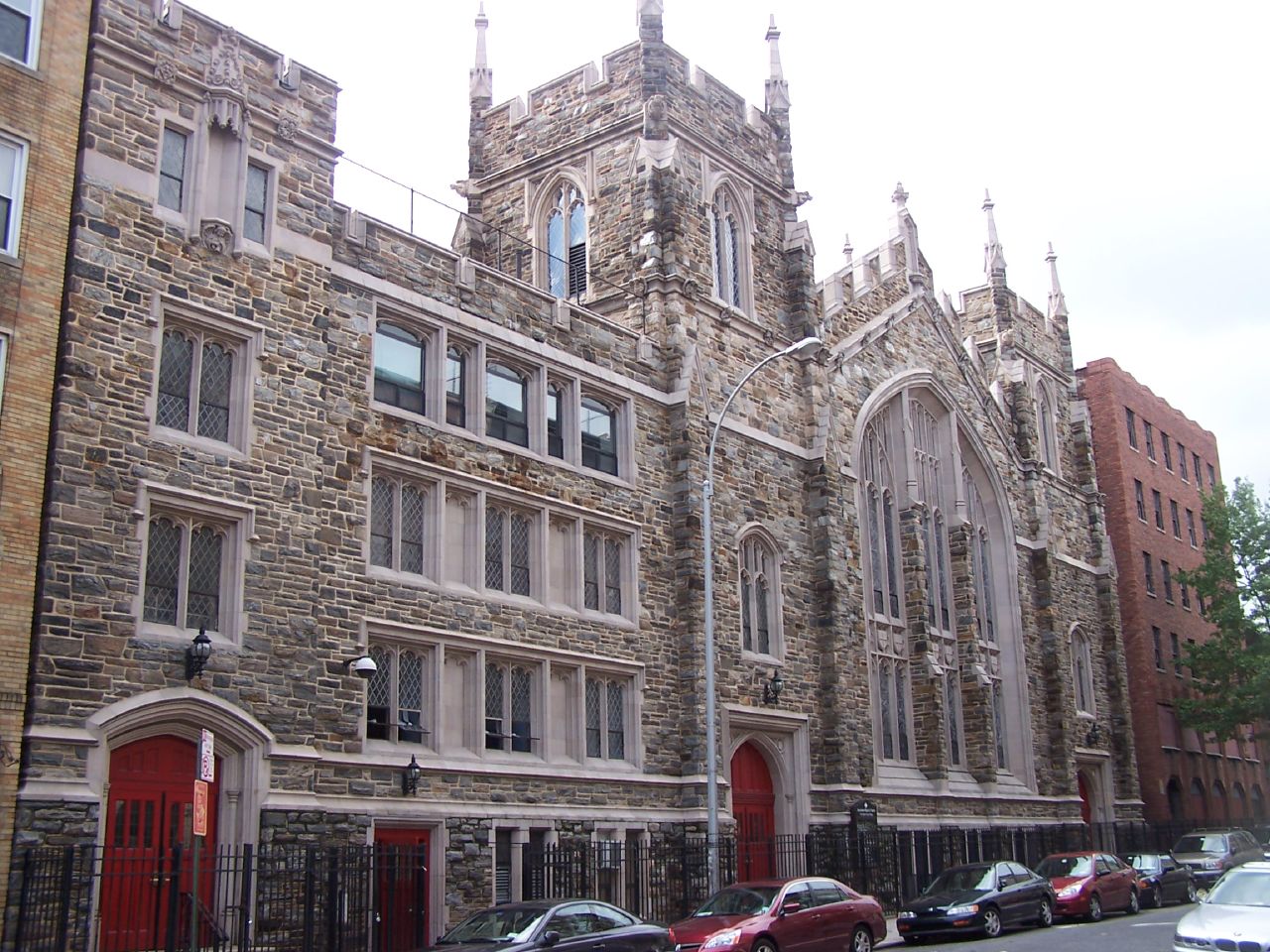
Abyssinian Baptist Church
In 1808, a group of Ethiopian seamen and free Black New Yorkers stood up and walked out of a church that expected them to sit in segregated pews. They did not go looking for another church to attend. They founded their own. They named it Abyssinian Baptist, after the ancient name for Ethiopia, and in doing so planted the seed of what would become the largest African American congregation in New York City, the largest Baptist congregation in the world, and one of the most politically consequential churches in American history. The walk from those first meetings on the corner of William and Frankfort Streets in lower Manhattan to the present sanctuary at 132 West 138th Street in Harlem took more than a century and passed through at least seven locations.
A Congregation in Motion
Abyssinian Baptist spent its first hundred years migrating northward through Manhattan, tracing the path of the city's Black population. From William and Frankfort Streets, the congregation moved to 44 Anthony Street, until the mortgage was foreclosed in 1854. They worshipped temporarily at 356 Broadway, then settled at 166 Waverly Place in Greenwich Village, in a neighborhood then sometimes called "little Africa." Internal conflict drove a split in the 1880s, with Reverend William M. Spelman ousted from the pulpit in 1885, taking a faction with him to 37th Street. By 1902, the congregation had moved uptown to 242 West 40th Street. The decisive leap came under Adam Clayton Powell Sr., who became pastor in 1908 and pitched a tent next to what would become Marcus Garvey's Liberty Hall in Harlem. Under his preaching, the congregation's size exploded. By 1930, Abyssinian Baptist had 13,000 members.
The Young German in the Pews
In 1930, a young German theology student arrived in New York for postgraduate study at Union Theological Seminary. His name was Dietrich Bonhoeffer. A Black fellow seminarian named Frank Fisher introduced him to Abyssinian Baptist, where Bonhoeffer taught Sunday school and fell in love with African American spirituals, taking a collection of recordings back to Germany. He listened to Adam Clayton Powell Sr. preach what the pastor called the Gospel of Social Justice, and something shifted in the young theologian. He later described the experience as the point at which he "turned from phraseology to reality." Bonhoeffer observed that at Abyssinian, "one can truly speak and hear about sin and grace and the love of God... the Black Christ is preached with rapturous passion and vision." On his return to Germany, these convictions fueled his outspoken opposition to the Nazi regime and its persecution of Jews, a resistance that ultimately cost him his life.
Music at the Crossroads
The church was never simply a place of worship and politics. It was a center of the Harlem gospel tradition and an important site for religious music during the Harlem Renaissance. Fats Waller played the organ at Abyssinian when his father, Edward Martin Waller, served as a minister there, learning the instrument that would anchor his career. The church conducted the wedding of Nat King Cole and Maria Ellington Cole, and in 1958 hosted the funeral of W.C. Handy, known as the Father of the Blues. These were not incidental events. They reflected the church's position at the intersection of Black spiritual life, artistic expression, and public ceremony, a place where the sacred and the cultural were understood as inseparable.
Building Beyond the Sanctuary
In 1989, Reverend Calvin Butts founded the Abyssinian Development Corporation, creating a nonprofit arm of the church devoted to community development and social services. The ADC produced $500 million in development over the following decades, including the first new high school in Harlem in fifty years, the first large supermarket in the neighborhood, a retail center, and housing. Yet the church's development ambitions also courted controversy. The ADC purchased the neighboring Renaissance Ballroom and Casino, a historic Harlem cultural landmark, in 1993 with promises of restoration. Instead, the organization fought landmark status for the building in 2007, sold it in 2014, and the original structure was demolished in 2015 to make way for condominiums. The episode illustrated the complex tensions between community development and historic preservation that define modern Harlem.
An Act of Walking Out
The church and its community house were designated a New York City Landmark on July 13, 1993, a formal recognition of what the congregation had embodied since its founding: the insistence that dignity is not negotiable. Abyssinian Baptist Church exists because a group of people refused to accept the seats they were assigned. Every chapter of its history, from the migrations through lower Manhattan to the political activism of the Powell era to the development fights of the twenty-first century, flows from that original act of refusal. The building at 132 West 138th Street, with its stained glass windows and marble furnishings, stands between Adam Clayton Powell Jr. Boulevard and Lenox Avenue, not as a relic of a bygone era, but as a living institution still shaping the neighborhood and the nation.
From the Air
Located at 40.817N, 73.942W at 132 West 138th Street in Harlem, Manhattan, between Adam Clayton Powell Jr. Boulevard and Lenox Avenue. The church is in the Strivers' Row area of central Harlem. Nearest airports: KLGA (LaGuardia, 6nm east), KTEB (Teterboro, 10nm northwest). Central Park is visible to the south; the Harlem River and the Bronx are to the east.