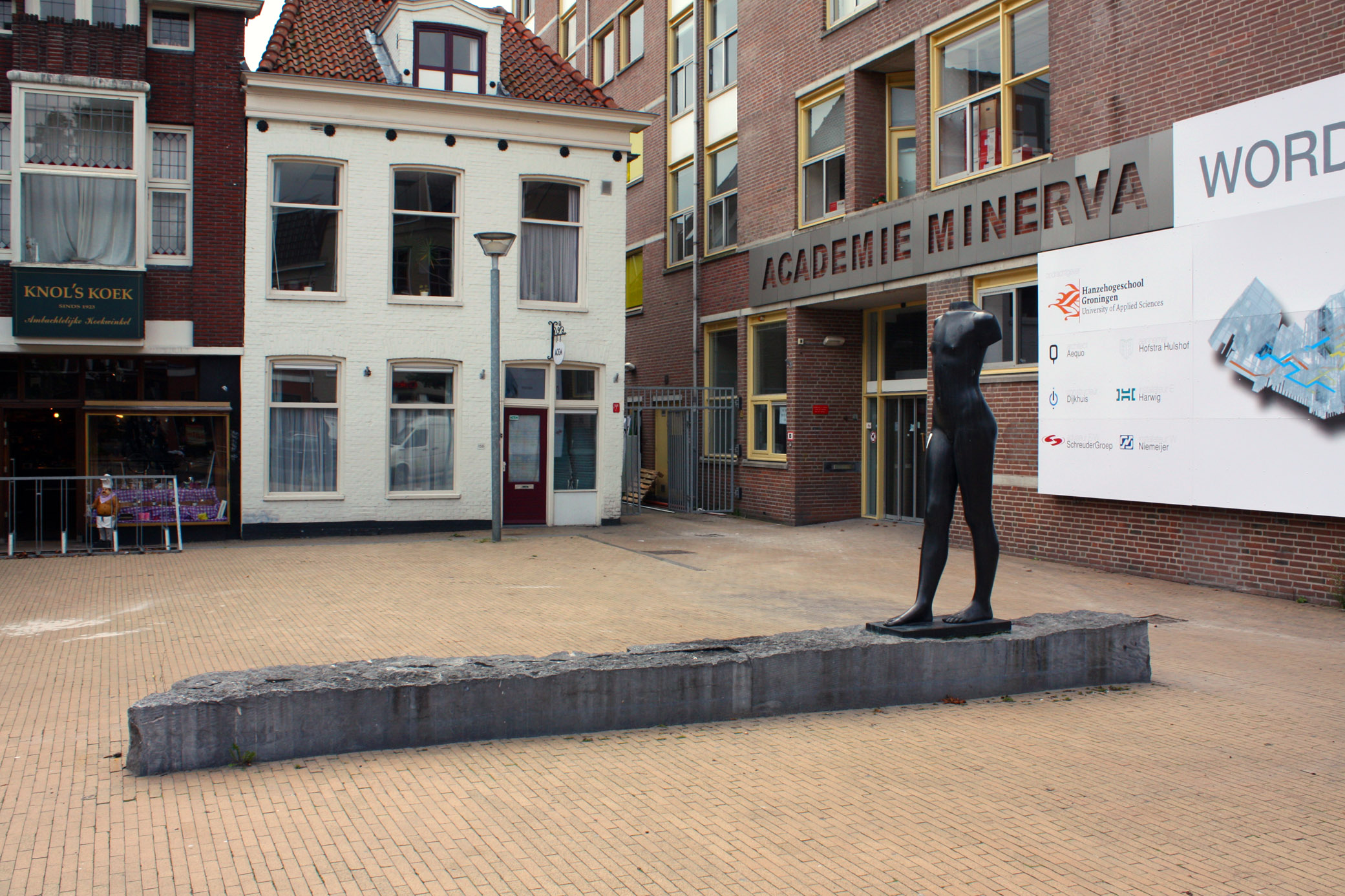
Academie Minerva
In January 1798, with the French revolutionary armies still recasting the political map of Europe, six citizens of Groningen unlocked a borrowed room and opened a school. Their idea was unusual even by the standards of an unusual century. Under one roof they would teach drawing, building, and seafaring. A boy who wanted to be a painter and a boy who wanted to captain a North Sea schooner could, in principle, sit on the same bench. That improbable hybrid is the seed from which Academie Minerva, the oldest art academy in the Netherlands, grew.
Painters and Pilots
Gerardus de San took charge of the drawing department first. By October 1798 the construction and nautical classes were running too. Groningen was a port city of canals and brick warehouses, looking out over the Wadden Sea toward Hamburg and London, and any school worth its name had to serve both the merchant houses and the artists who decorated their walls. The arrangement persisted, in one form or another, for more than a century. As late as the post-war years, students of the merchant navy school still wore sailor uniforms on academy grounds and lived together in a municipal boarding school called the Admiraal Van Kinsbergen on Noorderstationsstraat, just up the road from the painters' easels.
The Society That Became Minerva
In 1820, an Art-loving Society with a sentence-long Dutch name, Kunstlievend Genootschap ter aanmoediging en bevordering van teken-, schilder-, graveer-, en beeldhouwkunst, was founded to give amateur artists and connoisseurs in the city formal instruction. From 1824 it began holding drawing and painting competitions, first for residents of the province and later for any Dutch citizen. The Society and the older school overlapped uneasily until financial pressure forced a merger in 1838. The fused institution took the name Minerva, after the Roman goddess of wisdom and crafts, and the name has stuck through every reorganization since. A rival association, Pictura, was set up four years earlier in 1832 to keep the local-only competitions alive once Minerva opened its doors to the whole country.
Modernism on the North Sea
In 1913 the academy was folded into a larger secondary technical school, a municipal institute that combined applied arts, architecture, and the nautical school under one bureaucratic roof. The buildings that housed them, designed by Jan Wiebenga and Leendert van der Vlugt, were among the cleanest examples of early Dutch modernism in the north. As the technical and nautical wings expanded after the Second World War, the art department found itself increasingly crowded out. In 1964 it broke off again as an independent Academie voor Beeldende Kunsten. Two decades of itinerant teaching in borrowed spaces followed. In 1984 Minerva finally moved into a building of its own, designed by Piet Blom, the eccentric architect best known for the cube houses in Rotterdam, who gave the school an unmistakably theatrical home.
The Northern Eye
Minerva has shaped, and been shaped by, a distinctly northern strand of Dutch art. Members of De Ploeg, the expressionist circle founded in Groningen in 1918, studied there, and the academy has long served as a kind of nursery for what would later be called the Group of Figurative Abstraction. Its alumni list reads as a casual roll call of Dutch visual culture: Jozef Israels of the Hague School, born here and trained here before he ever painted the somber fisherfolk that made him famous; Otto Eerelman, the official painter of Queen Wilhelmina's coronation horses; Wim Crouwel, the graphic designer who redrew the look of Dutch institutional life in the 1960s; the contemporary photographer Awoiska van der Molen, whose dark, glowing landscapes feel like night-shifted descendants of the Dutch Golden Age. The annual Coba de Groot Stipendium and the Klaas Dijkstra Academy Prize keep the cycle of recognition turning.
Two Cities, One School
Minerva today is part of the Hanze University Groningen and organizes itself around three main tracks: Fine Art, Design, and Teacher of Fine Art and Design. A separate Academy for Pop Culture in nearby Leeuwarden, focused on popular music and design, operates under the same Minerva umbrella. The old nautical wing has long since split off, the seafaring school merging with the Maritime Academy Abel Tasman in Delfzijl, the technical school becoming part of the wider Hanze University. The painters and the sailors no longer share a classroom. But every Minerva student still studies inside an institution whose founding charter quietly insisted that the eye and the hand belong together, whether they are pointed at a horizon or a canvas.
From the Air
Located at 53.21 N, 6.56 E in the historic center of the city of Groningen. From cruise altitude the city sits at the junction of canals and rail lines on the flat northern Dutch plain, with the Martinitoren tower visible as a small dark spike. Academie Minerva's Piet Blom-designed building is in the southern part of the inner city near the Praediniussingel canal. Nearest airports: Groningen Airport Eelde (EHGG) about 10 km south, Bremen (EDDW) about 170 km east.