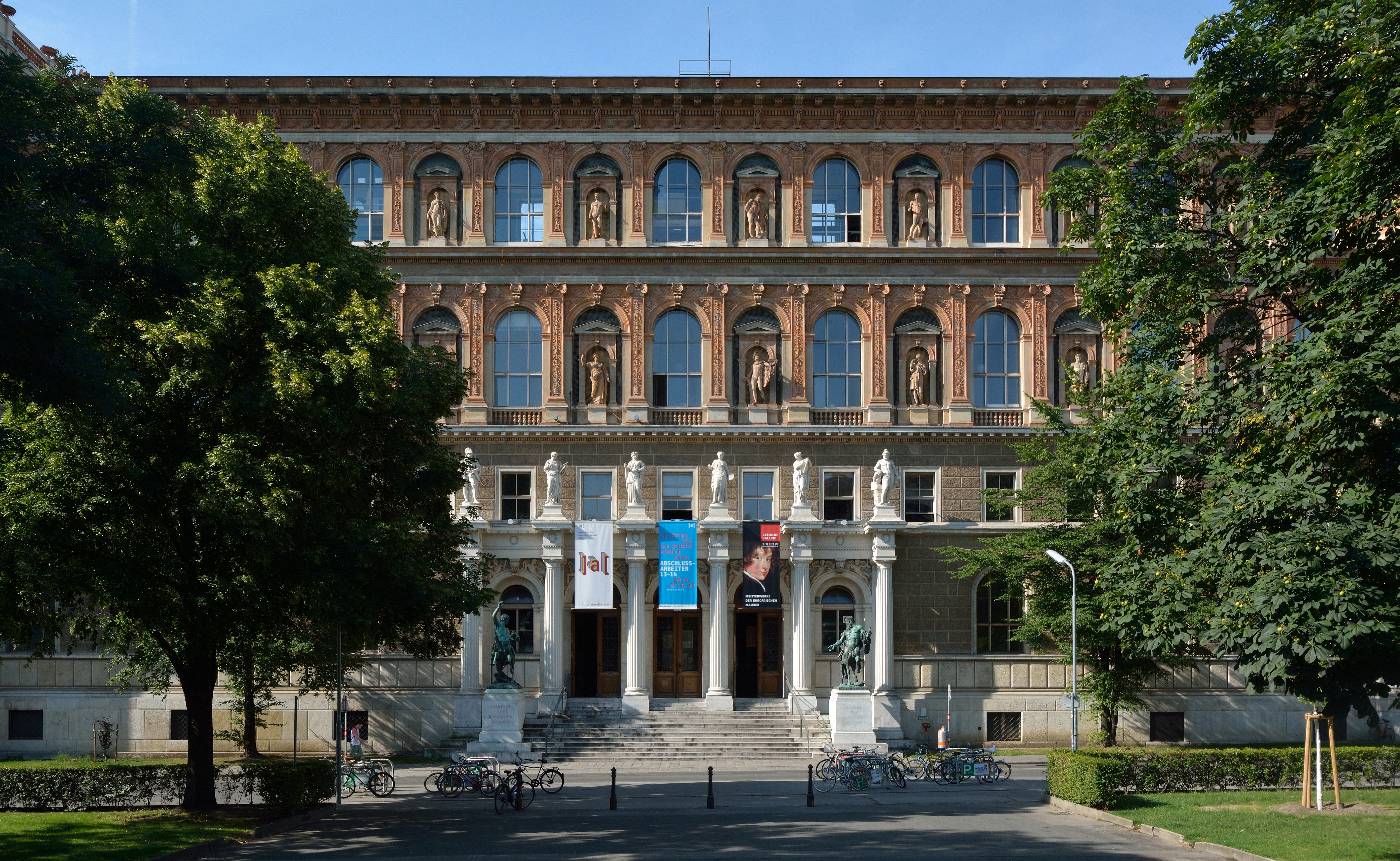
Academy of Fine Arts Vienna
Twice rejected. In 1907 and again in 1908, a young man from Linz named Adolf Hitler walked into the Academy of Fine Arts Vienna, submitted his portfolio, and was turned away by professor Christian Griepenkerl. It is a moment that alternative-history novelists cannot stop reimagining -- Eric-Emmanuel Schmitt built an entire novel around it -- because the decision seemed so small at the time. A single unknown student, an unremarkable admissions committee meeting. The academy's professors could not have known they were deciding anything beyond the fate of one mediocre watercolorist. But the building on Schillerplatz, with its Theophil Hansen facade and its Anselm Feuerbach ceiling frescoes, had been making and breaking artistic careers for more than two centuries before Hitler arrived, and it has continued doing so for more than a century since.
A Court Painter's Private Venture
The academy began in 1688 as the private project of Peter Strudel, a court painter who modeled it after Rome's Accademia di San Luca and the Parisian Academie de peinture et de sculpture. Emperor Joseph I rewarded Strudel with a barony in 1701, making him Freiherr of the Empire. When Strudel died in 1714, the academy closed. It took until 1725 for Emperor Charles VI to revive it, appointing the French painter Jacob van Schuppen as director and rechristening the institution as the Imperial and Royal Court Academy of painters, sculptors, and architecture. Under Maria Theresa's reforms in 1751, and later during the deanships of Michelangelo Unterberger and Paul Troger, the academy's prestige grew steadily. By 1767, archduchesses Maria Anna and Maria Carolina had become its first honorary members -- a signal that art education had become a matter of imperial concern.
The Ringstrasse Showpiece
For nearly two centuries the academy moved between borrowed quarters. That changed in 1872, when Emperor Franz Joseph I elevated the institution to the supreme government authority for the arts and commissioned a building worthy of the title. Architect Theophil Hansen designed the new headquarters as part of Vienna's grand Ringstrasse development, that sweeping boulevard carved from the old city fortifications. The building on Schillerplatz opened on April 3, 1877, though interior work -- including Anselm Feuerbach's ceiling frescoes -- continued until 1892. Hansen gave the academy an Italian Renaissance facade that announced its ambitions in stone. Inside, the art collection had been growing since 1822, when honorary member Count Anton Franz de Paula Lamberg-Sprinzenstein bequeathed a collection that still forms the backbone of the gallery's holdings. Today the Kupferstichkabinett alone holds approximately 150,000 drawings and prints.
Darkness and Reconstruction
The Anschluss of 1938 brought the academy under Nazi control. Like all Austrian universities, it was forced to purge Jewish faculty and students under the Nuremberg Laws -- the same racial ideology that its most infamous rejected applicant had helped to create. The institution that had refused Hitler became an instrument of the regime he built. After the war, reconstruction was slow. The academy was not formally reconstituted until 1955, when Austria regained full sovereignty. Secretary Eduard von Josch was dismissed for Nazi Party membership. The institution had to reckon with what it had become and what it had lost -- not just the art and scholarship destroyed during the war, but the people expelled from its halls who never returned.
Painting, Pixels, and Philosophy
Walk through the academy today and the range is striking. Thirteen departments span everything from Abstract Painting and Figurative Painting to Art and Digital Media, Video and Video-installation, and something called Textual Sculpture. The six institutes cover fine arts, art theory and cultural studies, conservation and restoration, natural sciences in art, teacher education, and architecture. About 900 students study here, nearly a quarter of them from abroad. Faculty have included the philosopher Peter Sloterdijk, and alumni range from Friedensreich Hundertwasser, whose riotous, organic architecture rejected everything the Ringstrasse stood for, to Gottfried Helnwein, whose hyperrealist paintings confront viewers with imagery they would rather not see. The library holds roughly 110,000 volumes. Three centuries after a court painter's private experiment, the academy remains one of the most internationally recognized art schools in the German-speaking world.
From the Air
Located at 48.20N, 16.37E in central Vienna, on Schillerplatz in the Innere Stadt (1st district), near the Ringstrasse. The building sits southwest of the Staatsoper (Vienna State Opera). Best viewed from 2,000-3,000 feet AGL where Vienna's historic center and the Ringstrasse's boulevard layout are visible. Nearest major airport: Vienna International Airport (LOWW), approximately 10 nm southeast. The Danube and Donaukanal provide useful visual references when approaching from any direction.