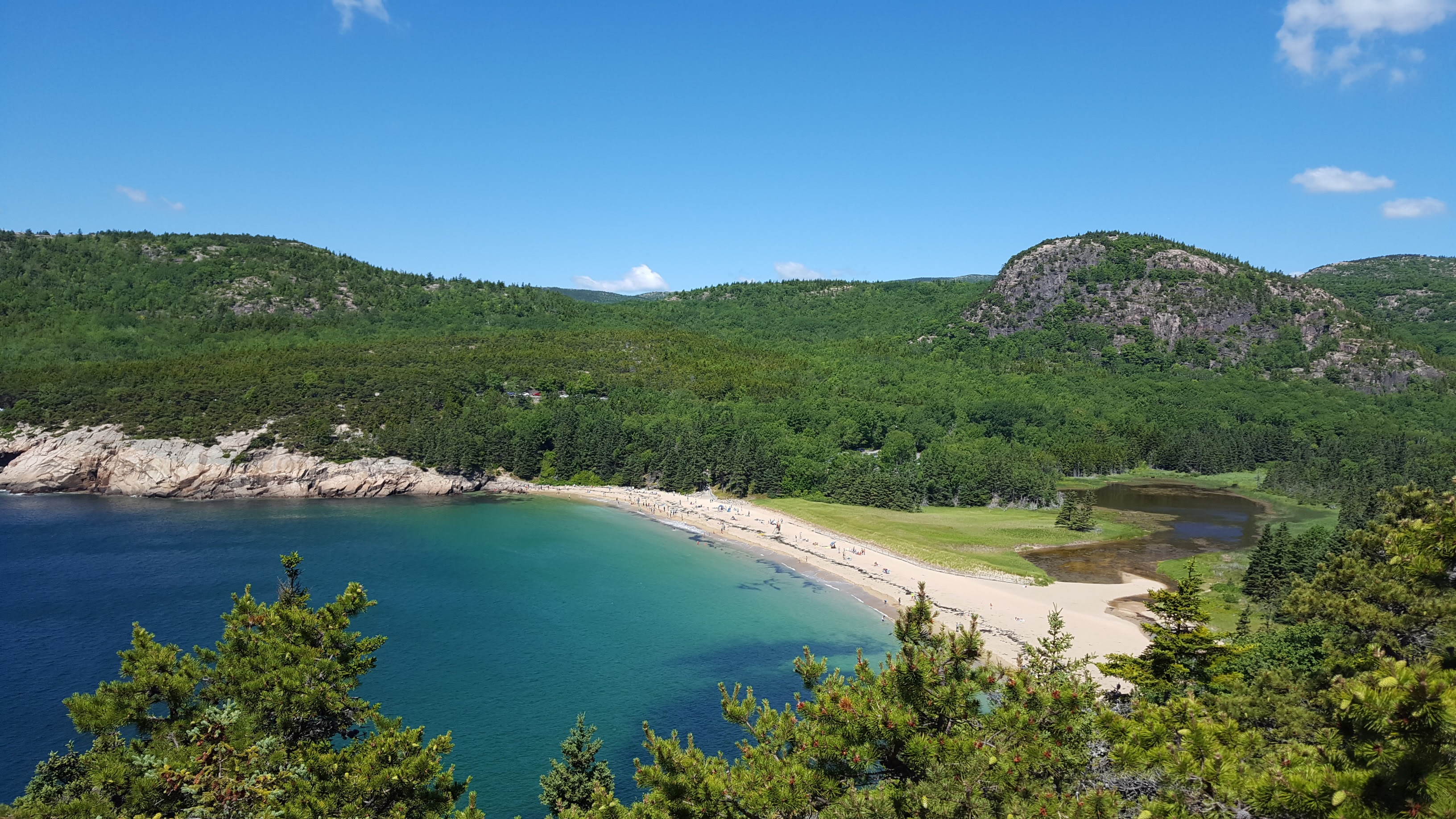
Acadia National Park
The sun rises here first. On the summit of Cadillac Mountain, 466 meters above the pounding Atlantic, you can watch the first rays of dawn touch American soil - at least from October through March, when the angle is right. Below, the Maine coast fractures into a maze of granite headlands, spruce-dark islands, and coves where lobster boats bob at their moorings. This is Acadia, New England's only national park, where the mountains of an ancient range tumble directly into the sea. The Wabanaki people called this place 'the sloping land,' and from any summit, you understand why: everything tilts toward the water, toward the endless blue horizon.
Ice-Carved Grandeur
Eighteen thousand years ago, a glacier a mile thick sat on this landscape, pressing down with unimaginable weight. When it finally retreated, it left behind Mount Desert Island - the third-largest island on the US Atlantic coast - and a terrain unlike anywhere else in eastern America. The mountains are smooth on their northern slopes where the ice advanced, but shattered into cliffs on their southern faces where the ice plucked rock away. Valleys became glacial lakes. Somes Sound became the only fjord on the American Atlantic coast.
The granite itself is 400 million years old, pink and grey, exposed by the glacier's scouring. It forms the bald summits that give Acadia its distinctive look - treeless domes rising above dense forest, offering 360-degree views that sweep from the mainland to the open ocean. On a clear day, you can see Canada.
The Carriage Roads
John D. Rockefeller Jr. loved horses and hated automobiles. When cars began appearing on Mount Desert Island in the early 1900s, he responded by building 45 miles of carriage roads through the mountains - graded for horse-drawn vehicles, surfaced with crushed stone, crossed by seventeen stone bridges that look like they've stood for centuries. He designed them to showcase the landscape, with carefully planned vistas opening at each turn.
The cars won, of course. But Rockefeller's roads remain, now used by hikers, cyclists, and cross-country skiers. They wind through forest and along lake shores, past beaver ponds and through gaps in the granite ridges. The bridges are works of art - each one different, built from local stone, blending into the landscape as if they'd grown there. No motorized vehicles allowed. The only sounds are footsteps, birdsong, and wind in the spruce.
Where the Trails Go
Acadia packs remarkable hiking into a small space - 158 miles of trails across just 49,000 acres. Some are gentle lakeside strolls. Others are serious scrambles up granite faces, with iron rungs and ladders bolted into the rock. The Precipice Trail on Champlain Mountain is essentially a via ferrata, closed when peregrine falcons nest on its cliffs but otherwise open to anyone willing to climb iron rungs up exposed rock faces.
The payoff is always the view. From the open summits - Cadillac, Champlain, Dorr, Penobscot - the Atlantic stretches to infinity. Islands dot Frenchman Bay like scattered stones. The forests below shift from the deep green of spruce to the paler hues of birch and maple. In October, when the foliage peaks, the hills burn with color, reds and oranges and golds cascading down to the blue water.
The Dark Sky
On a clear night, away from Bar Harbor's lights, Acadia becomes one of the darkest places on the East Coast. The Milky Way arcs overhead in a band of ancient light, dense enough to cast faint shadows. Meteor showers spark and flare. The only sounds are waves on rock and the occasional cry of an owl.
The park actively protects this darkness, one of the last pockets of natural night sky in the crowded Eastern Seaboard. Rangers lead night sky programs. The park road becomes an informal observatory, cars pulled over at overlooks, families wrapped in blankets, faces turned upward. In a region where most people have never seen true darkness, Acadia offers something increasingly rare: the universe, unfiltered.
The Living Coast
The tidal pools are worlds in miniature. At low tide, the granite ledges expose communities of sea stars, urchins, anemones, and crabs. Harbor seals haul out on offshore rocks. Bald eagles soar over the headlands. In the forests, 273 species of birds have been recorded - warblers, woodpeckers, the chickadee that serves as Maine's state bird.
The ocean shapes everything here. Fog rolls in without warning in summer, muffling sound and limiting visibility to a few meters. Storms pound the exposed headlands with waves that throw spray fifty feet into the air. Thunder Hole, a narrow inlet in the granite, roars when the conditions are right, compressing incoming waves into explosive booms. The water is cold year-round - hypothermia territory for swimmers, but home to the lobsters that have sustained Maine's coastal economy for generations.
From the Air
Located at 44.2°N, 68.3°W on Maine's Downeast coast. Mount Desert Island is clearly visible - look for the distinctive shape with Somes Sound nearly bisecting it (the only fjord on the US Atlantic coast). Cadillac Mountain (466m) is the highest point on the US Atlantic coast and unmistakable. The pink granite summits contrast with dark spruce forest. The park encompasses most of the island plus portions of Isle au Haut to the south and the Schoodic Peninsula to the east. Bar Harbor sits on the northeast shore. Nearest airports: Hancock County (KBHB) 12km from park, Bangor International (KBGR) 80km. The coast is heavily indented with numerous islands. Summer fog common, especially June-August. Fall foliage peaks early October - spectacular color visible from altitude.