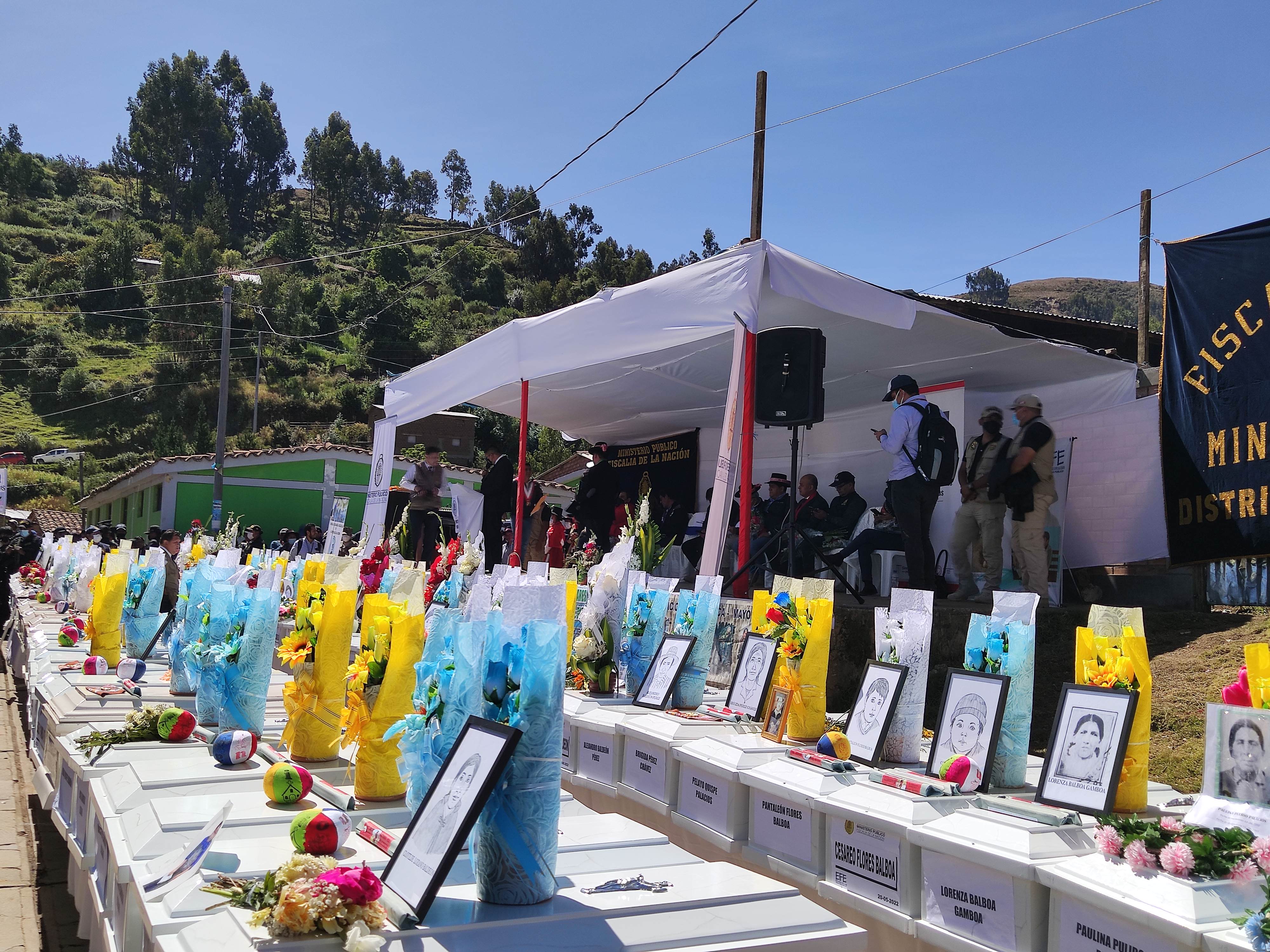
Accomarca massacre
Two twelve-year-old girls, Teófila Ochoa Lizarbe and Cirila Pulido Baldeón, saw and heard everything. They watched as soldiers went house to house in the hamlet of Quebrada de Huancayoc, dragging villagers from their homes, beating them with rifle butts, and herding them into buildings. They heard the gunfire, and then the screams, as the soldiers set the buildings ablaze. On August 14, 1985, the Peruvian Army killed approximately 69 unarmed civilians — men, women, and children — in the peasant village of Accomarca, in the Ayacucho region of Peru. The two girls survived to testify to what had happened.
Orders from Above
The massacre did not emerge from chaos. It was planned in a meeting attended by Second Lieutenant Telmo Hurtado Hurtado, Lieutenant Juan Rivera Rondón, and Major José Daniel Williams Zapata, commander of Lince Company. The Army's Chief of the Political-Military Command for the emergency zone had ordered an operational plan to "capture and/or destroy terrorist elements" in the Accomarca area. Two patrol units — Lince 6 under Rivera Rondón and Lince 7 under Hurtado — were selected to carry it out. The attendees were told that any villager found in Quebrada de Huancayoc should be considered a communist terrorist. With that order, the distinction between combatant and civilian — between a Shining Path guerrilla and a farming family — was erased on paper before it was erased in blood.
What Happened in the Quebrada
On the morning of August 14, the two patrol units moved into Quebrada de Huancayoc. Rivera Rondón's troops blocked escape routes while Hurtado's soldiers swept through the settlement. Villagers were pulled from their homes and beaten. They were lined up and forced into houses where soldiers opened fire on entire families. The buildings were then set on fire. According to the Center for Justice and Accountability, which later documented the case, approximately 100 unarmed civilians were killed during the operation. The official count recognized 69 dead, though some accounts place the number at 74. Among them were children. These were farming families in a remote Andean hamlet — people whose lives were defined by subsistence agriculture, not insurgency. The military had declared them terrorists in a meeting room, and that declaration became their death sentence.
Amnesty and Escape
In 1993, the Peruvian military justice system convicted Telmo Hurtado of abusing his authority and giving false statements — not for the killings themselves. The conviction was a gesture toward accountability that stopped well short of it. When the Fujimori government granted blanket amnesty for crimes committed during the internal conflict, even that token sentence was erased. Hurtado walked free. After the amnesty was repealed in 2002, Hurtado did not wait for civilian justice. He fled to the United States, where he was eventually detained on an immigration violation. His presence on American soil created an unexpected legal opening: two survivors of the Accomarca massacre filed a civil lawsuit against him in a federal court in Miami.
Justice in a Foreign Court
The lawsuit accused Hurtado of extrajudicial killings, torture, war crimes, and crimes against humanity. In 2008, a judge in Miami found Hurtado responsible for the massacre and ordered him to pay $37 million in damages to the victims. It was a civil ruling, not a criminal conviction, and whether the survivors would ever see the money was uncertain. But the judgment accomplished something that decades of Peruvian legal proceedings had not: it placed individual responsibility for the killings on the record, in a court of law, with the names of real victims attached. For the survivors and the families of the dead, the ruling meant that what happened in Quebrada de Huancayoc could no longer be officially denied or quietly forgotten.
The Weight of the Andean Silence
Accomarca sits in the Ayacucho region, the heartland of Peru's internal conflict, where the Shining Path launched its insurgency in 1980 and where the state's response was most devastating. The Peruvian Truth and Reconciliation Commission documented hundreds of similar episodes across the highlands — villages caught between a brutal insurgency and a military that treated poverty and indigenous identity as evidence of subversion. The Accomarca massacre became nationally notorious, one of the clearest cases of state terrorism during a conflict that killed an estimated 69,000 people. The two girls who survived to bear witness, Teófila and Cirila, carried the memory of that morning for the rest of their lives. The landscape around Accomarca is steep, terraced farmland climbing into thin air, a place that feels impossibly far from the meeting rooms where their neighbors' fates were decided.
From the Air
Accomarca is located at approximately 13.16°S, 74.22°W in the Ayacucho Region of Peru, in the central Andes. The village sits in a steep valley at high elevation, surrounded by terraced agricultural land. From 8,000–12,000 feet AGL, the settlement is visible as a small cluster amid the dramatic Andean topography. The nearest significant airport is Coronel FAP Alfredo Mendivil Duarte Airport (SPHO) in Ayacucho, approximately 60 km to the northeast. Expect variable weather with frequent clouds and limited visibility, especially during the rainy season (December–April).