Achill-henge
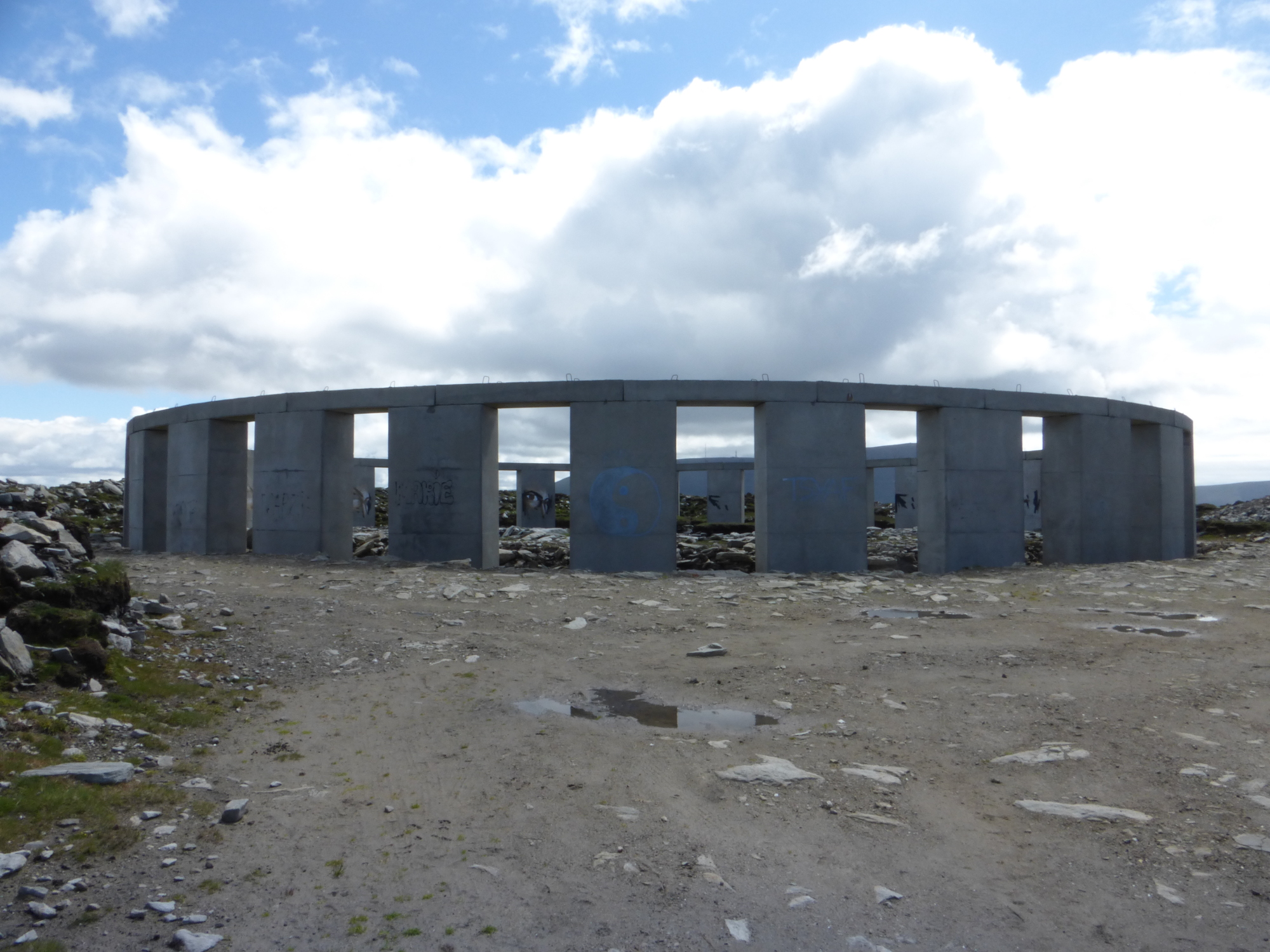
In November 2011, while Ireland was still reeling from the worst financial crisis in the history of the state, a property developer named Joe McNamara hauled thirty concrete columns up a hill on Achill Island, sank them into the bog, and topped them with a ring of concrete. The structure -- over four meters high and a hundred meters in circumference -- appeared over a single weekend. He had no planning permission. He offered no explanation beyond calling it an 'ornamental garden.' Ireland had its newest and most bewildering monument.
The Man Behind the Concrete
To understand Achill-henge, you have to understand Joe McNamara. Before he built an illegal henge on a remote Atlantic island, he had already achieved notoriety by driving a concrete mixer truck into the gates of Leinster House, the Irish parliament building, during a protest against Anglo-Irish Bank and the government's handling of the financial crisis. The truck damaged the gateway's paintwork. McNamara was charged with criminal damage and dangerous driving. He was found not guilty of both. The incident made him a folk hero to many Irish people who felt betrayed by the banking collapse and the austerity that followed. The henge was his next act -- bigger, more permanent, and considerably harder for the authorities to remove.
An Ornamental Garden (Apparently)
Mayo County Council was not amused. They sought a court order to force McNamara to demolish the structure, which had been built without planning permission on a hilltop bog on Achill Island. McNamara's defense was creative: he claimed the structure was exempt from planning rules because it was an ornamental garden. The claim did not persuade the courts. Theresa McDonald, director of the Achill Archaeological Field School, raised a more serious objection -- the henge may have been built within close proximity to a genuine Bronze Age archaeological site. The High Court ordered McNamara to cease all further work, and when he was found in breach of that order, the council's position was upheld. The term 'Achill-henge' itself carries a note of irony: real henges in Ireland are called stone circles, and McNamara's concrete pillars bear no structural or cultural resemblance to any prehistoric monument in the country.
The Henge Abides
Here is the remarkable thing: despite court orders, county council objections, and planning refusals, Achill-henge is still standing. As of 2024, the concrete circle remains on its hilltop, slowly weathering into the Achill landscape. Removing it would be expensive and logistically difficult -- the same remoteness that made Achill Island a striking location for the protest also makes demolition a bureaucratic headache. A newspaper poll found a majority of locals in support of keeping the structure, and some expressed admiration for it as a feat of engineering. Whether it is art, protest, vandalism, or garden ornament remains a matter of perspective. McNamara has since built another controversial structure -- 'Unhenged,' a henge in Brentwood, Essex -- suggesting that his appetite for unauthorized concrete monuments remains undiminished.
Concrete and Defiance on the Atlantic Edge
Achill Island is Ireland's largest island, connected to the mainland by a bridge, its landscape a dramatic collision of sea cliffs, blanket bog, and deserted villages. It is a place associated with remoteness, with hardship, with a kind of stubborn beauty. Achill-henge fits this context better than its creator may have intended. From the air, the concrete ring is visible on the hillside -- a pale circle against the dark bog, incongruous and oddly compelling. It is not Stonehenge. It is not even a henge. But it is, in its own absurd way, a monument to a very specific moment in Irish history: the rage and helplessness that ordinary people felt when the banks collapsed, the government bailed them out, and the bill came due. That the monument is illegal, unauthorized, aesthetically questionable, and impossible to remove only makes it a more fitting symbol of the chaos it commemorates.
From the Air
Located at 53.98°N, 10.10°W on Achill Island, off the northwest coast of County Mayo. The henge is visible from moderate altitude as a pale concrete circle on a dark bog hillside. Achill Island is Ireland's largest island, connected to the mainland by a bridge. Nearest airports: Knock Airport (EIKN), approximately 80 km southeast; Connemara Regional Airport (NNR), approximately 70 km south. The island features dramatic sea cliffs along its western coast.