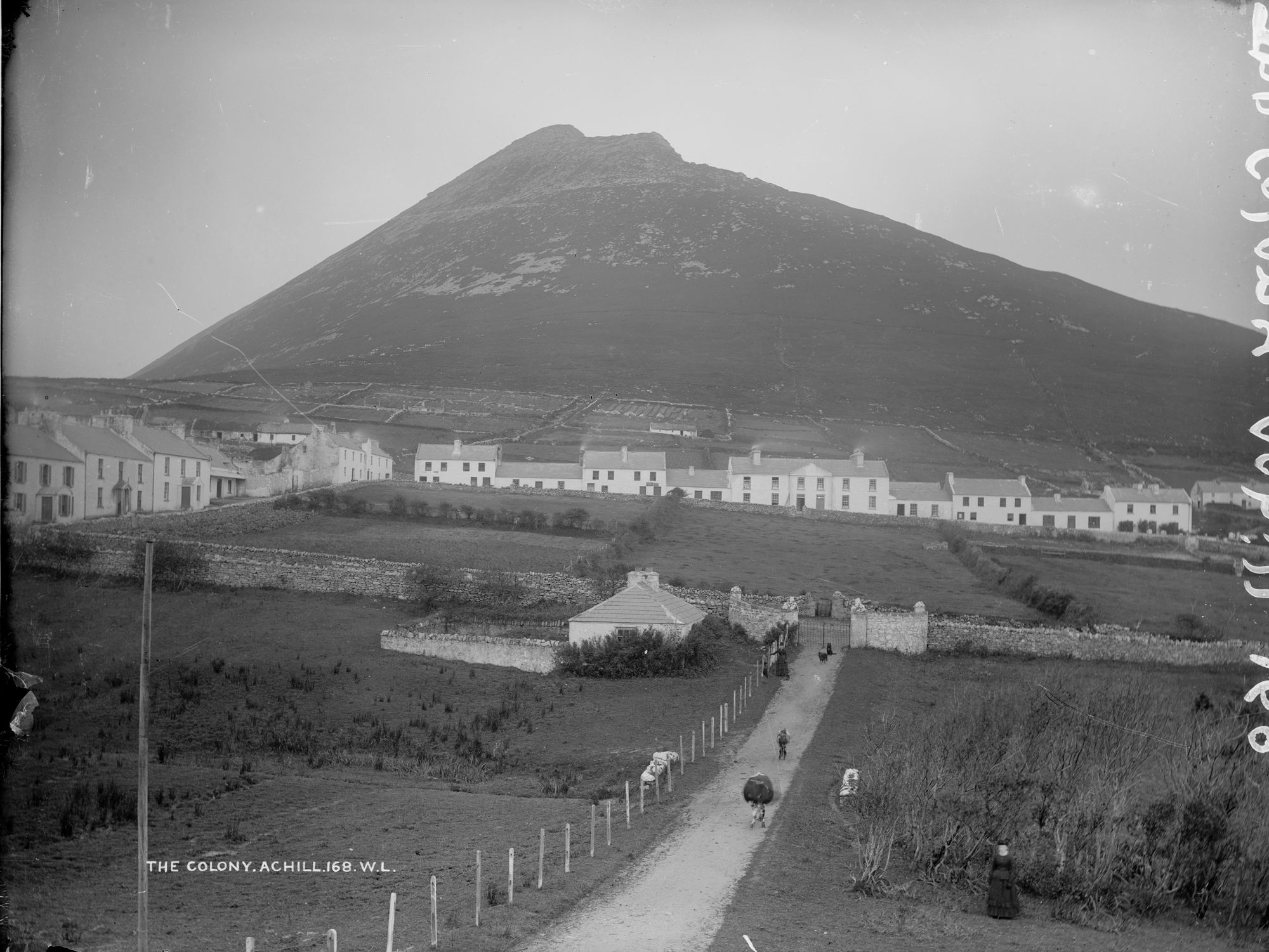
Achill Island
A 17th-century Mayo prophet named Brian Rua U'Cearbhain foretold that 'carriages on wheels with smoke and fire will come to Achill and the first and last carriages will carry dead bodies.' When the railway finally reached Achill Sound in 1894, its first journey brought home 32 victims of the Clew Bay drowning disaster - young men whose overcrowded boat capsized as they transferred to a steamer bound for Scotland and seasonal potato-picking work. The line closed in 1937, and one of its final runs carried ten Achill men who had died in a fire at their Scottish bothy. The prophecy had been fulfilled, though no supernatural power was needed to predict tragedy for a community so poor that its young people had to cross the sea to survive.
The Deserted Village
On the slopes of Slievemore mountain stand 80 roofless stone cottages, their walls still defining the rooms where families once lived, their vegetable plots still visible as rectangular depressions in the ground. This is the Deserted Village, abandoned when the Great Famine struck in 1845 and the surviving residents moved to Dooagh on the coast to take up fishing when the potato crops failed. Yet the village wasn't entirely forgotten: until the 1940s, herders used these cottages as 'booley' summer dwellings, bringing cattle to the mountain pastures in an ancient practice of transhumance that connected Achill to pastoral traditions stretching back millennia. Today visitors walk freely among the ruins, reading the landscape for traces of lives lived at the edge of survival.
Cliffs and Currachs
At Keem Bay, where the R319 road ends in a sweeping arc of sand, the mountain of Croaghaun rises behind and plunges on its far side in sea cliffs that rank as the third-highest in Europe. Here in the 1950s and 60s, local fishermen launched currachs - the traditional skin boats that had served Irish coastal communities for centuries - to hunt basking sharks for their liver oil. The oil lubricated the aerospace industry: these same frail boats that Saint Patrick might have recognized helped build Concorde and launched Telstar. The basking shark fishery ended, but the cliffs remain, accessible by a walking trail that leads west from the bay to views that drop away vertically to the Atlantic hundreds of meters below.
The Banshees Return
In 2023, the film The Banshees of Inisherin brought Achill international attention, though the fictional island of Inisherin doesn't exist. Director Martin McDonagh filmed across Achill's landscapes: the pub at Doogort, the beaches at Keem, the stone-walled fields that give the island its patchwork appearance from above. The film's melancholy tone matched something essential about Achill, a place where beauty and hardship have always coexisted, where the views can be sublime and the weather brutal, where writers from Heinrich Boll to Graham Greene sought inspiration in the island's mix of isolation and community. A Banshees of Inisherin Locations Trail now guides visitors to filming sites, though the island had been drawing those seeking the authentic rural Ireland long before the cameras arrived.
Bridge to Another World
The Michael Davitt Bridge connects Achill to the mainland, named for the founder of the National Land League who fought for tenants' rights in an era when landlords could evict families at will. The bridge has been replaced twice since 1887 - modern traffic and salt corrosion wearing out structures faster than the engineers anticipated - and the current version dates to 2008. Crossing it feels like entering another world: mobile phone signal weakens (only Three provides reliable coverage), the roads narrow, and the landscape opens into heath and mountain. The island stretches about 20 kilometers from the bridge at Achill Sound to its western tip, with most services concentrated in Keel and Dooagh near the western end. Visitors who arrive by the sparse bus service or by car discover an Ireland that tourism has touched but not transformed.
From the Air
Located at 53.96N, 10.04W off the western coast of County Mayo, Ireland. Ireland West Airport Knock (EIKN/NOC) lies approximately 70 km to the east. The island is connected to the mainland by bridge and stretches roughly 20 km east-west. Croaghaun (688 m) and Slievemore (671 m) dominate the skyline. From altitude, the deserted village on Slievemore's slopes appears as regular stone patterns. The Great Western Greenway cycling path terminates at the bridge. The island's exposed western beaches face the full force of Atlantic weather systems.