Achilleion (Corfu)
"I want a palace with pillared colonnades and hanging gardens, protected from prying glances -- a palace worthy of Achilles, who despised all mortals and did not fear even the gods." Empress Elisabeth of Austria wrote those words after the worst year of her life. Her only son, Crown Prince Rudolf, had died in the Mayerling incident of 1889, a murder-suicide that shattered the Habsburg court. Devastated and increasingly reclusive, Elisabeth turned to the one figure from mythology who seemed to match her sense of defiant suffering: Achilles, the hero who chose a short, glorious life over a long, forgettable one. In 1890, on a hillside in the village of Gastouri on Corfu, she built her refuge.
A Palace for a Wounded Empress
The property had belonged to Petros Vrailas-Armenis, a Corfiote philosopher and diplomat, and was known as Villa Vraila before Elisabeth acquired it in 1888. The palace she built was designed in Pompeian style, intended to evoke the mythical Phaeacian palaces of Homer's Odyssey. The German sculptor Ernst Herter was commissioned to fill the grounds with statuary inspired by Greek mythology, and his Dying Achilles, sculpted in Berlin in 1884, became the centerpiece of the gardens. The statue depicts Achilles gazing skyward, reaching for divine help as he dies, an image that captured Elisabeth's own sense of helpless grief. Paintings and statues of the Trojan War filled the main hall, depicting both heroic and tragic scenes. Elisabeth used the Achilleion as a purely private retreat. She received only her daughters, Marie Valerie and Gisela, with their husbands. Her own husband, Emperor Franz Joseph, disliked sea voyages and never visited. The palace was her solitude made architectural.
The Kaiser's Revision
Elisabeth visited the Achilleion frequently until 1896, then lost interest and considered selling it. After her assassination in Geneva in 1898, the palace changed hands. Kaiser Wilhelm II of Germany purchased it in 1907 and immediately began reshaping the grounds to reflect his own, considerably less melancholy, relationship with Achilles. He commissioned sculptor Johannes Gotz to create a new statue: an imposing bronze Achilles in full hoplite armor, shield emblazoned with a gorgon's head, standing as a guardian of the gardens and facing north toward the city of Corfu. The archaeologist Reinhard Kekule von Stradonitz advised on the statue's placement. Where Elisabeth had seen Achilles as a figure of beautiful doom, Wilhelm saw him as a military ideal. He also removed the statue of the German poet Heinrich Heine that Elisabeth had installed, a small act of cultural revision that spoke volumes about the difference between the palace's two owners. Wilhelm used the Achilleion until 1914, conducting diplomatic business between excavations at the ancient temple of Artemis elsewhere on Corfu.
From Casino to Museum
After World War I, the Achilleion passed through various governmental uses. Artifacts were auctioned off during the interwar period. In 1962, the Greek tourism authority leased the palace to a private company that operated it as a casino, and it was in this incarnation that the Achilleion found its way into popular culture. The 1981 James Bond film For Your Eyes Only used the palace as the setting for a baccarat scene, with Roger Moore's Bond playing chemin de fer in the top-floor casino room while the gardens and their statuary provided the backdrop. The casino closed in 1983, and the palace was converted into a museum managed by the Hellenic Tourism Development Company. It remains the most visited attraction on Corfu. In 2003, it hosted a meeting of European agriculture ministers, a use that would have baffled both Elisabeth and Wilhelm but perhaps not Achilles, who understood that even the grandest stages eventually serve purposes their builders never imagined.
Two Statues, Two Visions
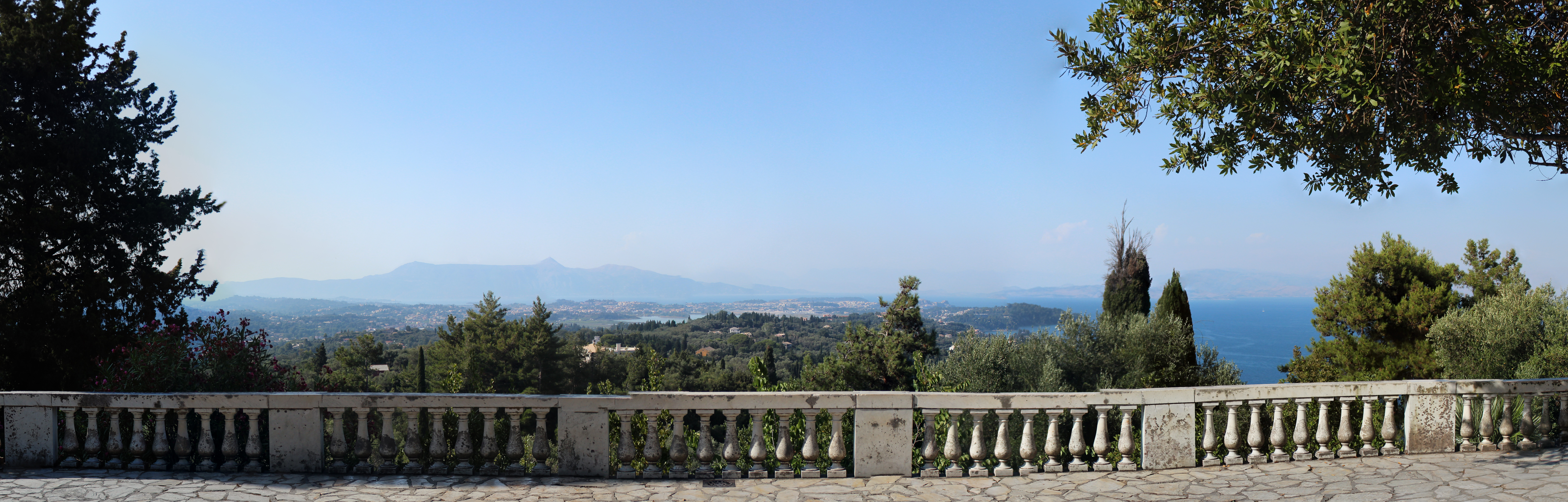
The gardens remain the heart of the Achilleion, and the tension between its two eras is visible in their statuary. Herter's Dying Achilles occupies the lower garden: the hero in his final moment, vulnerable, reaching upward, a monument to grief. Gotz's Victorious Achilles stands higher, armored, armed, facing outward like a sentinel. One was placed by a woman mourning her son. The other was placed by a man who inscribed its base with a dedication subsequently removed after World War II. The gardens sit on top of the hill and provide panoramic views of the city of Corfu to the north, the southern part of the island, and the Ionian Sea to the east. Surrounded by green hills and framed by water, the Achilleion occupies one of the most beautiful settings on an island famous for them. The classical statues lining the terraces, the colonnaded walkways, and the views create what one architectural historian called a monument to platonic romanticism and escapism.
The Palace from the Sea
From the air or the water, the Achilleion appears as a cream-colored neoclassical building set into a green hillside about ten kilometers south of Corfu city. The terraced gardens descend the slope in formal tiers, and the bronze Achilles is visible as a dark figure against the palm trees. The Ionian Sea stretches east, and on clear days the Albanian coast is visible across the strait. The palace is small by royal standards, intimate rather than imposing, which was exactly Elisabeth's intention. She wanted protection from prying glances, and the hillside location, screened by gardens and vegetation, provided it. That a palace built for solitude became a casino, a film set, and a tourist attraction is the kind of irony that Greek tragedy, which Elisabeth loved, would appreciate.
From the Air
Located at 39.56N, 19.90E on the island of Corfu, Greece, approximately 10 km south of Corfu city. The neoclassical palace is visible as a cream-colored building set into a green hillside above the coast. The terraced gardens and bronze Achilles statue are distinguishable from low altitude. The Ionian Sea lies to the east, and the Albanian coast is visible across the strait. Nearest airport: Corfu International (LGKR) approximately 8 km north. Recommended viewing altitude: 1,500-3,000 feet for detail of the palace and its garden terraces.