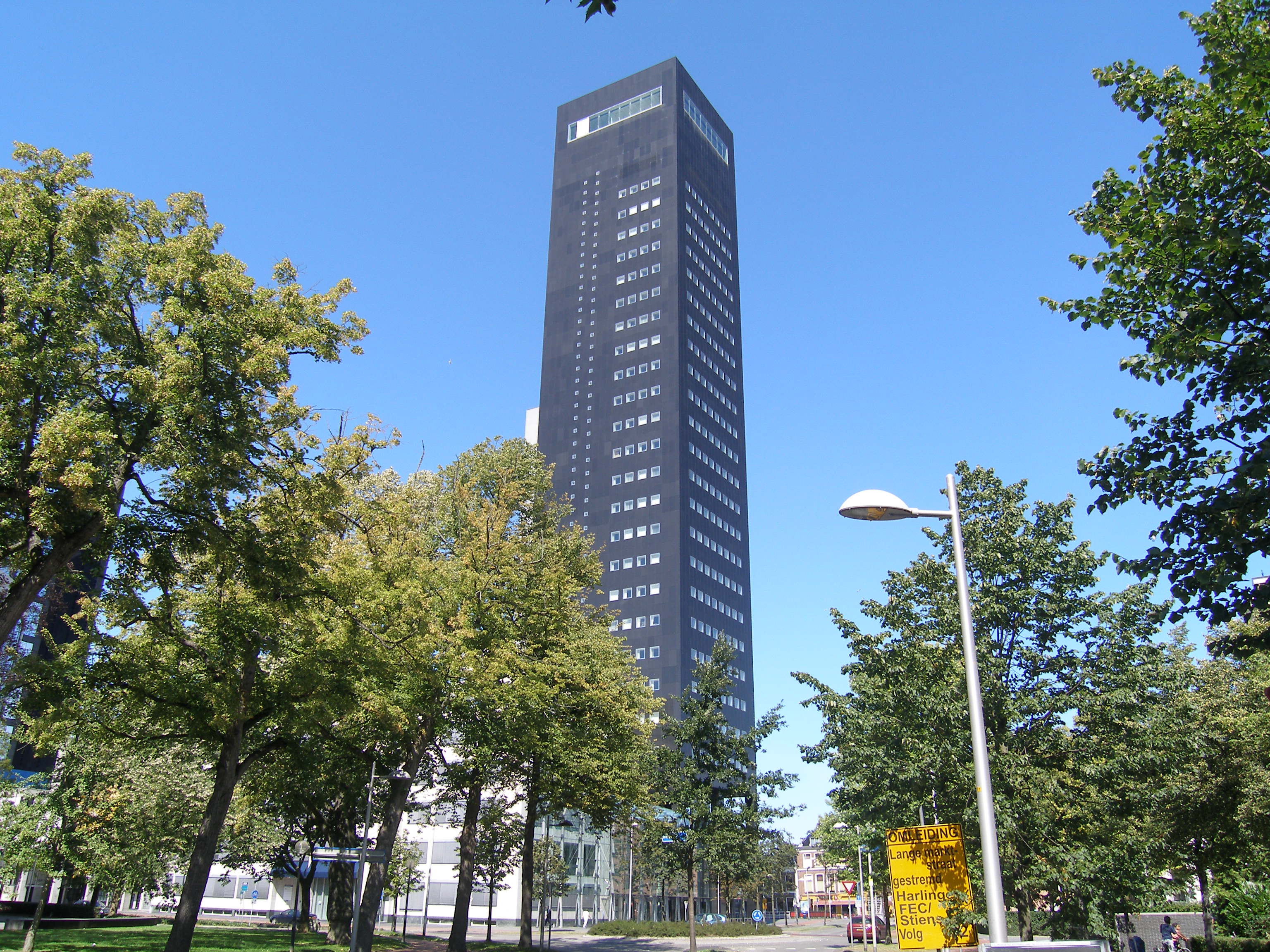
Achmeatoren
Three times since it opened in 2002, the Achmeatoren has dropped one of its black granite plates off its 115-meter facade. Three times nobody has been hit. In a city where the tallest pre-modern landmark is a 39-meter tower that has been leaning since 1532, the arrival of a slender black-and-grey skyscraper over Leeuwarden Station was always going to be a controversial gesture — but it is the building's quiet ritual of shedding cladding into a busy commercial district, with statistically improbable luck, that has become its strangest signature.
The Tallest Thing in the North
At 115 meters across 26 floors, the Achmeatoren is the 23rd tallest building in the Netherlands and, more pointedly, the tallest in the entire northern half of the country. From a great deal of Friesland — a province whose horizon is mostly sky, dairy cattle, and the occasional church spire — you can see it in clear weather as a single dark vertical, the punctuation mark at the end of the long flat sentence of the polders. Architects Abe Bonnema and Jan van der Leij of Bonnema Architecten in Hardegarijp designed the tower as two slender volumes of different heights pushed into one another: the taller clad in black granite, the shorter in grey, both lifted on slim legs over a steel-and-glass arcade that doubles as the pedestrian route from the railway station into the city center.
The Air Force Said No
Before it could be built, the tower had to survive an objection from a powerful neighbor. Leeuwarden Air Base, home to Royal Netherlands Air Force F-16s and now F-35s, sits just north of the city, and aviation authorities pushed back hard on the 1999 proposal: a 115-meter spike on the approach path was not what fast-jet operations wanted to see. The project was ultimately approved because of its social and economic importance to Leeuwarden, but the compromise still glows above the city at night. Bonnema's firm — reluctantly, according to the record — placed four warning lights at the corners of the tower. Those were later replaced by a continuous double-lined neon contour running all the way around the top, first in green, then changed to red. The aviation light has become part of the city's nightscape.
The Falling Plates
The granite cladding has had a less graceful career than the lights. Since the building was completed, plates have detached from the facade on three separate occasions. The phrase in the official record is precise and slightly stunned: the building has lost its granite plates three times but no one has ever been injured. That is a remarkable run of luck for a busy site directly opposite Leeuwarden's main railway station, where commuters and tourists move under and around the tower at all hours. Each incident triggered inspections, repairs, and the kind of conversation a building's owners do not want to have in public. The tower stands today with its dark cladding intact — a small monument to the gap between architectural ambition and the unforgiving physics of stone hung at altitude.
View From the Twenty-Sixth Floor
Inside, the building hosts a working mix of tenants — Deloitte, FBTO, AppMachine, De Friesland — with a Tourist Information Centre on the ground floor where the granite-clad volume lifts off its legs. The interplay of a shifting office market, hybrid work, and advancing automation has meant the tower is not always fully occupied, an issue any twenty-first-century office building knows by heart. But the prize is reserved for the 26th floor: a semi-public panoramic space that looks out across Leeuwarden, the surrounding villages of Marssum and Stiens, the dark line of the A31, and on a clear day the silver edge of the Wadden Sea. Standing at the top of the tallest building in northern Netherlands, in the flattest part of Europe, the view is more horizontal than vertical — mostly horizon, mostly weather, the whole province laid out below.
From the Air
Located at 53.198°N, 5.792°E at the south edge of Leeuwarden, immediately in front of the main railway station. The 115-meter tower is the tallest building in northern Netherlands and is conspicuous in clear weather, marked at night by a red neon contour around the crown. Leeuwarden Air Base (EHLW) sits a few kilometers north — expect active F-35 traffic and respect the controlled airspace; the tower exists in its current form only because aviation objections were overruled in 1999. Groningen Airport Eelde (EHGG) is the nearest civil field, about 55 km east.