Acoma Massacre
Before the Pilgrims landed at Plymouth, before Jamestown was founded, the Spanish had already established the template for American colonization through violence. In January 1599, Juan de Onate's conquistadors assaulted Acoma Pueblo, a fortress city built atop a 367-foot sandstone mesa in what is now New Mexico. The attack killed approximately 800 Acoma people - men, women, and children - and the punishment that followed was designed to terrorize all Pueblo peoples into submission: every male survivor over 25 had one foot amputated; younger males and all females were enslaved for twenty years. Two Hopi visitors had their hands cut off and were sent home as a warning. This was Spain's announcement of what awaited those who resisted colonial rule. The massacre at Acoma predates nearly every event in conventional American history, yet it established patterns of conquest, resistance, and cultural survival that define the Southwest to this day.
The Sky City
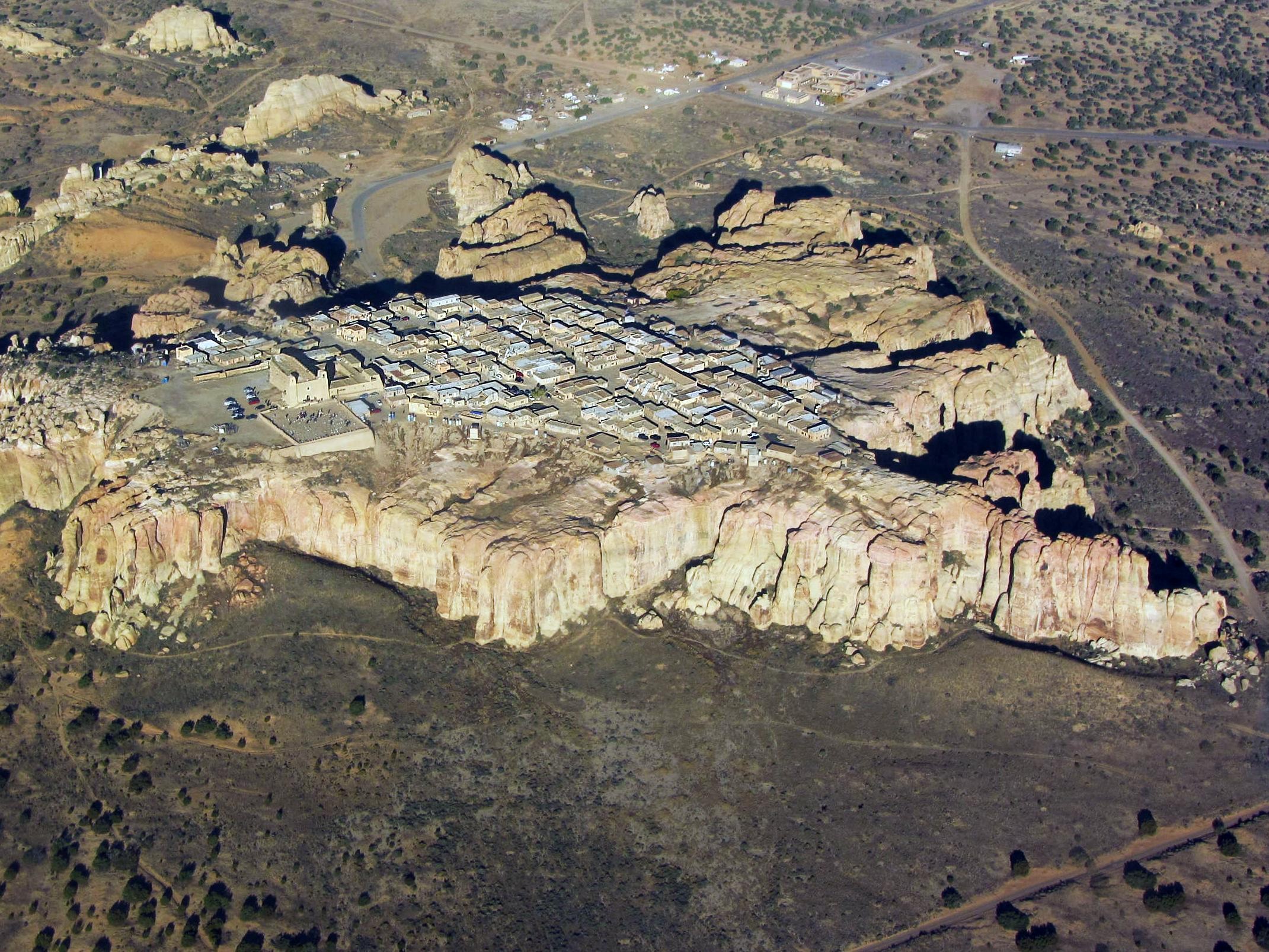
Acoma Pueblo sits atop a sandstone mesa that rises dramatically from the high desert floor. The Acoma have lived here continuously for at least a thousand years, making it one of the oldest continuously inhabited settlements in North America. The mesa's sheer cliffs made it nearly impregnable - the only access was a treacherous hand-and-toe trail carved into the rock. By 1598, when the Spanish arrived, perhaps 4,000 people lived at or around the pueblo. They had developed sophisticated systems of water collection, agriculture on fields below the mesa, and architecture that used the rock itself as defense. The Spanish called it the 'Sky City' and recognized both its strategic importance and its symbolic power. If Acoma could be subdued, all Pueblo peoples would understand Spanish might.
Collision
Juan de Onate had received a royal charter to colonize New Mexico, establishing Spanish rule, extracting tribute, and converting natives to Catholicism. His forces were small - a few hundred soldiers and settlers - attempting to control a vast territory of independent pueblos with tens of thousands of inhabitants. In December 1598, Onate's nephew Juan de Zaldivar arrived at Acoma with sixteen men, demanding food and provisions. What happened next is disputed: Spanish accounts claim unprovoked attack; Acoma oral history describes soldiers violently breaking into homes to take maize and blankets, leaving women exposed to winter cold. Fighting erupted. Zaldivar and eleven soldiers were killed. Word reached Onate, who declared the Acoma in rebellion and ordered his remaining nephew, Vicente de Zaldivar, to punish them with a force of seventy men.
The Assault
In January 1599, the Spanish attacked the seemingly impregnable mesa. Vicente de Zaldivar developed a plan to haul a small cannon up a hidden path while the main force assaulted the primary trail. The cannon's fire proved devastating - Acoma warriors had never faced artillery. For three days the battle raged, with Spanish soldiers eventually breaching the pueblo's defenses and setting fires that spread through the tightly packed buildings. By the battle's end, approximately 500 Acoma men had been killed, along with some 300 women and children. Many died in the fires; others were killed in close combat. Those who survived - about 500 - were taken prisoner. Some Acoma escaped capture and later rebuilt, but the pueblo had been shattered. The Spanish casualties were minimal, demonstrating the brutal efficiency of European warfare against indigenous defenses.
The Punishments
Onate convened a trial at San Juan Pueblo in February 1599. The outcome was predetermined. He sentenced all males over 25 to have their right feet amputated and to serve twenty years of slavery. Twenty-four men suffered this mutilation. Males between 12 and 25 and all females over 12 were sentenced to twenty years of servitude. Sixty young girls were sent to Mexico City and distributed among Catholic convents. When King Philip II of Spain learned of these punishments years later, he recalled Onate and eventually banished him from New Mexico for his cruelty. But the damage was done. Pueblo peoples understood that Spanish rule meant absolute submission or annihilation. The psychological impact lasted for generations - until 1680, when the Pueblo Revolt finally expelled the Spanish for twelve years, proving the flame of resistance had never been extinguished.
Memory and Monument
The Acoma Massacre remains a sensitive subject. In 1998, during the 400th anniversary of Spanish colonization, Acoma activists cut off the right foot of a statue of Juan de Onate near Alcalde, New Mexico, with a note: 'We took the liberty of removing Onate's right foot on behalf of our brothers and sisters of Acoma Pueblo.' A giant equestrian statue of Onate erected in El Paso in 2007 drew protests from Acoma descendants. In 2020, during the George Floyd protests, several Onate statues were removed across New Mexico. Acoma Pueblo today welcomes visitors who climb the mesa - now by stairway - to tour the Sky City and its historic church. The pueblo has survived Spanish conquest, Mexican rule, and American expansion. The people still live there. The foot that was taken has not been forgotten.
From the Air
Located at 34.90°N, 107.58°W in western New Mexico. Acoma Pueblo is dramatically visible from altitude as a flat-topped sandstone mesa rising from surrounding desert terrain. The pueblo buildings and San Esteban del Rey Mission church sit on the mesa top. Albuquerque lies 60 miles east. Interstate 40 passes nearby. The nearest major airport is Albuquerque International Sunport (ABQ). The landscape of mesas and desert extends in all directions.