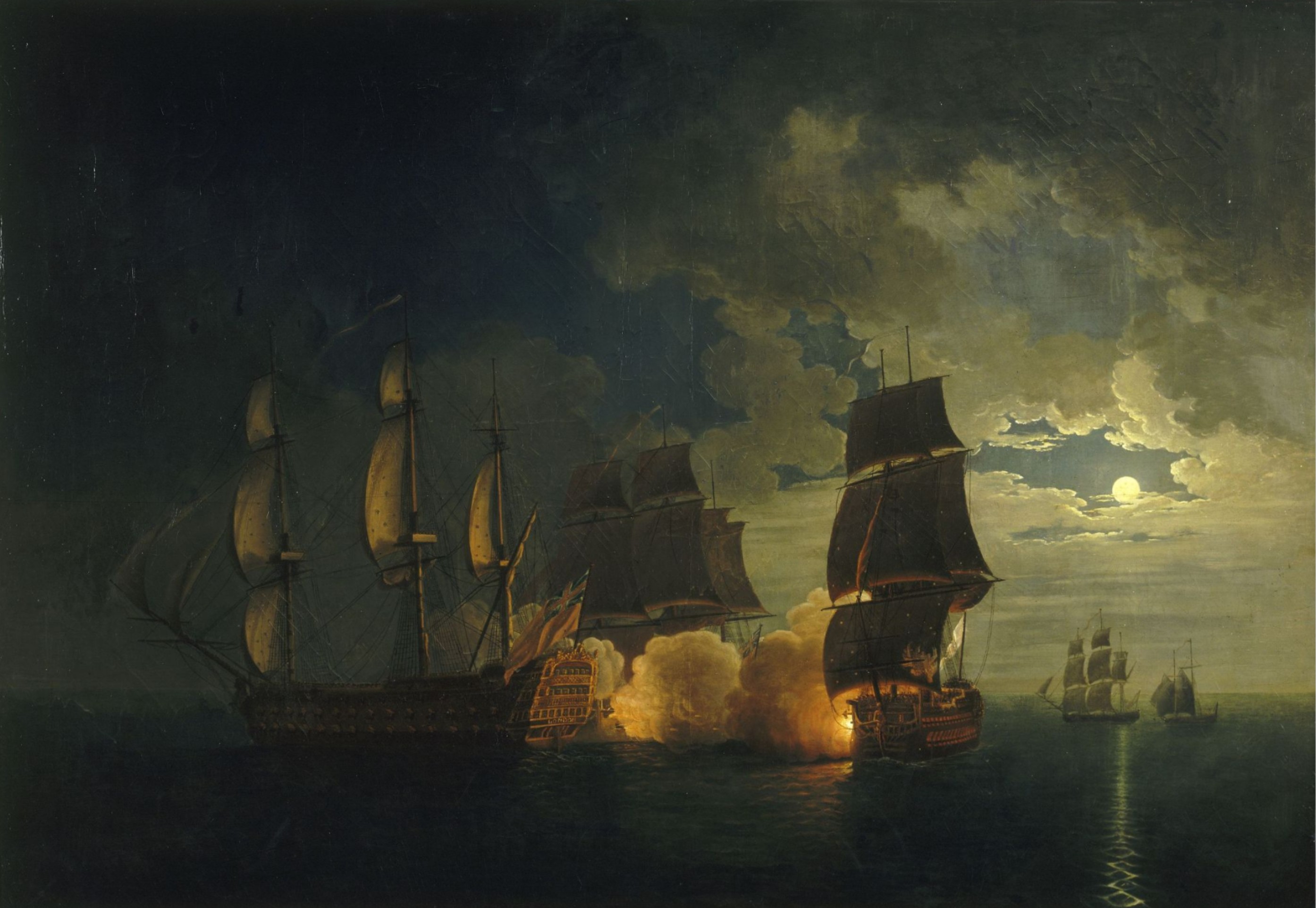
Action of 18 October 1782
The Scipion was winning when she sank. On October 18, 1782, the French 74-gun ship of the line had just pulled off one of the most audacious escapes of the American Revolutionary War - outfighting a 98-gun British flagship, raking her from stern to bow, tangling both pursuing warships together, and then slipping away into the darkness while her enemies sorted out the wreckage. Captain Nicolas Henri de Grimouard had sailed his outgunned vessel through a night-long running battle off the coast of Hispaniola and brought her into the shelter of Samana Bay. Then, attempting to anchor in the shallows, the Scipion struck a submerged rock and went down. The crew survived. The ship did not. It was the kind of ending that would have strained credulity in a novel.
Two Strange Sails
On October 17, 1782, a British squadron was cruising off the coast of San Domingo - the 98-gun HMS London, the 74-gun HMS Torbay, and the 14-gun sloop HMS Badger. They spotted two unfamiliar sails and gave chase to the northwest. The quarry turned out to be the French 74-gun Scipion, under Captain Grimouard, and her escort, the 40-gun frigate Sibylle. The odds were decisively against the French. London alone outgunned Scipion by a wide margin, carrying 98 cannon to Scipion's 74. With Torbay adding another 74 guns, the British squadron held roughly a two-to-one advantage in firepower. By 2:24 in the afternoon, London had closed within range, and the two ships of the line began a running fight. Chase guns cracked across the water. London fired the occasional broadside. Sibylle, rather than flee, turned back to help her larger companion, attacking London's bow and inflicting real damage while the flagship focused on Scipion.
Broadside to Broadside
For six hours the pursuit continued, London gradually closing the distance. At 8:30 in the evening, the two ships of the line finally drew alongside each other and began exchanging full broadsides - the brutal, point-blank gunnery that defined naval warfare in the age of sail. Twenty minutes later, they crashed together. Scipion's cathead locked against London's starboard gangway, and the fight became intimate and savage. Muskets and small arms joined the cannon. Sailors on both ships fired into the groups of men working the upper deck guns, the range now measured in feet rather than yards. The carnage was enormous. Then Grimouard made his move. Scipion backed away from London, cleared her stern, and delivered a devastating raking broadside - firing from London's stern straight through the length of the ship, the cannonballs tearing through everything in their path. The blast destroyed London's rigging and masts, leaving the British flagship crippled. Torbay, under Captain John Gidoin, had finally arrived to engage Scipion's port side, but the disabled London drifted into her, and the two British ships became tangled together.
The Night Chase
At 10:20 p.m., Scipion stopped firing. The British assumed she had surrendered. London tried to come alongside and take possession, but her wrecked rigging made maneuvering impossible. Kempthorne ordered Gidoin to approach the French ship instead - but while the British sorted themselves out, Scipion caught a gust of wind and began sailing away. She had not surrendered at all. The chase resumed through the night of October 17 into 18, the British firing sporadically as the French steadily opened the gap between them. By dawn, Torbay - now the faster pursuer, since London was barely operational - trailed Scipion by a mile and a half. Through the morning and into the afternoon, Gidoin slowly regained ground. By 3:30 p.m. on October 18, he was close enough to fire into Scipion again. But Grimouard had found his refuge. He sailed directly into Samana Bay, on the northeast coast of what is now the Dominican Republic, and attempted to anchor in its protected waters.
Victory and the Rock
Samana Bay should have been the end of the story - a triumphant conclusion to an escape against impossible odds. Instead, as Scipion maneuvered to drop anchor, she struck a submerged rock and began taking on water. The ship that had outfought a force twice her strength, that had raked a 98-gun flagship and left two pursuers tangled in each other's rigging, sank in the very harbor that was supposed to save her. It was a total loss. But Grimouard had managed the one thing that mattered most: his crew escaped almost intact. The human cost of the battle fell overwhelmingly on the British side, where London's damage was severe. The aftermath divided along national lines. Louis XVI made Grimouard a count for his bravery, and commissioned a painting of the action from Auguste-Louis de Rossel de Cercy to commemorate the French captain's achievement. In London, Captain Kempthorne faced a court of inquiry for failing to capture an inferior ship. He was acquitted of all charges, though the record of that night's fight - the raking, the entanglement, the escape - spoke for itself.
Beneath the Bay
Samana Bay today is known for its humpback whale watching, its mangrove-fringed shores, and its proximity to Los Haitises National Park. Somewhere beneath its waters, the remains of the Scipion rest on the rock that ended her final voyage. The bay has seen centuries of traffic since - fishing boats, ferries, tour vessels carrying visitors to the karst caves and bird colonies along the coast. Few of them know that a French warship lies below, or that the calm waters once sheltered a captain who had just accomplished one of the most remarkable feats of seamanship in the Revolutionary War. Grimouard went on to serve with distinction, wounded but unbowed by the action. The Scipion's story endures as a reminder that in war at sea, skill and audacity could overcome raw firepower - and that the ocean gives no prizes for cleverness. A single rock, invisible beneath the surface, was enough to undo everything the crew had fought all night to achieve.
From the Air
Located at 19.18N, 69.32W in Samana Bay on the northeast coast of the Dominican Republic. The bay is a large, sheltered inlet visible from altitude, bordered by the Samana Peninsula to the north and the Los Haitises karst formations to the south. The wreck of the Scipion lies somewhere in the bay's waters, though its exact position is not precisely marked. Nearest airport is Samana El Catey International (MDCY). From cruising altitude, look for the wide mouth of Samana Bay opening to the east, with the green hills of the peninsula forming a natural breakwater. The bay is approximately 15 nautical miles long and 5 nautical miles wide - large enough to understand why Grimouard chose it as shelter, shallow enough at the edges to understand how a ship could strike rock while anchoring.