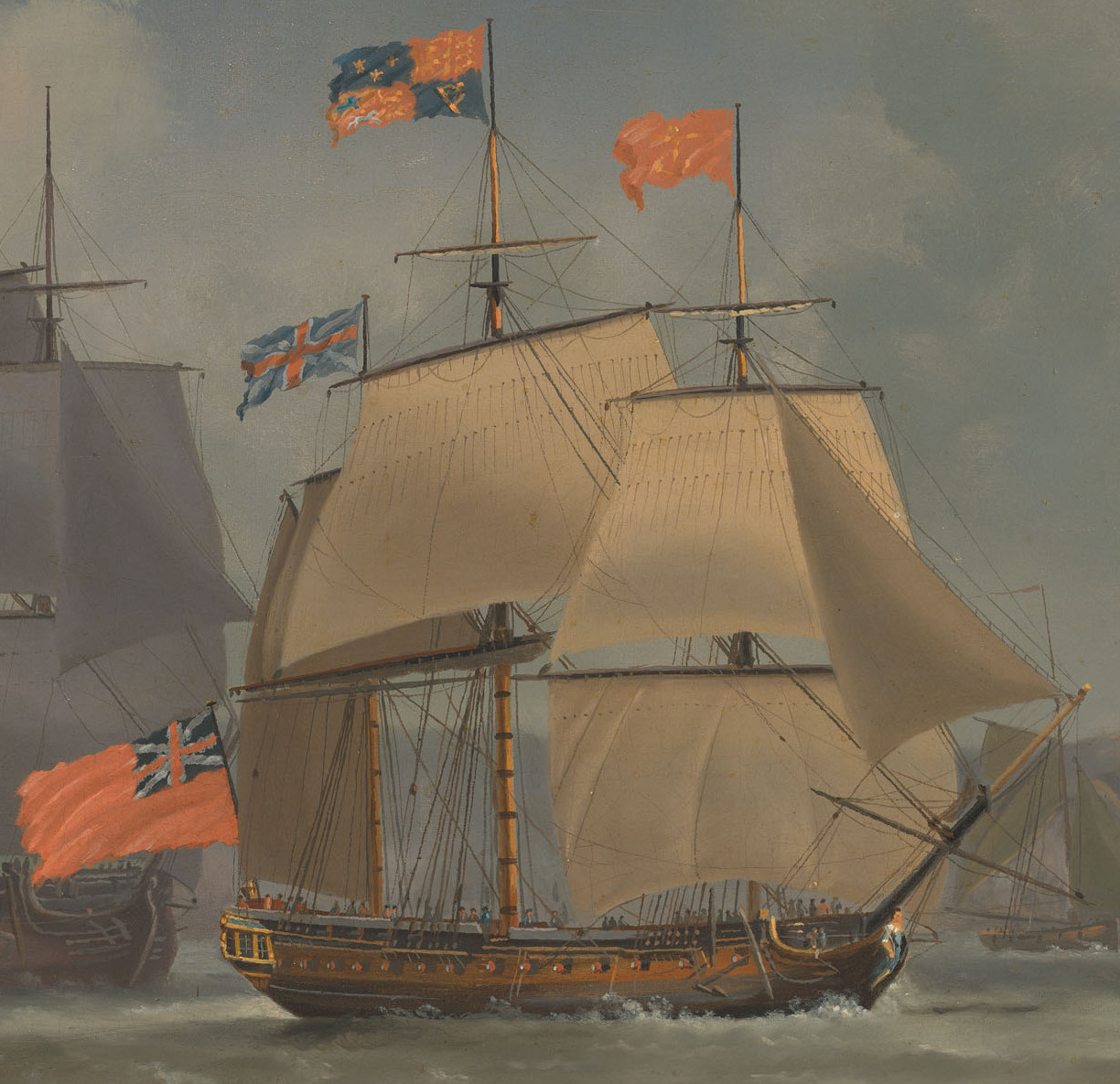
Action of 3 February 1812
At six in the morning on February 3, 1812, Captain Sir James Lucas Yeo stood on the quarterdeck of HMS Southampton and watched a 44-gun frigate riding at anchor south of Gonave Island. The ship was the Heureuse Reunion, flagship of what had been Haiti's navy -- until its crew defected to a regional warlord weeks earlier. At her helm was a French privateer named Gaspard, answerable to no recognized government, commanding a vessel powerful enough to threaten merchant shipping across the Caribbean. Yeo sent a boat to demand Gaspard's commissioning papers. Three minutes later, the answer came back: Gaspard would not submit. If the British wanted a fight, they should fire their bow chasers and make it official.
An Island Divided Against Itself
Haiti in 1812 was a country in fragments. The revolution that had expelled the French in 1804 produced the first independent Black republic in the Western Hemisphere, but independence did not bring stability. Emperor Jean-Jacques Dessalines, the revolution's leader, was assassinated in 1806 on the orders of his own subordinates, Henri Christophe and Alexandre Petion. The two men split the country between them: Christophe took the north, Petion the south. In the vacuum of central authority, regional warlords carved out fiefdoms. One of these was Jerome-Maximilien Borgella, who seized control of the Sud department after the death of Andre Rigaud in September 1811. The Haitian Navy, such as it was, defected from Christophe to Borgella in January 1812, giving the warlord a small but dangerous fleet crewed by sailors from multiple nations and commanded by Gaspard, a French privateer with no allegiance to any Haitian faction.
A Frigate with a Complicated Past
The Heureuse Reunion had not always flown Haitian colors. She began her career as the French frigate Felicite, part of a squadron that tried to resupply Guadeloupe -- France's last Caribbean colony -- in 1809. When Vice-Admiral Sir Alexander Cochrane's British blockading squadron intercepted the French force, Felicite was captured without resistance by HMS Latona. Deemed too old for Royal Navy service, the British sold her to Henri Christophe, who recommissioned her as Amethyste. She became the core of the fledgling Haitian Navy. Now, under Borgella's control and renamed Heureuse Reunion, the 44-gun frigate was the most powerful warship in Haitian waters -- and in the hands of a privateer whose intentions toward neutral merchant shipping were, at best, uncertain. Captain Yeo's orders mentioned Christophe and Petion by name but said nothing about Borgella. Yeo decided the gap in his instructions was permission enough.
Seventy-Five Minutes at Dawn
The bow chasers of HMS Southampton barked at 6:30 in the morning, followed seconds later by a full broadside. Gaspard's plan was to close the distance and board -- the Heureuse Reunion carried a larger crew, and hand-to-hand combat would favor numbers over discipline. But Yeo was a skilled sailor, and Southampton's crew was better drilled. The British frigate kept her distance, denying Gaspard the boarding action he needed while pouring fire into the Haitian ship's rigging and hull. Within thirty minutes, the Heureuse Reunion had lost her masts. She drifted, dismasted and battered, unable to maneuver or flee. The two smaller vessels in Gaspard's squadron offered no support, running for the shelter of coastal batteries at Petit-Goave. By 7:45, someone aboard the wrecked frigate called out a surrender. Gaspard himself was too badly wounded to give the order; to this day, the identity of the person who yielded the ship remains unknown.
The Aftermath on Two Shores
Yeo landed most of his prisoners on the nearby shore, then sailed to Port-au-Prince to offload the rest and rig temporary jury masts on the captured frigate. He retained twenty prisoners for trial at Port Royal, Jamaica. When the Heureuse Reunion arrived in Jamaica, Yeo's superiors approved his initiative. The ship was renamed Amethyste -- the same name she had carried in Christophe's service -- and returned to Christophe by the British, restoring the vessel to the Haitian leader they recognized as legitimate. The battle proved to be the last significant naval action in the region during the Napoleonic Wars. British patrols continued, but no French or American force challenged their dominance of Caribbean waters again. For Haiti, still tearing itself apart between rival governments and regional strongmen, the loss of a single frigate was a footnote in a longer, harder struggle toward nationhood.
From the Air
The action took place in the Gulf of Gonave at approximately 18.53N, 72.68W, south of Gonave Island off Haiti's western coast. From altitude, the Gulf of Gonave is a broad, sheltered body of water between the northern and southern peninsulas of Haiti. Gonave Island is the large landmass in the center of the gulf. Nearest airports include Toussaint Louverture International (MTPP/PAP) at Port-au-Prince, roughly 25 km to the east. The town of Petit-Goave, where Gaspard's escort vessels fled, is visible along the southern shore of the gulf.