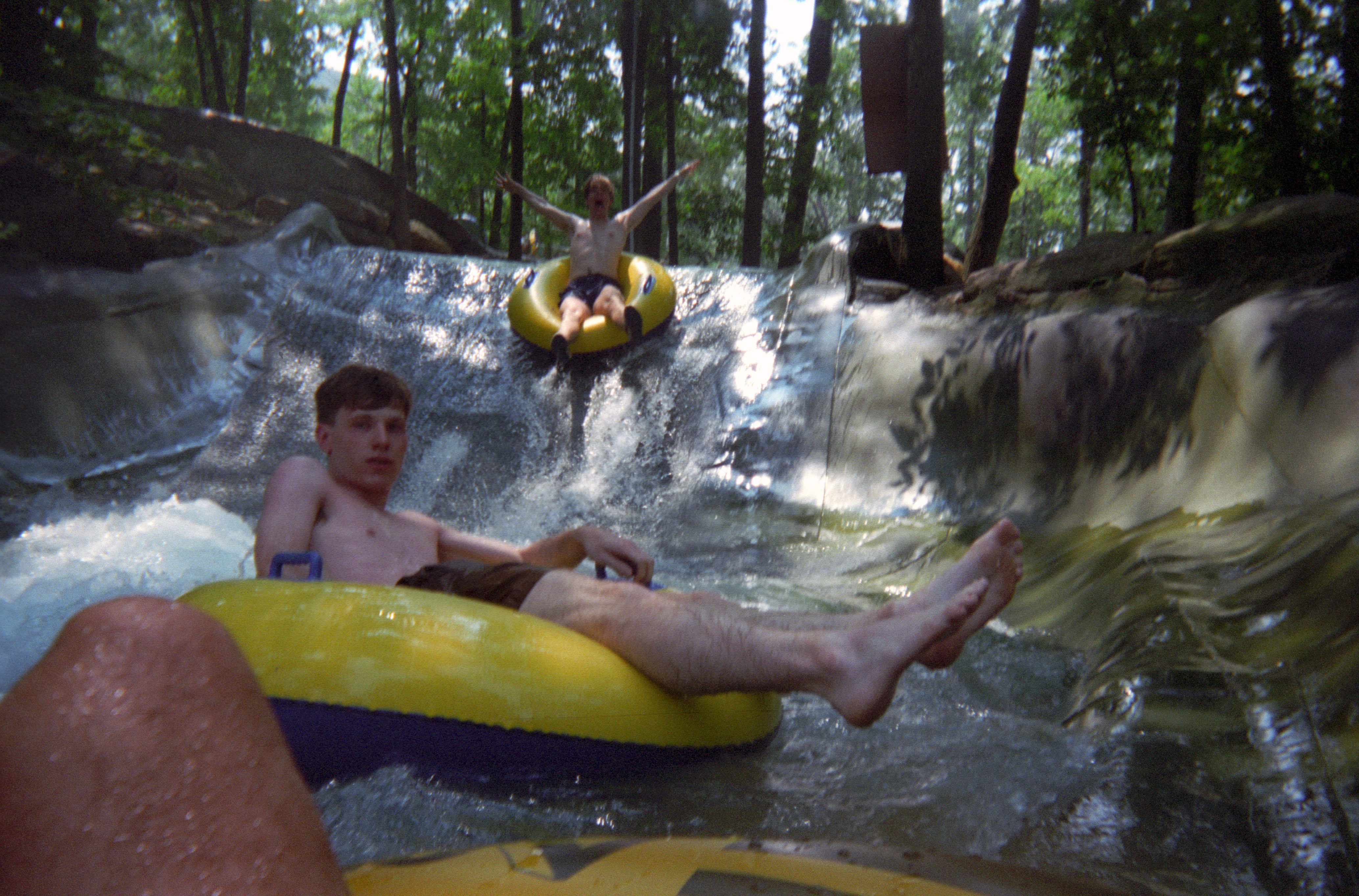
Action Park
The opening day promotions tell you everything. On July 4, 1978, a new amusement park in Vernon Township, New Jersey, celebrated its grand opening with a Dolly Parton look-alike contest and a tobacco juice-spitting competition. Action Park had arrived, and for the next eighteen years, it would become the most notoriously dangerous amusement park in American history -- a place where healthcare workers nicknamed it 'Traction Park,' where at least six people died on its rides, and where a popular New Jersey joke list begins with: 'You've been seriously injured at Action Park.'
A Ski Resort's Summer Fever Dream
Eugene Mulvihill had a problem common to ski resort owners: summers brought no revenue. His company, Great American Recreation, owned the Vernon Valley/Great Gorge ski area in the mountains of Sussex County, and in 1976, Mulvihill installed an alpine slide down one of the steep ski trails to fill the off-season gap. By 1978, he had added water slides, a go-kart track, and a name: Action Park. The concept grew into three sprawling sections -- the Alpine Center, Motorworld, and Waterworld -- the latter becoming one of America's first modern water parks. At its peak in the 1980s, Action Park drew over a million visitors per year, with as many as 12,000 flooding in on busy summer weekends. Thrill-seekers from across the New York metropolitan area made the pilgrimage to Vernon Township, drawn by rides that existed nowhere else in the world. There was a reason for that.
Rides Built Without a Blueprint
Action Park's designers seemed to build rides first and ask questions about physics later. The Cannonball Loop was a water slide with a complete vertical loop -- like a roller coaster, but with your bare skin against fiberglass and water. Employees were offered $100 to test it; one who accepted later said the money 'did not buy enough booze to drown out that memory.' The ride opened and closed repeatedly as injuries mounted, never operating for more than a few days at a stretch. The skatepark lasted a single season before the park buried it under dirt and, in the words of a former employee, 'pretended it never existed.' The Super Go Karts had speed governors, but employees knew to jam tennis balls into the mechanisms, turning a children's ride into high-speed bumper cars. The Kayak Experience used submerged electric fans to simulate whitewater rapids; in 1982, a man died of cardiac arrest after touching exposed wiring while trying to reboard his kayak. The Tidal Wave Pool earned itself a singular nickname: 'The Grave Pool.'
The Grave Pool and the Toll
The deaths accumulated across the park's history like dark footnotes. The Tidal Wave Pool, which opened in 1981, claimed three lives by drowning -- a fifteen-year-old boy in 1982, a twenty-year-old in 1984, and an eighteen-year-old in 1987. But the pool's true infamy lay in the number of near-drownings; the lifeguards became some of the most battle-tested rescue swimmers in the region. Staff were teenagers, often undertrained and sometimes intoxicated. Training sessions for rescuing drowning victims doubled as hazing rituals for new hires, who were abandoned in the water to fend for themselves. State regulators did little despite repeated violations. Mulvihill's company operated without liability insurance at times -- New Jersey didn't require it -- and found it cheaper to fight lawsuits than buy coverage. When a 110-count grand jury indictment eventually came down, it targeted the park's illegal self-insurance scheme. Mulvihill pleaded guilty to five insurance fraud charges.
The Slow Unraveling
By the 1990s, costly lawsuit settlements and rising insurance premiums were picking off rides one by one. A recession thinned the crowds. The park still advertised itself as the world's largest water park, but behind the scenes, creditors were circling. First Fidelity Bank sued over $19 million in debt. Law firms filed claims for unpaid legal fees stretching back years. In February 1996, creditors petitioned to force Great American Recreation into bankruptcy. The company filed for Chapter 11 that March. Action Park limped through one final summer, closing as usual on Labor Day 1996 and launching a website -- optimistic to the end -- where visitors could enter a lottery for park tickets. The following June, Great American Recreation announced the cessation of all operations. The park that had seemed indestructible, that had survived deaths and lawsuits and indictments, was gone.
Traction Park's Afterlife
Canadian resort developer Intrawest purchased the property in 1998 for $10 million, gutted the most dangerous attractions, and reopened the water section as Mountain Creek Waterpark. The Alpine Center's bungee tower was demolished. Motorworld became condominiums and parking lots. But Action Park's legacy proved harder to dismantle than its rides. The park became a cultural touchstone for Generation X-ers across New Jersey, New York, and Connecticut -- a shared scar, a badge of survival. The 2020 documentary 'Class Action Park' on HBO brought the stories to a new audience, and the park's reputation has only grown with time. In a world of safety regulations and liability waivers, Action Park stands as a monument to a stranger era -- when an amusement park could be built on the philosophy that the customer is always expendable.
From the Air
Located at 41.19N, 74.51W in Vernon Township, Sussex County, New Jersey, nestled in the Appalachian Ridge and Valley region. The site is now Mountain Creek ski resort and waterpark, visible from the air as ski runs cut into forested hillsides along Route 94. Best viewed at 3,000-5,000 feet AGL. Nearest airports: Sussex Airport (KFWN) approximately 8nm northwest; Aeroflex-Andover Airport (12N) approximately 10nm north. The terrain is hilly with ridgelines running northeast-southwest. Clear weather recommended for best visibility of the resort layout against the surrounding forested mountains.