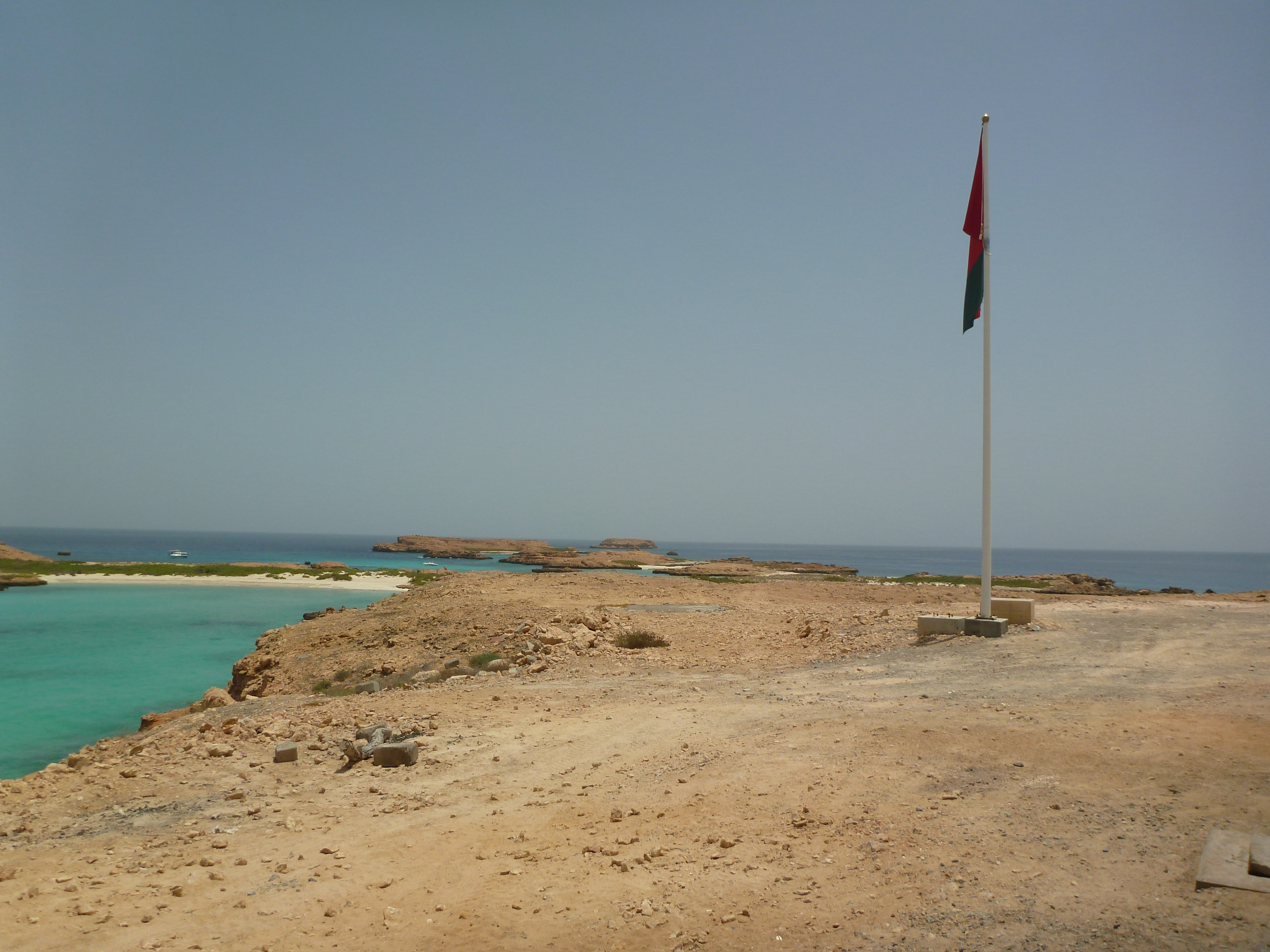
Ad Dimaniyat Islands
An ancient Greek-language sailing manual, the Periplus of the Erythraean Sea, mentions these islands as the Calaei Islands -- a name likely derived from Kalhat, the medieval Arabian trade city that served as a crucial stop for ships moving between Arabia and India. Two thousand years later, the nine islands of the Ad Dimaniyat archipelago remain a way station, though the travelers now are green sea turtles hauling themselves onto the beaches to nest, and sooty falcons riding the thermals overhead.
Archipelago of Nine
The Ad Dimaniyat Islands lie about 18 kilometers off the coast of Barka, roughly 70 kilometers west of Muscat. The total land area is modest -- 100 hectares spread across nine islands with names that sound like a poem in Arabic: Kharabah, Huyoot, Al Jabal Al Kabeer. The largest, Um As Sakan, splits into two sub-islands, Um Al Liwahah and Al Jawn, the latter itself comprising three small islets. The islands belong to the Muscat Governorate, falling within Wilayat AlSeeb, but their remoteness gives them the character of a place that belongs to no one and everyone.
Coral Kingdoms Below
Beneath the surface, the islands hold some of the Gulf of Oman's richest reef systems. Several varieties of coral found here are considered rare, creating an underwater landscape that supports a dense community of marine life. The reefs draw divers willing to pay for the privilege and endure the bureaucratic process of obtaining permission from the Ministry of Environmental Protection and Climate Affairs. Visits are capped at five days, groups limited to twelve people, and fees structured to limit traffic: non-Omanis pay 10 Omani rials for diving and overnight camping. The restrictions are deliberate. These islands serve biology first and tourism second.
Wings and Shells
BirdLife International has designated the archipelago an Important Bird Area, and the designation is well earned. Sooty gulls breed here alongside bridled terns, roseate terns, and white-cheeked terns. Sooty falcons -- sleek, long-winged raptors that winter in Madagascar and East Africa -- use the islands as nesting grounds. On the beaches, green and hawksbill sea turtles dig their nests in sand that has received their eggs for longer than anyone can record. The hawksbill, critically endangered worldwide, finds in these protected beaches one of the quiet refuges that its survival depends upon.
Guardians of Remoteness
The protection regime reflects Oman's broader approach to environmental conservation: quiet, firm, and increasingly expensive for those who want access. The fee structure has been revised upward in recent years, moving from a flat one-rial entry fee to a tiered system that distinguishes between visits, diving, and camping. Locals pay roughly half what expatriates do. The approval process itself acts as a filter, requiring advance permission that discourages casual visits. The result is an archipelago that most Omanis know exists but few have visited -- a nature reserve that works precisely because it remains hard to reach and expensive to enter.
From the Air
The Ad Dimaniyat Islands sit at approximately 23.86N, 58.09E, about 18 km offshore from Barka. The nine islands are clearly visible from altitude as a scattered chain against the blue-green Gulf of Oman. Best viewed at 2,000-5,000 feet AGL. Muscat International Airport (OOMS) lies approximately 70 km to the east. The islands are a protected nature reserve -- no landing facilities.