Adelaide
The scent of shiraz drifts from cellar doors barely twenty minutes from downtown. Trams glide past sandstone churches and Victorian arcades toward beaches where the Indian Ocean laps white sand. Welcome to Adelaide, the Australian capital city that moves at its own unhurried pace, surrounded by some of the world's finest wine regions and wrapped in a green belt of parklands that Colonel William Light designed nearly two centuries ago. This is a city built by free settlers rather than convicts, a place where progressive ideals took root early and where the world's second-largest fringe festival now erupts each March in a month-long celebration of art, music, and irreverent creativity. Adelaide may lack the skyscraper drama of Sydney or Melbourne's laneway intensity, but it offers something increasingly rare: a cosmopolitan experience without the crowds, where world-class dining, pristine beaches, and rolling vineyards converge within half an hour's drive.
A City of Free Spirits
Adelaide's DNA is different from other Australian capitals. Founded in 1836 as a planned colony for free settlers, it attracted British reformers seeking to build something new, unshackled from the convict system. This idealism manifested in Colonel Light's visionary grid of wide boulevards surrounded by parklands, a design that endures today and gives Adelaide its distinctive spaciousness. The city became an incubator for progressive change, pioneering the secret ballot, becoming the first place in the world where women could both vote and stand for parliament, and becoming the first Australian state to legalise homosexuality in the 1970s. This reformist spirit morphed into cultural adventurism when the Adelaide Festival began in 1960, eventually spawning the Adelaide Fringe, now second only to Edinburgh in scale. Each March, the city transforms as warehouses become theatres, parks fill with performers, and the laid-back capital becomes anything but quiet.
Where Wine Meets the City
No Australian city sits closer to its wine country than Adelaide. The Barossa Valley, Clare Valley, McLaren Vale, and Adelaide Hills wrap around the city like a viticultural embrace. German immigrants brought winemaking traditions to the Barossa in the 1840s, establishing dynasties that still produce some of Australia's most celebrated shiraz. South of the city, McLaren Vale's Mediterranean climate yields bold reds that compete with the world's best. This proximity shapes Adelaide life profoundly. Restaurants embrace BYO culture more enthusiastically than anywhere else in Australia, corkage fees are modest, and a wine tour can be squeezed into an afternoon. The National Wine Centre downtown offers immersive experiences for those who cannot escape to the vineyards. At the Adelaide Central Market, a Victorian-era food hall still thriving after 150 years, you can assemble picnic provisions worthy of any cellar door visit.
The Central Market and Multicultural Flavours
Beneath one ornate Victorian roof, the Adelaide Central Market captures the city's multicultural soul. Greek fishmongers, Italian delicatessens, German butchers, Vietnamese grocers, and Chinese produce vendors have operated here across generations. Gouger Street and Chinatown fan out beside it, forming a precinct where lawyers rub shoulders with recent migrants over laksa, dim sum, and dumplings. Adelaide's waves of immigration, from the southern Europeans of the 1950s to Southeast Asian arrivals after the Vietnam War, created neighbourhood identities that persist. Norwood retains Italian flavours, the inner west echoes with Greek, and the cafe culture thrives on continental traditions. The pie floater, an Adelaide invention that plunges a meat pie into thick pea soup, represents the more eccentric British-Australian heritage, while the AB, chips buried under yiros meat and multiple sauces, speaks to later influences.
Beaches and the Laid-Back Life
Adelaide stretches 28 kilometres along Gulf St Vincent, and its beaches anchor the local lifestyle. Glenelg, where South Australia was proclaimed in 1836, remains the most popular seaside suburb, reachable by vintage tram from the city centre. Jetties dot the coastline at Semaphore, Henley Beach, and Brighton, offering fishing, sunset walks, and the ritual of fish and chips with a view. The beach culture reinforces Adelaide's reputation as Australia's largest country town, a description some embrace and others resent. What's undeniable is the quality of life: uncrowded roads, affordable housing compared to eastern capitals, and the ability to surf before work and taste shiraz after. Summers run hot and dry, pushing temperatures past 40 degrees Celsius during heat waves, but air conditioning is universal and the beach is never far.
From Adelaide Oval to Mad March
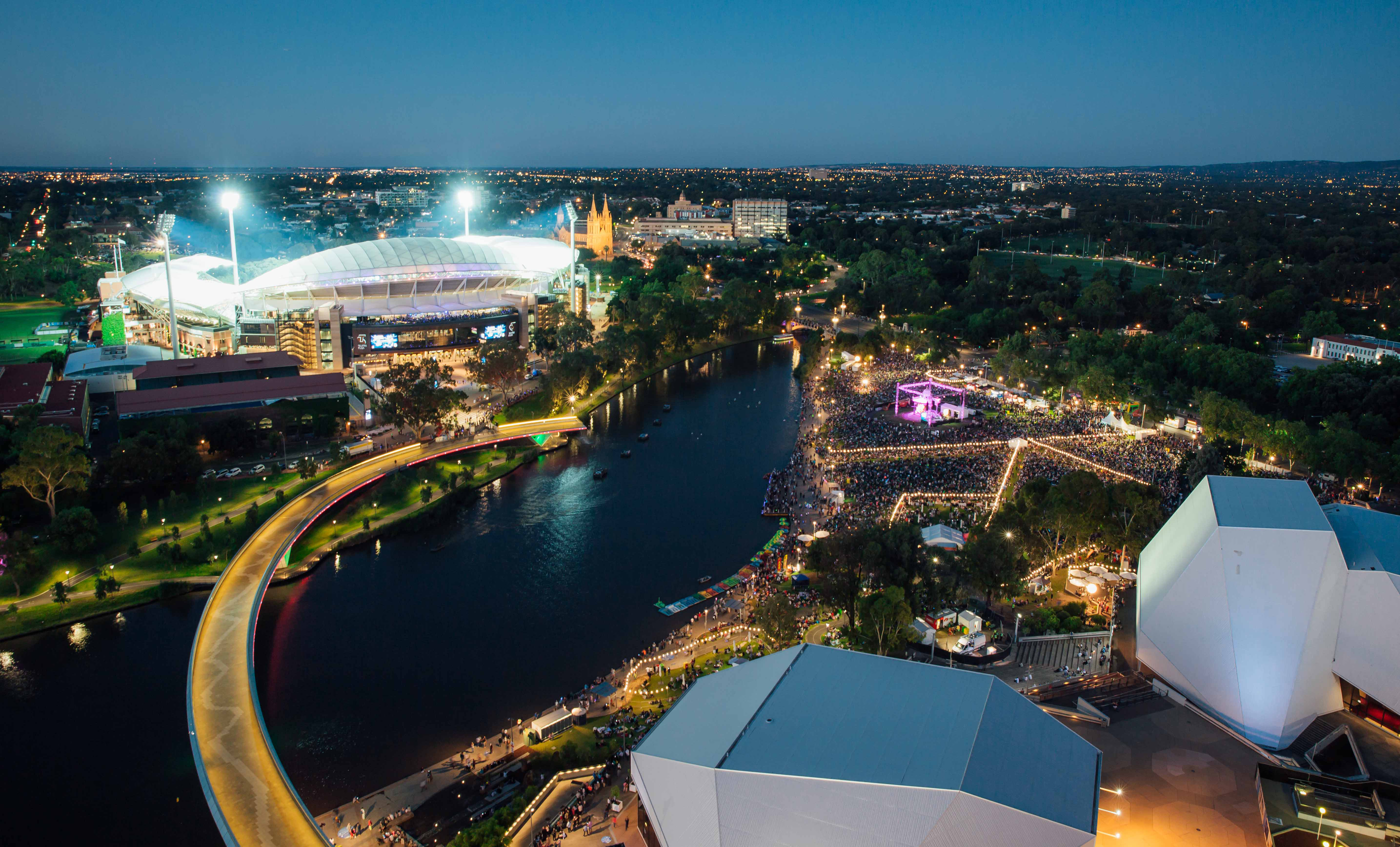
Sport weaves through Adelaide culture as thickly as wine. Adelaide Oval, nestled between the city and North Adelaide within Light's encircling parklands, hosts summer cricket and winter Australian rules football in one of the world's most picturesque sporting grounds. The redeveloped oval retains heritage grandstands while adding modern facilities, and catching a match there should top any visitor's list. The city also hosts the Tour Down Under, the southern hemisphere's biggest cycling race, and the Adelaide 500 supercar event. But the ultimate Adelaide experience remains Mad March, when the Fringe, Festival, WOMADelaide world music festival, and various sporting events overlap in a month-long explosion of activity. Hotel prices surge, restaurants overflow, and the normally sleepy streets pulse with an energy that contradicts every country-town cliche.
From the Air
Located at 34.93 degrees S, 138.60 degrees E on a coastal plain between the Adelaide Hills and Gulf St Vincent. The city appears clearly from altitude as a grid pattern surrounded by green parklands. Adelaide Airport (YPAD) lies 7km west of the CBD. Key landmarks visible from the air include the Adelaide Oval, the Torrens River, and the distinctive wide boulevard grid extending to the coastline at Glenelg. Wine regions visible to the north (Barossa Valley) and south (McLaren Vale).