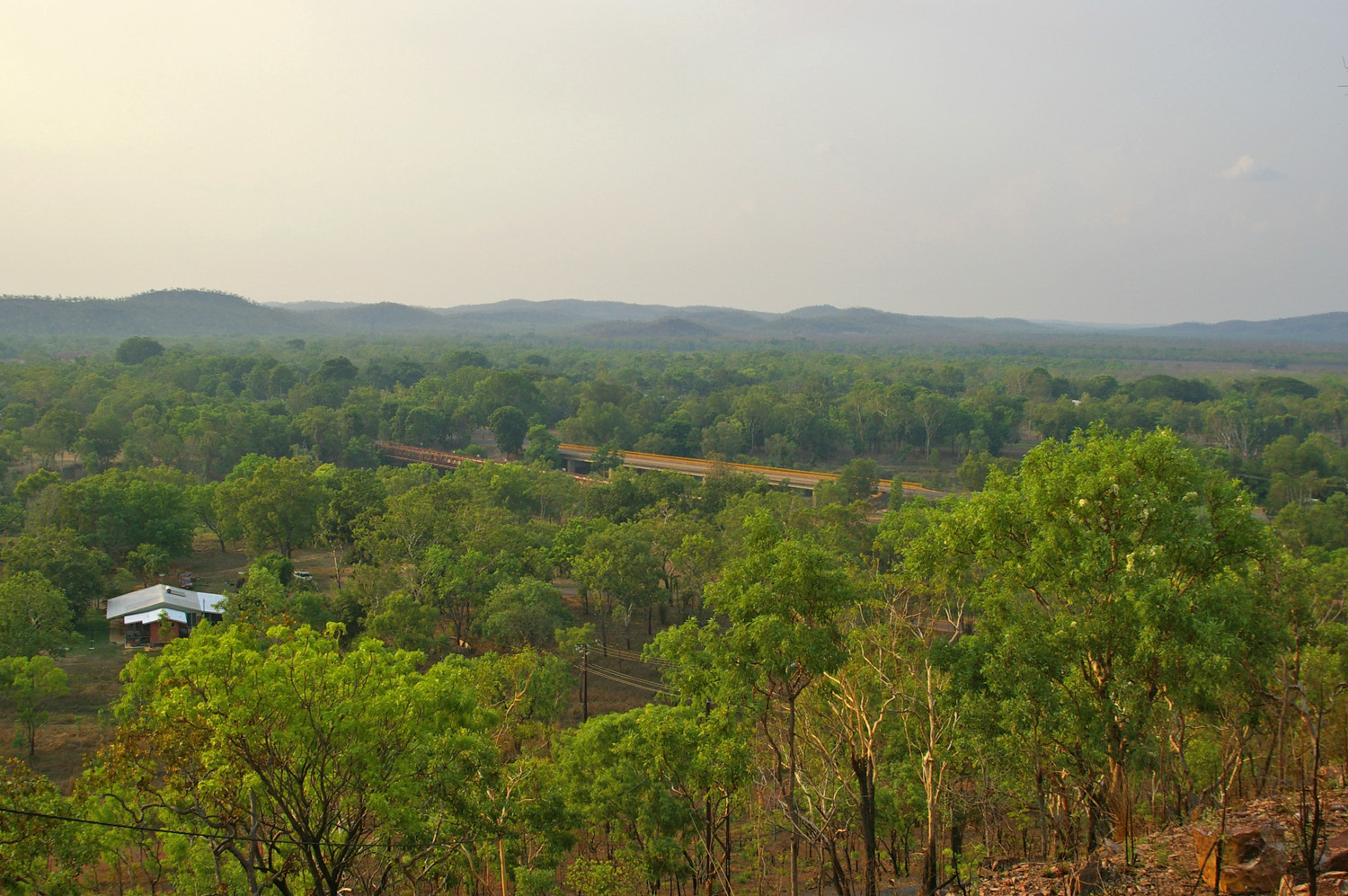
Adelaide River, Northern Territory
Charlie the buffalo lived at Adelaide River until his death in 2000. He was beloved by the locals, and he was famous: the 1986 film 'Crocodile Dundee' features a buffalo scene, and Charlie was the buffalo. He now stands stuffed in the bar of the Adelaide River Inn, a local landmark with a more compressed biography than most. Adelaide River is like that — a small town, a hundred kilometers south of Darwin on the Stuart Highway, that has accumulated an improbable amount of history.
The Overnight Stop
Before any of the history that gives Adelaide River its weight, it was simply a useful place to cross a river. The Kungarrakan and Awarai Aboriginal peoples are acknowledged as the traditional owners of the land, but their connection was largely ignored in the early colonial period, as the place names reveal — the town is called Adelaide River, named for a river in South Australia that in turn was named for a British queen.
In the 1870s, Adelaide River was the overnight stopping point for the Haimes Royal Mail Coach linking Southport with the goldfields at Pine Creek. The crossing was a bottleneck that entrepreneurs quickly exploited: a hotel on the riverbank, a restaurant called the 'Jolly Waggoner,' and a police station by 1879. When the railway from Palmerston was being built southward to the goldfields, it reached Adelaide River in April 1888. The 155-meter steel girder bridge across the river — five 31-meter spans on four sets of piers — was completed just before the wet season. The first train to cross reached the southern bank on 3 December 1888, hauled by a locomotive called 'Silverton.'
The War Town
Adelaide River's transformation during World War II was extraordinary. In 1939, the town was designated as a rest area for personnel from Darwin. By 1942, with Japan pressing south and Darwin having been bombed, that modest designation had become wildly inadequate — up to 30,000 Australian Army and United States soldiers were based in and around the town at the height of hostilities.
A military airfield was built beside the railway station. An artillery and weapons range was established at Tortilla Flats nearby. An ammunition dump with its own spur railway line was set up at Snake Creek, two miles north. Rail sidings were added at the town station specifically to handle ambulance trains bringing wounded personnel to the field hospitals that had been established here — the 107th Australian General Hospital and 119th Australian General Hospital among them. The Adelaide River War Cemetery, established in August 1942, holds those who did not survive treatment.
By 1943, more than 2,000 vehicles per day were using the road between the military camps, which accelerated the sealing of what would become the Stuart Highway. The infrastructure built under wartime necessity became the permanent skeleton of the modern Northern Territory's road network.
After the Guns Fell Silent
Adelaide River was officially proclaimed a town on 11 January 1962. The North Australia Railway kept the town connected until declining passenger numbers led to services being suspended in 1976 and the line formally closed in 1981. The old station became the Adelaide River Railway Heritage Precinct in 2001, preserved and maintained by volunteers who hope one day to run a heritage train on restored track.
In 1999, the town experienced a violent episode that marked it differently: police Sergeant Glen Huitson was shot and killed by fugitive Rodney Ansell on the Old Bynoe Road near Livingstone. Huitson was posthumously awarded several bravery medals. A park in the town was dedicated in his memory.
Today Adelaide River is a rest stop on the Stuart Highway, offering fuel and accommodation to the long-distance traffic between Darwin and the south. The showgrounds — home to the Adelaide River Show and the Adelaide River Races, first run in 1942 — include the only grass turf racing track in the Northern Territory. The river itself, wide and brown and muscular, continues to define the place, upstream of the Adelaide and Mary River Floodplains, an Important Bird Area recognized internationally for its ecological significance. The war cemetery, the stuffed buffalo, the heritage station: Adelaide River holds its history without particularly advertising it.
From the Air
Adelaide River town lies at approximately 13.24°S, 131.11°E, where the Stuart Highway crosses the Adelaide River about 100 km south of Darwin. From the air, the town is small but its river crossing is distinctive — the bridge over the broad Adelaide River is visible, as are the showgrounds south of the river. The Adelaide and Mary River Floodplains spread to the north and east, visible from altitude as extensive wetlands. Recommended viewing altitude: 1,500–3,000 feet AGL. Nearest airport: a former military airstrip adjacent to the town; Darwin International Airport (YPDN) is approximately 100 km north. The modern Adelaide–Darwin railway corridor is visible passing through the area.