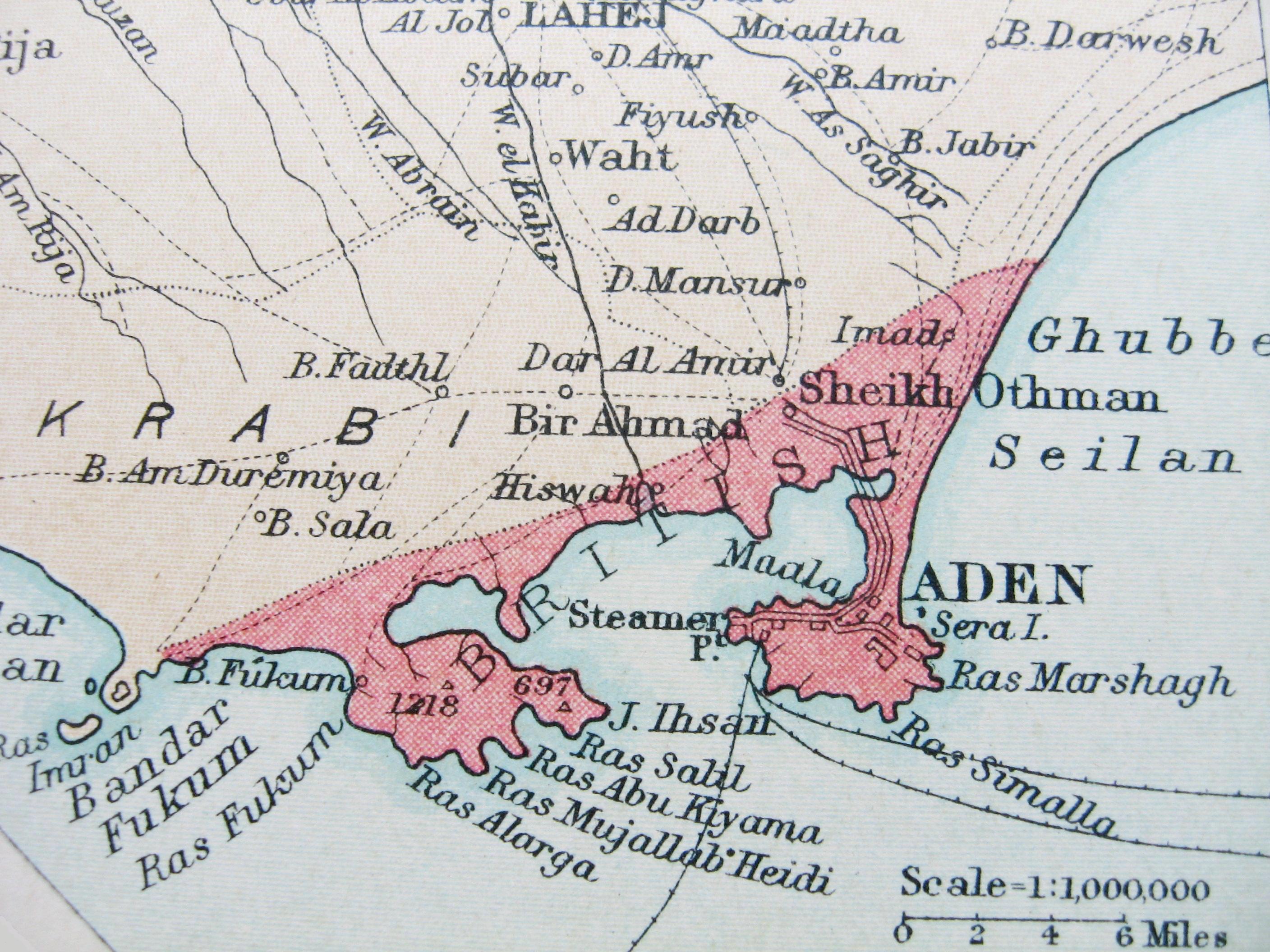
Aden Colony
By 1958, Aden was the second-busiest harbor in the world, surpassed only by New York City. That statistic alone explains why Britain clung to this volcanic port at the southwestern tip of the Arabian Peninsula for more than a century. Aden was never about Aden itself -- it was about everything that passed through it. Ships fueling between the Suez Canal and India, oil flowing from the BP refinery at Little Aden, military assets positioned to project power across the Middle East. The colony's importance, one British official wrote, "cannot be overestimated." But the people who actually lived there -- the Arab dockworkers, the Yemeni migrants, the Jewish artisans, the tribal leaders from the protectorates -- had their own ideas about what Aden should become. The collision between imperial utility and local aspiration made the colony's final decades a volatile and often violent chapter in the story of decolonization.
The Empire's Fueling Station
Britain seized Aden in 1839, initially governing it as an extension of British India under the Bombay Presidency. The port's value was geographic: it sat astride the main shipping routes connecting the Red Sea to the Indian Ocean, an ideal place to coal the steamships that powered imperial commerce. Even after Indian independence in 1947, Aden's strategic importance only grew as Britain reoriented its defense posture around oil. The Little Aden refinery processed five million tons of crude oil annually, forming the backbone of the colony's economy. Aden became a Crown Colony in 1937, and by the 1950s it served as the hub of Britain's Arabian defense network, surrounded by a patchwork of protectorate treaties with local sultans and sheikhs who accepted modest British subsidies in exchange for keeping the peace -- or at least keeping out of the way.
Strikes, Nasser, and the Radio
The calm that British officials attributed to their garrison actually owed more to the absence of compelling alternatives. That changed in the 1950s, when Gamal Abdel Nasser's Arab nationalism began crackling through Radio Cairo into every coffeehouse in Aden. Author R. J. Gavin captured the shift: "Men who had long lived in isolation now found a common political language and a breathtaking, liberating community of sentiment across the Arab world." The results were immediate and combustible. Laborers at the Little Aden refinery struck in March 1956, stoning police at the gates. By 1958, a state of emergency was declared following a string of bombings, and a general strike brought widespread rioting. The deportation of 240 Yemenis followed. As author Gillian King observed, "By ignoring the views of the local labour force, the British pushed much of the Arab population into opposition against their rule, who previously had been by no means captivated by Nasser." The British had managed to create the very enemy they feared.
An Ancient Community Dispersed
Jewish communities had lived in Aden and Yemen for millennia, serving primarily as artisans and craftsmen. The British occupation of 1839 had actually strengthened the Aden congregation, and during both World Wars, Jews in the colony prospered. But the creation of Israel shattered this equilibrium. In December 1947, following the UN declaration supporting a Jewish state, riots swept Aden Town. At least 70 Jewish residents were killed, and much of the Jewish Quarter was burned and looted. The population figures tell the story of a community's erasure: from roughly 4,500 in 1947, fewer than 500 remained by 1963. In 1949, after the Arab-Israeli War closed the Red Sea and Suez Canal to Jewish emigration, nearly 49,000 Jews from Yemen, Aden, and the Protectorate were gathered in camps and airlifted to Israel in what became known as Operation Magic Carpet. A community that had predated Islam in the region vanished within a generation.
Federation and the Final Retreat
Britain's exit strategy was the Federation of South Arabia -- a proposed union of Aden Colony with the surrounding protectorates that Harold Macmillan hoped would allow indirect British control through loyal sultans. The problem was fundamental: Aden was urban, educated, secular, and left-leaning; the protectorates were rural, largely illiterate, religiously conservative, and governed by autocratic sultanates. Forcing them together was, as many Adenis recognized, a step backward for a colony already progressing toward self-government. The federation was opposed by the majority of Aden's population, elections for the new council were rigged, and strikes and protest marches became routine. On January 18, 1963, the colony was reconstituted as the State of Aden within the federation, but the arrangement solved nothing. Internal disturbances intensified into the Aden Emergency, and British troops departed for the last time on November 30, 1967 -- 128 years after the Royal Marines had first landed. The federation became the People's Republic of Southern Yemen, and in a final rebuke, declined to join the Commonwealth.
From the Air
Located at 12.80N, 45.03E at the tip of the Arabian Peninsula, where the Gulf of Aden meets the approaches to the Bab el-Mandeb Strait. The old colony centered on the Crater district within an extinct volcanic caldera, with Steamer Point (Tawahi) serving as the harbor district. The Little Aden refinery complex is visible on the peninsula to the west. Aden International Airport (OYAA) serves the area. The Shamsan Mountains rise to approximately 550m behind the old town. The harbor remains one of the world's great natural anchorages.