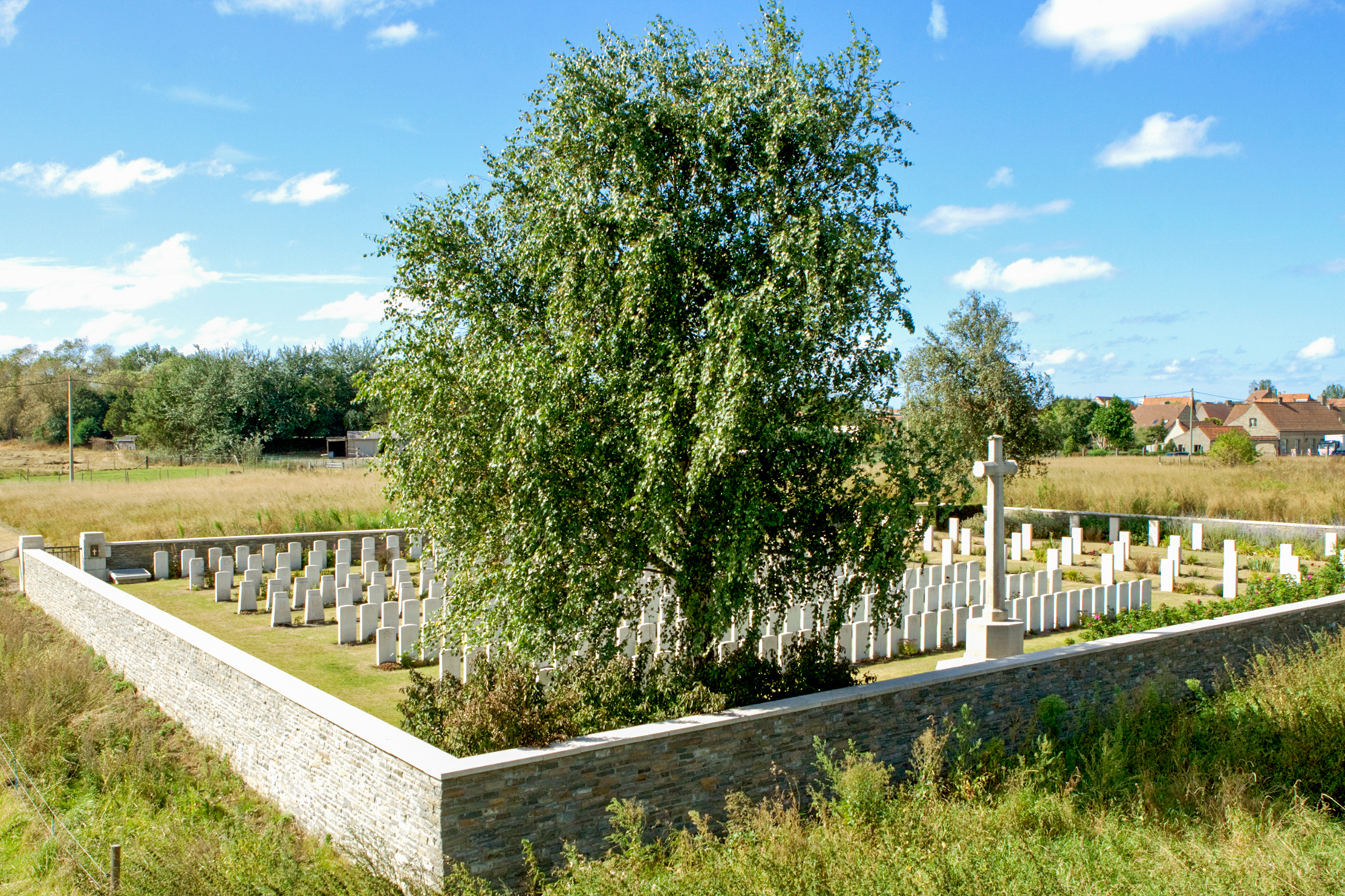
Adinkerke Military Cemetery
You cannot drive to it. A fifty-metre path of grass leads from the road into farmland, and at the end of that path the headstones appear in their disciplined rows. Adinkerke Military Cemetery sits in the flat fields of westernmost Belgium, a few kilometres from the French border, surrounded by sugar beets and grazing cattle. The Commonwealth War Graves Commission keeps it the way it keeps all its grounds: lawn cropped close, white Portland stone slightly warmed by the maritime light, the Cross of Sacrifice rising at the back like a quiet sentry. What makes this cemetery worth the walk is not its scale but its composition. Russian soldiers lie here. So do Czech and Slovak airmen, German servicemen, and one member of the Egyptian Labour Corps. Two wars share the same field.
The Path Through the Beets
The grass path is part of the cemetery's design now, but it began as practicality. When the Allies opened the ground in 1917, this corner of Belgium sat just behind the Yser front. Casualty clearing stations had been pushed back from the firing line because the firing line was bad, and Oosthoek, between Adinkerke and Veurne, was where the wounded were brought to be sorted and patched. The 24th and 39th Casualty Clearing Stations worked here from July to November of 1917, and the 1st Canadian Casualty Clearing Station spent a brief stretch at Adinkerke itself that summer. Soldiers who survived the trip from the trenches but not the surgery were buried in the nearest dry ground. That is most of the 168 First World War Commonwealth dead here. They were not killed at Adinkerke. They died at Adinkerke.
Three Pilots
Among the headstones are three flying aces, men whose work was new enough that the language had only just invented the word for it. Francis Dominic Casey was Irish, born in 1890, awarded the Distinguished Service Cross, dead in 1917. Arnold Jacques Chadwick was Canadian, also born in the 1890s, also DSC, also dead in 1917. Their war was the war of the wood-and-wire biplane, the open cockpit, the parachute that did not yet exist for fixed-wing pilots. A third stone belongs to John Mungo-Park, an English Squadron Leader who flew Spitfires in the next war. He was killed in 1941, age twenty-three, with the Distinguished Flying Cross and Bar. Three pilots, three decades, the same row.
Two Wars in One Field
After 1918 the cemetery should have been finished. Most Western Front cemeteries were. But the 1940 German invasion of Belgium pushed the British Expeditionary Force back through this same coast on its way to Dunkirk, and Adinkerke received a new generation of dead, fifty-five Commonwealth burials from the Second World War. Many of them are airmen, shot down on raids over German targets or while returning from them, scattered crashes brought together by geography. The 142 Czech, Slovak and German graves are part of that second war's strange politics. Russian soldiers from the earlier conflict lie in the same ground, as does one man from the Egyptian Labour Corps, an unarmed wartime worker far from home. The cemetery does not separate them. The CWGC's principle is that the dead rank equally.
The Churchyard Extension
There is a second Adinkerke war cemetery, and it is easy to miss. The Adinkerke Churchyard Extension sits on the west side of the village church and holds a Belgian military plot alongside sixty-seven Commonwealth First World War burials. The numbering runs continuously with the civilian graves around it, so a row may pass from a village butcher to a Lancashire private without break. This is the older Belgian way of burial, the war dead folded into the parish rather than gathered into formal ranks. Walk from the churchyard to the military cemetery and you cross a thousand years of how communities choose to remember.
What the Stones Say
Each Commonwealth headstone is two feet eight inches tall and carries the same elements: regimental badge at the top, name and rank, date of death, often a religious symbol, and at the foot a short inscription chosen by the family. Some are scriptural. Some are tender, almost private. Some are the kind of plain sentence a parent writes when there are no other words. The cemetery's silence is not solemn so much as it is steady, the wind moving across the open polder, the path back through the grass leading you out the way you came in.
From the Air
Adinkerke Military Cemetery lies at 51.0708 N, 2.6024 E, in rural polderland about 4 km inland from the De Panne beach and 3 km north of the French border. From altitude the area reads as a flat patchwork of fields and drainage ditches; the village of Adinkerke sits to the northeast with its rail line running east toward Veurne. Closest airports are Ostend-Bruges (EBOS) about 30 km northeast and Lille-Lesquin (LFQQ) about 65 km south. Recommended viewing altitude 2,000 to 3,500 feet under VFR. Coastal sea fog can move inland quickly in spring and autumn.